In brief
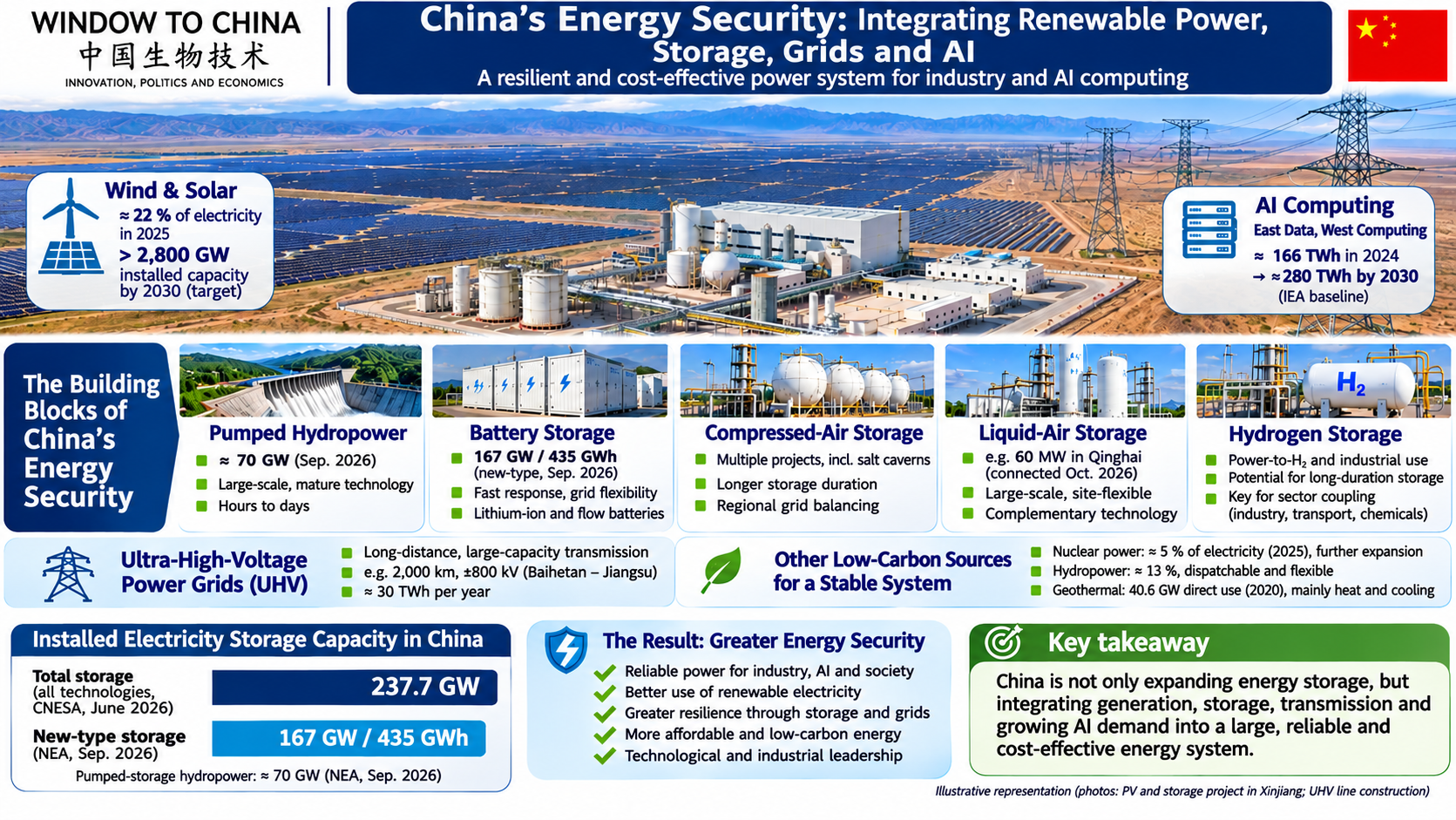
China is building one of the world’s largest and most diversified electricity storage systems. According to the National Energy Administration (NEA), operational new-type electricity storage reached 167 GW / 435 GWh by September 2026, while pumped-storage hydropower reached 70 GW. Wind and solar generating capacity exceeded 2,000 GW, making the integration of variable renewable electricity an increasingly important task. Source: NEA, October 2026.
The driving force is not only renewable expansion. China’s extensive manufacturing sector and rapidly growing AI computing clusters need reliable, affordable and increasingly low-carbon electricity. According to the International Energy Agency (IEA), Chinese data centres consumed approximately 102 TWh in 2024; its baseline projection is 277 TWh in 2030. These are estimates and projections, not metered national totals or guaranteed outcomes. Source: IEA, Key Questions on Energy and AI.
China’s energy security strategy combines five storage pathways — pumped hydropower, batteries, compressed air, liquid air and hydrogen — with ultra-high-voltage transmission, dispatchable generation and demand flexibility. The East Data, West Computing initiative adds another dimension by locating suitable computing infrastructure closer to energy-rich regions.
The central challenge is not simply how to store renewable electricity, but how to integrate generation, storage, transmission and growing demand into a reliable and cost-effective energy system.
Further reading — technologies, infrastructure and sources
1. The challenge: Renewable electricity and industrial demand
China’s electricity system is undergoing a major transformation. By the end of September 2026, installed wind and solar power capacity had reached approximately 2,010 GW, or almost half of the country’s total generating capacity. During the first three quarters of 2026, wind and solar produced approximately 1,920 TWh, equivalent to 23.8% of electricity consumption. Installed capacity (GW) and electricity generated (TWh) must not be confused. Source: NEA.
Large industrial electricity demand, electrification and new computing facilities make system reliability a central economic requirement. Storage can shift electricity over time, but the amount needed also depends on the generation mix, grid connections and flexibility of demand.
2. Pumped hydropower: Established large-scale storage
Pumped-storage hydropower uses surplus electricity to pump water into an upper reservoir and releases it through turbines when additional power is required. China had approximately 70 GW of pumped-storage generating capacity by September 2026. Discharge duration depends on the usable reservoir volume, not merely the power rating. Source: NEA.
The 3.6-GW Fengning facility in Hebei illustrates the scale of Chinese pumped storage. Another project in Jiangsu highlights the role of large reservoirs. Previous Window-to-China reports: Fengning pumped-storage plant; Jiangsu reservoir project.
3. Batteries: Fast response and daily balancing
Batteries dominate China’s new-type energy storage segment, particularly lithium iron phosphate (LFP) systems. Their applications include frequency regulation, peak shifting and balancing daily changes in solar and wind output. The NEA reported 167 GW / 435 GWh of new-type storage in total in September 2026; this is not a battery-only figure. It includes other non-pumped technologies. The ratio corresponds to an average nominal duration of approximately 2.6 hours across this category. Source: NEA.
China is also developing vanadium redox-flow batteries, whose energy capacity can be increased by enlarging electrolyte storage tanks. AI-assisted operating platforms can support fault detection and system management. Previous Window-to-China reports: Dalian flow battery; AI-supported storage platform; Xinjiang PV-storage integration.
4. Compressed-air storage: Large-scale mechanical storage
Compressed-air energy storage (CAES) uses electricity to compress air for later expansion through generating machinery. Advanced systems recover compression heat to improve efficiency. Underground salt caverns can provide large storage volumes, but suitable geology and efficient thermal management are important constraints. Previous Window-to-China reports: Salt-cavern storage in Hubei; 100-MW CAES installation.
5. Liquid-air storage: A developing alternative
Liquid-air energy storage (LAES) uses electricity to liquefy air at cryogenic temperatures. During discharge, the liquid is warmed and expanded to drive a generator. Unlike pumped hydropower or cavern-based CAES, it does not depend on a mountainous site or suitable underground caverns. However, its competitiveness depends on round-trip efficiency, heat recovery, capital expenditure and operating experience. China is testing the technology at increasing scale. Previous Window-to-China report: Liquid-air storage in Hebei.
6. Hydrogen: Energy storage and industrial feedstock
Electricity from wind and solar can be used to produce hydrogen through electrolysis. Hydrogen can be stored for industrial use or converted back into electricity when needed. Its potentially large storage volumes make it relevant to long-duration balancing, but reconversion entails substantial energy losses. Direct use in chemicals, refining or other industrial processes can therefore be more efficient than using hydrogen solely as an electricity-storage medium. Hydrogen is best considered both an industrial energy carrier and a potential long-duration storage option.
7. Ultra-high-voltage grids: Balancing geography
China’s long-distance ultra-high-voltage (UHV) networks connect major generating regions with industrial and population centres. The approximately 2,000-km, ±800-kV Baihetan–Jiangsu direct-current link is designed to transmit around 30 TWh of hydropower electricity annually. Previous Window-to-China report.
Storage balances supply over time; transmission balances supply across regions. They are complementary rather than interchangeable: simultaneous renewable shortfalls across large regions still require other sources of flexibility.
8. Energy security in the age of AI
Large computing clusters require highly reliable electricity, cooling, fast grid connections and local backup systems. The IEA estimates Chinese data-centre electricity demand at 102 TWh in 2024 and projects 277 TWh by 2030 in its base case. The future path remains uncertain and depends on AI deployment and efficiency improvements. Source: IEA, regional electricity demand table.
China’s East Data, West Computing programme encourages the development of computing infrastructure in regions with favourable energy and cooling conditions. Some computing workloads can move closer to power generation, while other services must remain near users. Even where renewable electricity is plentiful, uninterrupted operation requires grid resilience, uninterruptible power supplies, backup generation and effective thermal management.
The IEA notes that China’s data-centre electricity supply still relies substantially on coal, so the expansion of computing capacity does not automatically translate into low-carbon operation. Source: IEA, Energy supply for AI.
9. Beyond storage: Diversified generation
Energy security also depends on generation technologies that do not fluctuate with wind and sunshine. Nuclear power provides continuous low-carbon electricity; reservoir hydropower can supply dispatchable power. Conventional thermal plants continue to support adequacy and flexibility, although their emissions create a decarbonisation challenge. Geothermal energy in China is used mainly for heating and cooling, reducing the need for other energy sources rather than providing large amounts of electricity. Previous Window-to-China report on geothermal energy.
10. How much storage is enough?
A 100-MW / 200-MWh battery can theoretically deliver 100 MW for about two hours. It cannot by itself bridge a prolonged renewable generation shortfall. The NEA’s 167 GW / 435 GWh new-type storage figures imply an average nominal discharge duration of 2.6 hours, but do not describe the entire Chinese electricity system’s resilience during multi-day shortages. Pumps, reservoirs, transmission, dispatchable plants, flexible industrial loads and potentially long-duration storage must all be considered together.
Conclusion: An integrated approach to energy security
China is not simply adding renewable power and storage installations. It is connecting generation, multiple storage technologies, UHV transmission, industrial demand and AI computing infrastructure. The strategic objective is to secure reliable, affordable and increasingly low-carbon electricity across a vast and highly industrialised economy.
Energy security is a property of the entire power system — not of any single storage technology.
Editorial note: Storage statistics use the NEA’s September 2026 definition of new-type storage; this excludes conventional pumped-storage hydropower. AI figures use the IEA’s comparable regional estimates and base-case outlook. Illustrative graphics should not be mistaken for documentary photographs of specific plants.