https://www.cas.cn/cm/202610/t20261012_5122079.shtml
doi/10.1021/jacs.6c10649/5251923
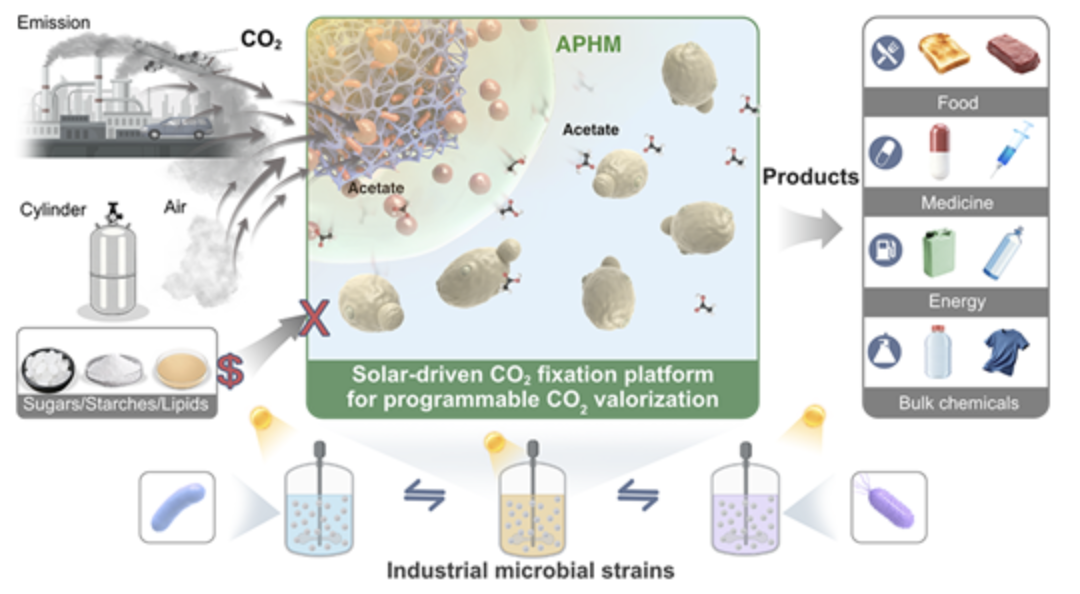
A team led by researchers Wang Bo and Yu Tao from the State Key Laboratory of Quantitative Synthetic Biology at the CAS Shenzhen Institute of Advanced Technology has designed a spatially compartmentalized, artificial photosynthetic hydrogel microsphere. By integrating light-energy harvesting, microbial carbon fixation, and product synthesis into a single microsphere, they have constructed a highly versatile material-biological hybrid platform.
While the idea sounds simple—using photocatalytic materials to absorb light energy and generate hydrogen, then utilizing that hydrogen with carbon-fixing microorganisms to capture carbon dioxide – the bottleneck of artificial photosynthesis lies in the fact that while photocatalytic materials and carbon-fixing microorganisms cannot be effectively integrated.
The team used a physical barrier to separate the photocatalytic zone from the microbial zone within a hydrogel-based framework. They utilized hydrogen gas as a short-range electron transfer medium and acetic acid as a chemical bridge molecule connecting the upstream and downstream processes, aiming to resolve all three challenges simultaneously within a single system.
They replaced the original inhibitory components with dithiothreitol (DTT), creating a dual-functional medium capable of both supporting bacterial growth and facilitating catalysis. With a modified formulation, the COF/Pt/Cr2O3 photocatalyst achieved a hydrogen yield of 62.0 mmol/g over five days—a sixteen-fold increase over the original version.
The team used sodium alginate and carboxymethyl cellulose as the matrix, cross-linking them with calcium ions to bind them together into double-network hydrogel microspheres approximately 4 millimeters in diameter. The microsphere shell contained the COF/Pt/Cr2O3 photocatalyst uniformly dispersed within it, while the core embedded a piece of high-temperature carbonized melamine foam.
Having solved the photocatalytic hydrogen production challenge, the team chose *Acetobacter woodii* for CO2 fixation. Naturally anaerobic and capable of efficiently utilizing hydrogen to produce acetic acid, it is an ideal microorganism for carbon fixation. However, it is highly light-sensitive, losing activity after just a few hours of exposure. The carbonized melamine foam in the microsphere’s core provided a perfect dark sanctuary for the bacteria to inhabit.
The double-network structure served as the design’s “skeleton,” enabling the microspheres to withstand stirring while retaining both the catalyst and the bacteria. The carbonized foam provided a safe habitat for the bacteria; being black and porous, it blocked over 99% of ultraviolet and visible light—as confirmed by transmission spectroscopy—while allowing gas molecules and nutrients to pass freely in and out.
By inoculating the carbonized foam core with *Acetobacter woodii*, the shell could continuously produce hydrogen under intense light while the bacteria in the core remained safely in the dark, undisturbed.
During ten days of continuous operation under intense light (60 mW/cm²), live/dead cell fluorescence staining and reactive oxygen species (ROS) assays showed that the bacteria in the core remained healthy and active throughout. In contrast, unprotected bacteria—lacking the foam shield—were almost entirely inactivated within 48 hours.
Over ten days, this artificial photosynthetic hydrogel microsphere system produced a cumulative 212.4 milligrams of acetic acid per liter, achieving a molar conversion efficiency of 88.85% from hydrogen to acetic acid. In contrast, a control group—where the catalyst and bacteria were simply mixed together—yielded only 23.7 milligrams of acetic acid per liter, with an efficiency of just 7.9%. Spatial compartmentalization boosted the coupling efficiency between light and biology by an order of magnitude.
Acetic acid can be assimilated by various industrial microorganisms via acetyl-CoA synthetase, entering central carbon metabolism and converting into acetyl-CoA. Acetyl-CoA serves as a metabolic “hub” from which countless products branch off, and acetic acid provides direct access to this central node.
This achievement opens up vast possibilities for the high-value utilization of carbon dioxide. From industrial exhaust to atmospheric carbon capture, wherever carbon dioxide exists, there is potential to turn waste into a valuable resource.