http://english.cas.cn/newsroom/research-news/202610/t20261012_1202298.shtml
https://onlinelibrary.wiley.com/doi/10.1002/anie.1197888
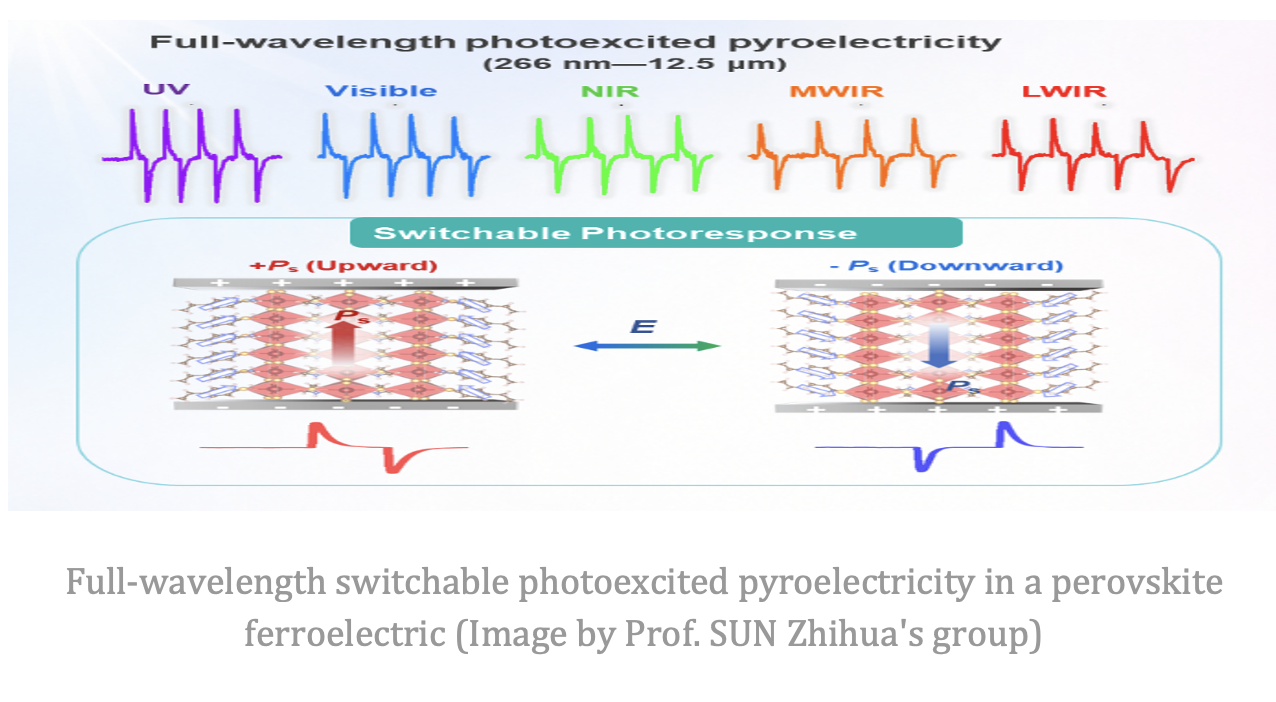
Researchers from the CAS Fujian Institute of Research on the Structure of Matter have achieved electrically switchable photoexcited pyroelectricity across a broad spectral range in a two-dimensional perovskite ferroelectric, (4-ethylanilinium)2(ethylammonium)2Pb3Br10, enabling room-temperature, self-powered light detection from ultraviolet (UV) to long-wave infrared wavelengths. The material can detect light from 266 nm to 12.5 μm, including the LWIR region.
In photoexcited pyroelectricity, incident light produces a transient temperature change that modulates the spontaneous polarization of a ferroelectric. This light-heat-electricity conversion can extend photoresponse beyond the material’s optical absorption edge while supporting zero-bias operation.
In this study, the researchers investigated a two-dimensional perovskite ferroelectric, (4-ethylanilinium)2(ethylammonium)2Pb3Br10. They found that the hybrid perovskite adopts a polar trilayered Ruddlesden–Popper structure at room temperature and undergoes a reversible ferroelectric-to-paraelectric transition near 390 K. Piezoresponse force microscopy and polarization–electric field measurements confirmed reversible domain switching, while the polarization retained its performance after 106switching cycles.
Under illumination, reproducible pyroelectric currents were recorded continuously from 266 nm in the UV region to 12.5 μm in the LWIR region, far beyond the 2.69 eV optical bandgap. Reversing the ferroelectric polarization reversed the output current without substantially changing its magnitude. The electrically programmed signal state remained stable for more than 6 hours, demonstrating nonvolatile and controllable photoresponse.
A crystal-based device operated at room temperature without an external bias or cryogenic cooling. Under 10 μm irradiation, it detected a temperature variation as small as about 0.1 K and delivered a responsivity of 0.42 μA W-1, a specific detectivity of 105 cm Hz1/2 W-1 and a response time of approximately 80 ms. The photoresponse remained stable over 200 switching cycles.
To demonstrate practical sensing, the team fabricated a single-crystal array device that directly detected human-body thermal radiation. The zero-bias output decreased systematically as a finger was moved farther from the device, and tests with thermal sources at different temperatures further verified reliable room-temperature infrared sensing.
According to the researchers, this work provides the first demonstration of electrically switchable photoexcited pyroelectricity across the investigated UV-to-LWIR spectrum in a perovskite ferroelectric. It offers a material strategy for self-powered, uncooled and ultrabroadband detectors as well as future intelligent thermal-sensing systems.