https://www.cas.cn/syky/202608/t20260818_5118510.shtml
https://doi.org/10.1002/adma.74519
Brain-computer interfaces (BCIs) represent a cutting-edge technology at the intersection of neurology, rehabilitation engineering, and artificial intelligence. The neural-integrating interface between the electrode and brain tissue directly determines the device’s service life, signal acquisition accuracy, and clinical safety; it serves as the foundation for achieving long-term, stable neural recording and precise, closed-loop neural modulation.
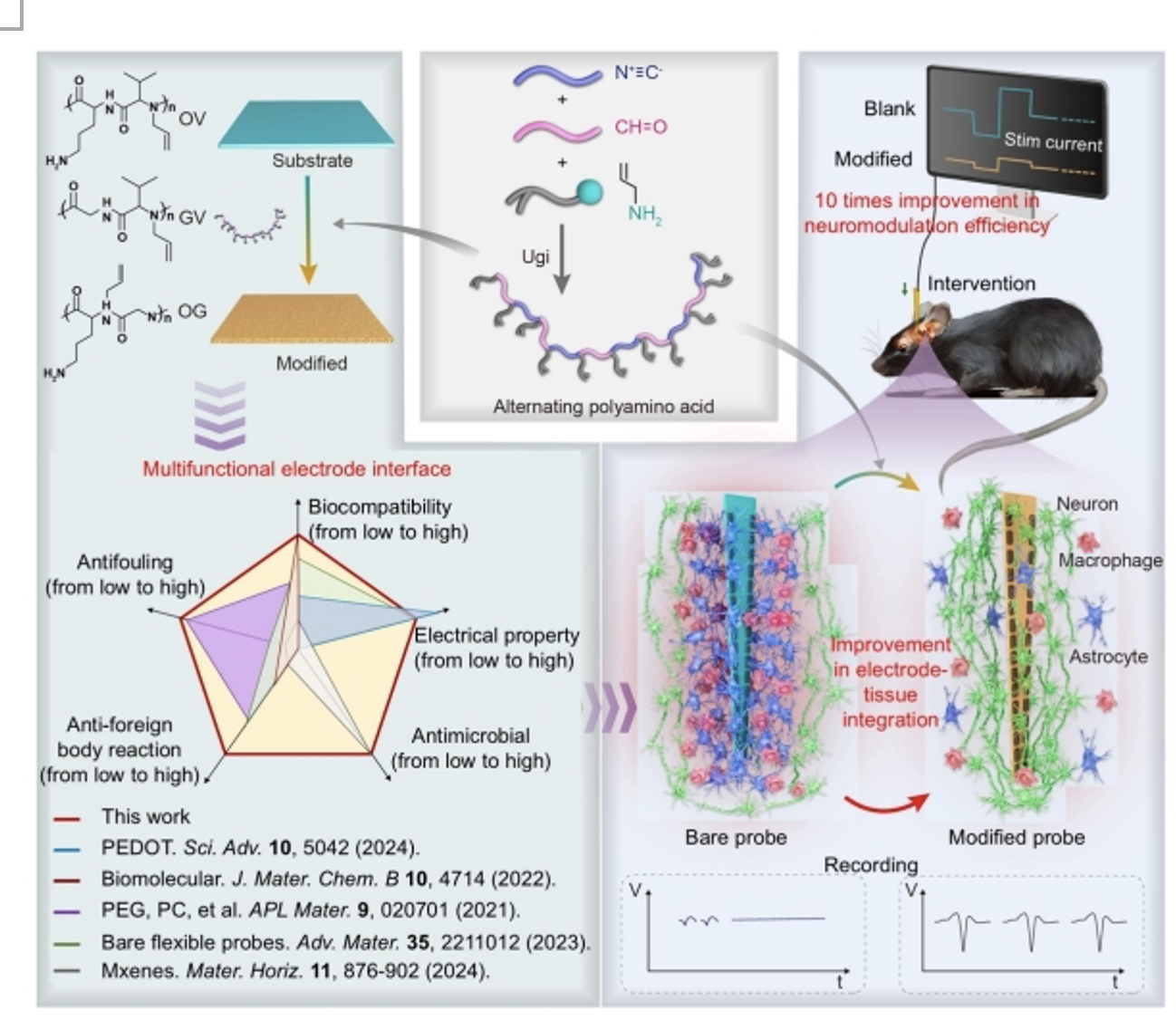
A research team led by the CAS Technical Institute of Physics and Chemistry (TIPC) has developed a multifunctional electrode interface coating based on alternating cationic peptides. This coating offers excellent biocompatibility, broad-spectrum antibacterial activity, resistance to protein and ion adhesion, and potent inhibition of the foreign body response, all without compromising the electrode’s electrochemical performance. Modified flexible neural electrodes underwent extensive validation in animal models, offering a universal solution for clinical-grade BCIs capable of ultra-long-term service and non-destructive replacement.
The peptide-based modification material is compatible with various implant substrates, including silicon, gold, polyimide, and medical-grade polyurethane. It forms an ultrathin modification layer via covalent surface grafting and achieves synergistic functionality through moderate high-potential activity and a hydrogen-bonded hydration barrier, all while preserving the electrode’s inherent mechanical and electrical properties.
The team implanted the modified flexible electrodes into the motor cortex of the brain and conducted continuous *in vivo* electrophysiological testing for up to 300 days; comparative results demonstrated superior overall performance compared to traditional bare electrodes. After 300 days of implantation, the modified electrodes showed no degradation in the number of effective working channels, and neuronal action potential amplitudes consistently remained above 155 μV. Regarding neural stimulation and modulation, 300 days post-implantation, the modified electrodes required only 2 μA to trigger significant motor responses, representing a 50-fold increase in overall neuromodulation efficiency.
Experimental results confirmed that the coating effectively prevented “bio-adhesion,” allowing the electrodes to be extracted intact without causing extensive brain tissue damage. Immunostaining revealed that the number of astrocytes and macrophages surrounding the modified electrodes was only about one-fifth of that observed with bare electrodes; furthermore, neuronal density within a 500 μm radius of the electrodes was comparable to that of healthy brain tissue, thereby resolving the “neuronal desert” problem typically found around conventional electrodes.
Figure: Schematic of the multifunctional poly-amino acid brain-computer interface achieving neural integration