https://www.cas.cn/cm/202608/t20260827_5119130.shtml
http://doi.org/10.1002/imt2.70158
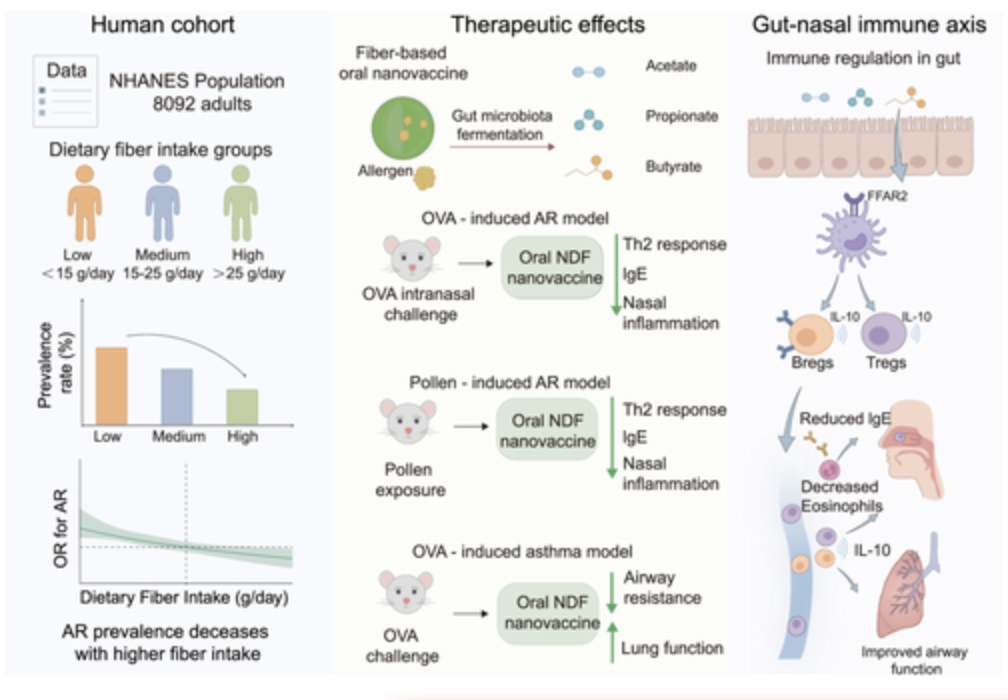
A team from the National Center for Nanoscience and Technology and collaborators have developed an oral nanovaccine for rhinitis based on nanodelivery technology. This vaccine achieves synergistic regulation by combining allergen delivery, the modulation of gut microbiota metabolism, and the remodeling of the gut-nasal immune axis.
The team led by Nie Guangjun and Zhao Ruifang has long specialized in nanomedicine and tumor immunotherapy, utilizing nanotechnology to precisely modulate the tumor microenvironment and mobilize the body’s immune cells to fight tumors. Research has shown that within the tumor microenvironment, the abnormal accumulation of metabolites creates a state of local immunosuppression and blunts the immune system’s killing capabilities—effectively “quieting” the immune system to evade its attacks. Consequently, the core logic of tumor immunotherapy lies in awakening the body’s dormant immune cells, enabling them to precisely identify and eliminate tumor lesions.
In contrast to the logic of tumor immunotherapy, the fundamental issue in allergic rhinitis is an overactive immune system that launches a sustained and excessive inflammatory attack against harmless allergens. This sparked an idea for “reverse innovation” among researchers: since nanocarriers can be used to specifically activate immune cells to fight tumors, could they be modified to precisely train the immune system? The goal would be to induce immune tolerance to specific allergens—such as pollen or dust mites—preventing the body from launching indiscriminate inflammatory attacks. However, modulating immune tolerance is a double-edged sword; while suppressing the abnormal allergic response, researchers must ensure that the immune system’s ability to defend against pathogens and bacteria remains intact.
During the study, the team discovered that certain short-chain fatty acids—such as formic acid and butyric acid—can soothe immune cells, maintain bodily homeostasis, and exert potent anti-inflammatory effects. A analyzing data from a cohort of 8,092 adults in the U.S. NHANES (National Health and Nutrition Examination Survey) database, they found that adequate intake of dietary fiber—found in vegetables, fruits, and grains—promotes gut health and can alleviate allergic reactions overall. While dietary fiber is not a substitute treatment for allergic rhinitis, statistical analysis revealed a clear correlation: individuals with insufficient dietary fiber intake faced a significantly higher risk of developing the condition.
Further analysis showed that dietary fiber serves as “food” for microorganisms and cannot be absorbed or utilized by the stomach. Once fiber passes through the stomach and reaches the intestines, gut microbiota break it down into short-chain fatty acids—such as acetic acid, propionic acid, and butyric acid—which the body can then absorb and utilize. Consequently, it was hypothesized that a link might exist between the gut and the nasal cavity.
To test this hypothesis, researchers conducted experiments using engineered mice expressing green fluorescent protein (GFP). By locally irradiating the mice’s intestines with ultraviolet light, the fluorescence of intestinal cells was irreversibly switched to red, effectively tagging the gut immune cells with a unique marker.
After orally administering a nanovaccine to the mice, flow cytometry was used to detect a large number of red fluorescent cells—originally from the gut—within the nasal mucosa. This provided direct visual evidence that gut-derived immune cells can migrate to the nasal cavity along the ‘gut-nose axis’.
Mechanistic studies revealed that the oral nanovaccine promotes the formation of tolerogenic dendritic cells and induces the generation of two types of regulatory cells: secretory regulatory B cells and regulatory T cells. Further confirmation via cell tracing and immunological analysis showed that these gut-derived regulatory cells migrate along the gut-nose axis to the nasal mucosa, where they establish local antigen-specific immune tolerance.
This revealed a novel mechanism by which gut-derived regulatory immune cells participate in inter-organ immune regulation, and also demonstrated that short-chain fatty acids must bind to cell-surface receptors to drive the proliferation of regulatory immune cells and facilitate their migration across organs.
The gut-nose axis mechanism allows short-chain fatty acids to be transported to the nasal cavity via bodily fluid circulation (such as blood and lymph), thereby alleviating inflammation in the nasal airways. However, direct oral administration of short-chain fatty acids results in rapid absorption by the stomach, preventing them from remaining in the gut long enough to exert a sustained effect.
As a consequence, the team developed an integrated nanoparticle system using “programmable” dietary fiber-based nanodelivery technology. This system transports the vaccine to the gut, where microbial breakdown generates small-molecule metabolites and slowly releases the cargo; this simultaneously delivers the allergen and shapes a tolerogenic microenvironment in the gut, overcoming the limitations of efficacy associated with simple dietary intake or free short-chain fatty acids. The size of these nanoparticles and the type of encapsulated allergen can be adjusted on demand, thereby modulating intestinal retention time and specific immune responses.
Researchers established a mouse model of allergic rhinitis that replicated the full spectrum of symptoms seen in humans, observing behaviors such as frequent sneezing and nose-scratching in the test subjects. Controlled experiments showed that in the group treated with the nanovaccine, nasal congestion subsided significantly, sneezing frequency dropped sharply, and nasal temperatures returned to normal. Histopathological analysis confirmed the resolution of nasal mucosal edema and a marked reduction in the infiltration of eosinophils—the cells that drive allergic reactions. Notably, even after an allergen challenge four months following the conclusion of an eight-day oral vaccine regimen, the mice maintained stable immune tolerance, with no recurrence of allergic symptoms.
Compared to conventional desensitization therapies, this oral nanovaccine not only restores antigen-specific immune tolerance and provides long-lasting protection but also repairs damaged nasal mucosa. By utilizing a natural dietary fiber carrier, the approach minimizes toxicological risks associated with small-molecule chemical drugs and integrates the delivery vehicle with the immunomodulator, reinforcing tolerance through dual pathways.
While the results of animal experiments at this stage are encouraging, the work remains in the phase of fundamental preclinical animal research; safety and efficacy trials involving large animals or non-human primates have not yet been conducted, and human clinical trials have not yet commenced,