
https://www.cas.cn/syky/202606/t20260617_5112741.shtml
https://www.sciencedirect.com/science/article/abs/pii/S0926337326007411
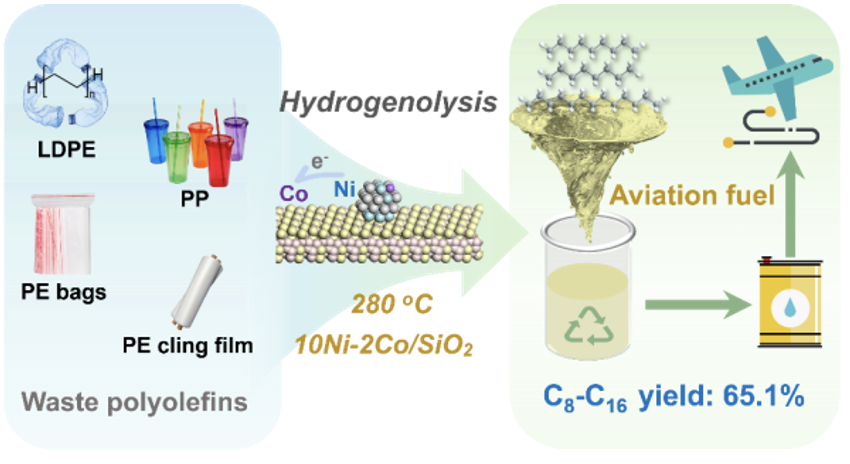
The CAS Shanghai Advanced Research Institute (SARI) has proposed a closed-loop route for converting waste polyolefins into naphtha-range products. They developed a catalytic conversion strategy based on non-noble metals, achieving the targeted hydrogenolysis of polyolefins into C8–C16 aviation kerosene components. Building on this foundation, the team recently designed a non-noble metal 10Ni-2Co/SiO2 catalyst and elucidated the mechanism of internal C–C bond cleavage in polyolefins and the formation of aviation kerosene fractions during hydrogenolysis.
Using the 10Ni-2Co/SiO2 catalyst, the team selectively converted waste polyolefins into aviation kerosene fractions (C8–C16 hydrocarbons) under mild conditions, achieving a liquid yield of 82.3% and a C8–C16 selectivity of 79.0%. The study optimized the C–C bond cleavage pathway and suppressed over-cracking by using Co-doping to modulate the electronic structure of Ni, thereby inducing the coexistence of Ni⁰ and Niᵟ⁺species and establishing a dynamic balance among cleavage, hydrogenation, and desorption. Through a combination of DFT calculations, in-situ infrared spectroscopy, and kinetic analysis, the researchers revealed the mechanism behind the preferential cleavage of C–C bonds at the β-position. Furthermore, coupling this process with renewable energy sources can reduce its carbon footprint, offering a new, green pathway for waste plastic upcycling and the decarbonization of the aviation industry.
Production of aviation kerosene from waste polyolefin plastics via non-noble metal catalysis