https://j.people.com.cn/n3/2026/0616/c95952-20467873.html
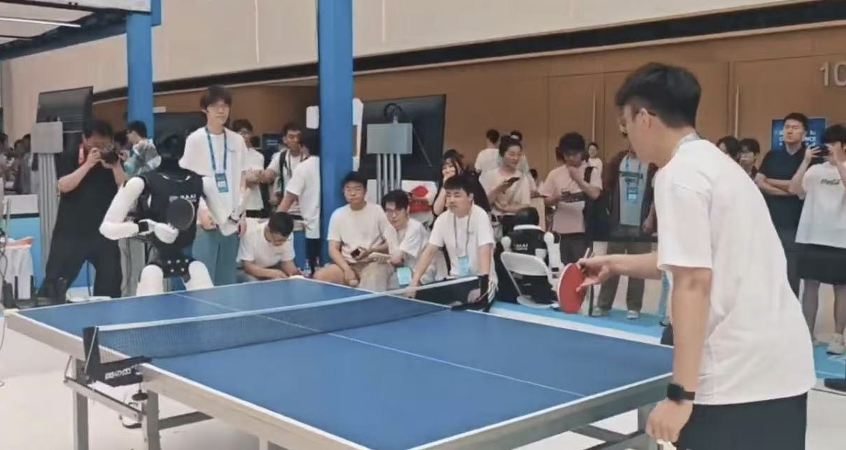
Table tennis balls travel at speeds exceeding 5 meters per second, with spin, landing points, and trajectories changing in an instant. Without any remote control, pre-programmed scripts, or human intervention, the humanoid bipedal “Agibot Expedition A3” robot (Zhiyuan Yuanzheng A3) autonomously executed a complete closed-loop control process—ranging from visual perception, trajectory prediction, and whole-body motion planning to the precise striking of the ball.
This technological breakthrough is the result of a joint research effort between Agibot and a team led by Zhang Shanghang of Peking University. The project utilized “SpikePingpong”—the world’s first table tennis motion control algorithm designed for humanoid robots—and a 20kHz high-frequency pulse camera developed by Professor Huang Tiejun of Peking University. These innovations increased the robot’s visual response speed tenfold compared to conventional methods and enabled the prediction of the contact point between the racket and the ball with millimeter-level accuracy, significantly enhancing motion control precision.