https://www.sciencedirect.com/science/article/abs/pii/S2095927326004627?via%3Dihub
https://www.cas.cn/syky/202606/t20260616_5112637.shtml
During growth and invasion, malignant tumors release specific biomarkers into body fluids such as blood, ascites, and urine. These biomarkers carry biological information regarding tumor onset and progression, providing a basis for early cancer diagnosis. However, the low concentration of cancer markers and cancer cells in body fluids, combined with the complexity of cell types present, makes precise detection challenging.
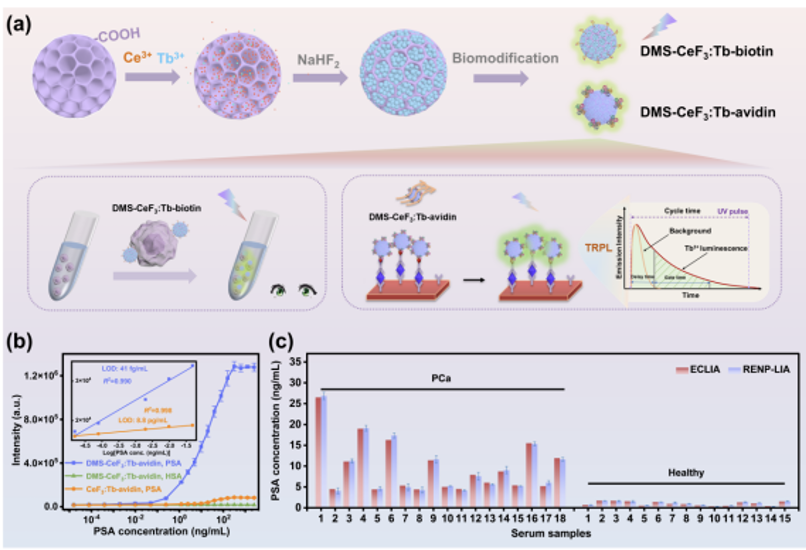
Rare-earth-doped fluoride nanoprobes possess excellent optical properties and have garnered significant attention in the field of cancer biomarker detection. Optimizing the luminescence performance of these probes enhances the signal-to-noise ratio, which is crucial for ultrasensitive detection. Recently, researchers from the CAS Fujian Institute of Research on the Structure of Matter and other institutions developed a simple in-situ enrichment strategy to synthesize silica/rare-earth fluoride (DMS-CeF3:Tb) nanocomposites featuring a pomegranate-like core-shell structure.
The DMS-CeF3:Tb probe enables ultrasensitive time-resolved fluorescence immunoassay detection of prostate-specific antigen (PSA), achieving a detection limit as low as 41 fg mL⁻¹—a sensitivity 976 times higher than that of commercial kits. Validation using serum samples from prostate cancer patients showed results consistent with hospital-based electrochemiluminescence immunoassays, confirming the probe’s clinical feasibility. Furthermore, biotin-modified DMS-CeF3:Tb nanoprobes can target cervical cancer cells; the resulting luminescence signal is stronger than that of normal cell groups, allowing for naked-eye differentiation and facilitating rapid, low-cost cancer screening at the cellular level. These findings demonstrate the potential of DMS-CeF3:Tb in early cancer diagnosis.