Nature 2025 science city ranking: six of top 10 in China, Qingdao is 31 between Munich and Berlin

https://www.nature.com/nature-index/supplements/nature-index-2025-science-cities/tables/overall

https://en.people.cn/n3/2025/1118/c90000-20391615.html

The newly released “Nature Index 2025 Science Cities” supplement shows that the number of Chinese cities in the global top ten rose from five in 2023 to six in 2024, marking the first time China holds a majority in the rankings.

The supplement draws on the Nature Index database, which tracks research articles published from 2015 to 2024. Its analysis uses “Share”, a fractional count reflecting institutional contribution to publications, as the primary metric, with time-series data adjusted to 2024 levels. Each city’s Share is calculated by summing the contributions of all affiliated institutions located within that city.

According to the Nature Index, the world’s leading science cities overall are: Beijing, Shanghai, New York metropolitan area (U.S.), Boston metropolitan area (U.S.), Nanjing (China), Guangzhou (China), San Francisco Bay Area (U.S.), Wuhan (China), Baltimore-Washington metropolitan area (U.S.), and Hangzhou (China).

Further analysis shows that Chinese cities hold a strong advantage in chemistry, physical sciences, and earth and environmental sciences, leading the global rankings in all three fields. Notably, Chinese cities claimed all of the top ten positions in chemistry for the first time. In the other two subject areas, they secured six of the top ten spots, with Beijing ranking first worldwide across all three domains.

European cities in the ranking start at 19 (London), followed by Zurich (28), Cambridge (29), Munich (30) and Berlin (32), following Qingdao at position 31.
more insights

http://english.cas.cn/newsroom/research-news/202604/t20260428_1158214.shtml

https://www.pnas.org/doi/10.1073/pnas.2530496123

Researchers from the CAS Qingdao Institute of Bioenergy and Bioprocess Technology (QIBEBT) have identified a conserved ubiquitin-mediated regulatory mechanism that coordinates metabolic flux among multiple biosynthetic pathways in yeast.

Eukaryotic cells operate under constant resource constraints, requiring them to allocate limited carbon supplies among multiple biosynthetic processes. Pathways responsible for producing carotenoids, sterols, and lipids are particularly interconnected, as they rely on shared metabolic precursors. Yet how cells dynamically balance these competing demands has remained unclear.

Using astaxanthin-producing Xanthophyllomyces dendrorhous yeast, the researchers identified an E3 ubiquitin ligase, PTR1, as a central regulatory hub that links carotenoid, sterol, and lipid metabolism. Further analysis revealed a PTR1-centered regulatory network that integrates these pathways. PTR1 modulates carotenoid biosynthesis through a reciprocal regulatory loop with the White Collar Complex (WCC), which is a key transcriptional regulator associated with carotenoid production. In addition, several PTR1-interacting proteins were identified, suggesting broader roles in fine-tuning sterol and lipid metabolism. Importantly, PTR1 homologs are conserved across diverse eukaryotic lineages, indicating that ubiquitin-mediated regulation represents an evolutionarily conserved strategy for coordinating metabolic networks.

http://english.cas.cn/newsroom/research-news/202604/t20260423_1157877.shtml

https://doi.org/10.1016/j.tibtech.2026.03.017

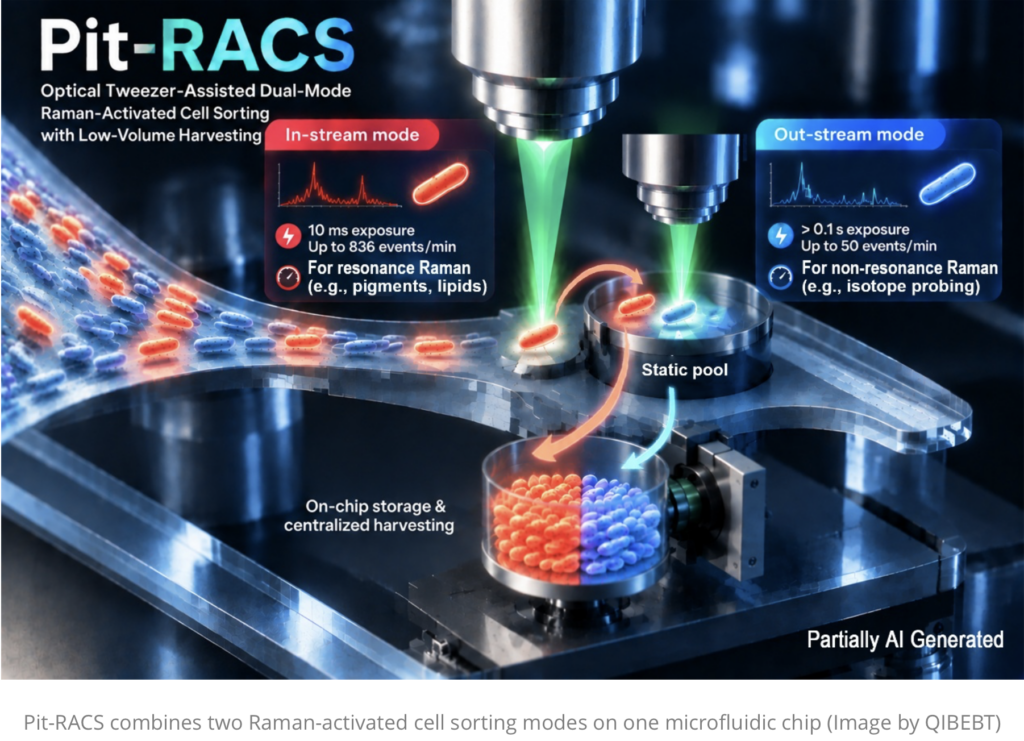
A team led by the CAS Qingdao Institute of Bioenergy and Bioprocess Technology (QIBEBT) has developed a new “process ramanomics” platform. This technology enables real-time, data-driven control of biomanufacturing.

The researchers validated their approach in polyhydroxyalkanoate (PHA) fermentation, a key route for biodegradable polyesters used in packaging and medical materials. Powered by machine learning, the platform achieved 99.75% accuracy in distinguishing PHB-producing cells from P34HB-producing ones, and quantified total PHA content and monomer composition at the single-cell level with a median absolute deviation below 3.8%, comparable to traditional gas chromatography.

In a pivotal 5,000-liter industrial fermenter trial, traditional offline testing pointed to harvesting at 28 hours when PHA content registered 66.32%. Process ramanomics, however, revealed a compositional shift invisible to conventional methods: the 4HB monomer ratio was 8.67% at 26 hours (within specification) but climbed to 11.28% by 28 hours, exceeding the compliance limit, demonstrating that earlier termination could safeguard product quality.

The platform’s single-cell resolution also showed that the content of intracellular PHA can vary by more than threefold among individual cells. At 26 hours, population heterogeneity was lowest, with 91.54% of cells producing at high levels and a 4HB composition that was within specification. This confirmed that 26 hours was the optimal harvest window.

The scientists further showed that process ramanomics can be applied to different chassis organisms and products. For example, it can be used for protein synthesis in yeast and lipid synthesis in Rhodococcus. This suggests that process ramanomics could serve as a general-purpose analytics engine for next-generation intelligent bioreactors.

https://en.people.cn/n3/2026/0324/c90000-20439477.html

At the Qingdao Humanoid Robot Data Training Center in Laoshan District of Qingdao, humanoid robots are trained for jobs such as intelligent industrial manufacturing, smart home, and commercial services. Data collectors here control robots to complete specific tasks like logistics sorting, supermarket restocking, kitchen operations, and component assembly. Through thousands of repetitions and trials, massive amounts of motion data are generated, endowing robots with a smarter “intelligent brain,” and helping humanoid robots enter all walks of life to serve thousands of households.

Back to …