A deep-sea isopod uses horizontal gene transfer with a symbiotic bacterium to withstand ultra-long starvation

https://english.news.cn/20260606/de8eff009a94407c8eeeb1fdab13d675/c.html

https://www.cell.com/cell/abstract/S0092-8674(26)00571-4?_returnURL=https%3A%2F%2Flinkinghub.elsevier.com%2Fretrieve%2Fpii%2FS0092867426005714%3Fshowall%3Dtrue

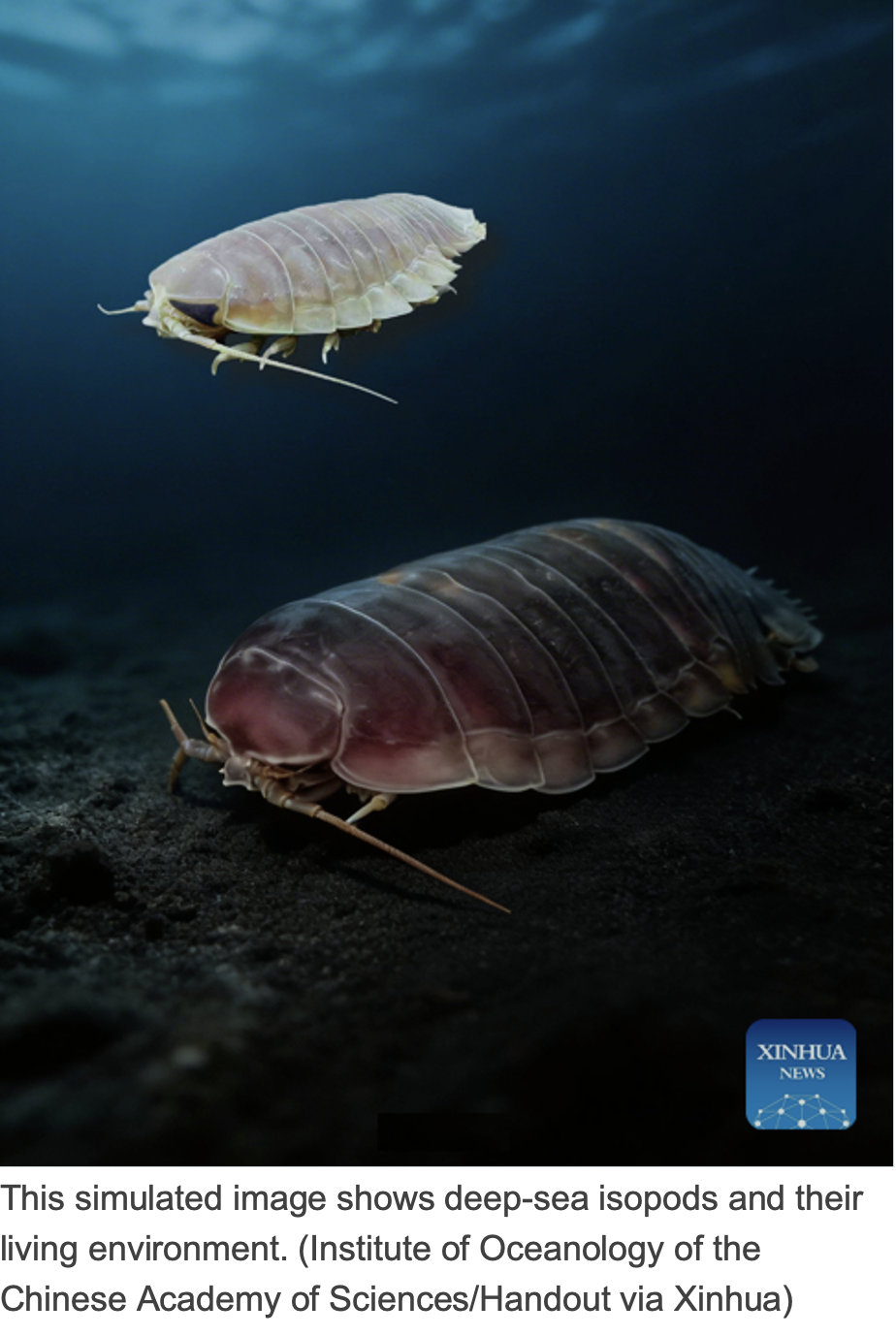
A joint research led by the CAS Institute of Oceanology in collaboration with the Hong Kong-based Chinese University of Hong Kong and Northwestern Polytechnical University in Xi’an deciphered the mechanism of ultra-long starvation tolerance in deep-sea isopods and provides an important paradigm for understanding how life balances growth and survival in extreme environments.

The deep sea is cold, dark, and almost entirely devoid of reliable nutrition, making long-term survival a remarkable evolutionary feat. To survive the abyss, the isopod possesses an enormous stomach that occupies about two-thirds of its body and acts like a deep-freeze pantry, allowing it to gorge when food is available and store the haul for months or even years. Second, it maintains an exceptionally low basal metabolic rate, essentially putting itself on permanent energy-saving mode. Together, these traits turn opportunistic binge eating into an ultra-long energy reserve.

In addition, a key gene involved in this metabolic slowdown, named ND1, is not originally part of the isopod’s own genome. The isopod “hijacks” it from an external symbiotic bacterium through horizontal gene transfer.

To verify ND1’s function, the researchers inserted the gene into zebrafish, nematodes, and human cells in the lab. Under normal temperatures, the gene recipients burned energy faster and became less tolerant of starvation. However, under cold conditions that mimic the isopod’s deep-sea home, ND1 suppressed energy metabolism, reduced mitochondrial activity, and boosted starvation endurance in zebrafish by a remarkable 37 percent.

This temperature-dependent switch solves the so-called “energy paradox” — how can a giant animal with high energy demands survive where food is extremely scarce? The ND1 acts as a metabolic thermostat, fine-tuning energy burn in response to environmental conditions. It provides a solution to the trade-off between body size and food scarcity.
more insights

http://english.cas.cn/newsroom/research-news/202606/t20260608_1161380.shtml

https://onlinelibrary.wiley.com/doi/10.1002/mlf2.70089

Researchers from the CAS Qingdao Institute of Bioenergy and Bioprocess Technology (QIBEBT) and Shenzhen Third People’s Hospital have developed a Ramanome-based phenotypic platform to improve the efficiency of bacteriophage evaluation for potential clinical use.

By combining Raman spectroscopy with a random forest model, the researchers introduced the Ramanome-based Phage Susceptibility Test (RPST). This phenotypic method reduces the turnaround time for host range verification to approximately one hour, compared to the 11–21 hours typically required by traditional plaque-based assays.

Bacteriophages offer a precise alternative to antibiotics in the fight against antimicrobial resistance. However, matching phages to clinical bacterial isolates remains challenging due to their narrow host ranges and the slow, qualitative nature of conventional assays.

The RPST framework monitors bacterial metabolic changes within 40 minutes of phage-host co-incubation and identifies four conserved Raman spectral biomarker regions linked to nucleic acids, proteins, and lipids. Combining these biomarkers into a Composite Infection Index (CII), the system achieved a 96.0% concordance rate across 25 phage-host pairs.

Unlike static assays, the continuous CII metric estimates the fraction of infected cells, enabling researchers to rank phage potency and determine the minimum MOI required to sustain infection.

While the method shows operational promise, the researchers acknowledge the need for large-scale, multi-center validation across different instruments to ensure long-term clinical reproducibility.

https://j.people.com.cn/n3/2026/0527/c94476-20460938.html

The Haier Group has announced an ultra-lightweight, artificial intelligence (AI)-powered exoskeleton robot designed to assist with movement. The company claims that using this robot can reduce physical energy expenditure by up to 37%.

The W3 features a “full carbon fiber + titanium alloy” design, resulting in a main unit weight of just 1.75 kilograms (kg). Equipped with the AI ​​Gait Algorithm 3.0 and built-in multi-dimensional sensors, the device can interpret a user’s movement intentions in milliseconds. Furthermore, it utilizes a “high-torque dual-motor + high-energy battery” system; the maximum assistive force per leg reaches 16 Newton-meters (N·m), effectively reducing the physical load on the body by approximately 5 kg.

According to Haier, the robot also features a “short-stride walking” mode designed to accommodate the specific gait characteristics of elderly individuals—namely, reduced muscle strength and a shortened stride length. By precisely compensating for muscle weakness, the device aims to enable a more stable and secure walking experience.

http://english.cas.cn/newsroom/research-news/202604/t20260428_1158214.shtml

https://www.pnas.org/doi/10.1073/pnas.2530496123

Researchers from the CAS Qingdao Institute of Bioenergy and Bioprocess Technology (QIBEBT) have identified a conserved ubiquitin-mediated regulatory mechanism that coordinates metabolic flux among multiple biosynthetic pathways in yeast.

Eukaryotic cells operate under constant resource constraints, requiring them to allocate limited carbon supplies among multiple biosynthetic processes. Pathways responsible for producing carotenoids, sterols, and lipids are particularly interconnected, as they rely on shared metabolic precursors. Yet how cells dynamically balance these competing demands has remained unclear.

Using astaxanthin-producing Xanthophyllomyces dendrorhous yeast, the researchers identified an E3 ubiquitin ligase, PTR1, as a central regulatory hub that links carotenoid, sterol, and lipid metabolism. Further analysis revealed a PTR1-centered regulatory network that integrates these pathways. PTR1 modulates carotenoid biosynthesis through a reciprocal regulatory loop with the White Collar Complex (WCC), which is a key transcriptional regulator associated with carotenoid production. In addition, several PTR1-interacting proteins were identified, suggesting broader roles in fine-tuning sterol and lipid metabolism. Importantly, PTR1 homologs are conserved across diverse eukaryotic lineages, indicating that ubiquitin-mediated regulation represents an evolutionarily conserved strategy for coordinating metabolic networks.

Back to …