QIBEBT: novel electro catalyst offers hydrogen production from seawater

https://doi.org/10.1016/j.checat.2024.101169

https://english.cas.cn/newsroom/research_news/chem/202411/t20241111_694029.shtml

Seawater electrolysis has long been seen as a promising pathway for sustainable hydrogen production but has faced significant limitations due to chloride ion (Cl⁻) corrosion, which can degrade a catalyst’s performance.

Scientists from the Qingdao Institute of Bioenergy and Bioprocess Technology (QIBEBT) of the Chinese Academy of Sciences, along with their collaborators, have developed an efficient electrocatalyst called Co-N/S-HCS that demonstrates remarkable activity and stability in seawater electrolysis. This offers a sustainable hydrogen production solution with minimal reliance on freshwater resources.

The Co-N/S-HCS electrocatalyst utilizes an asymmetric CoN₃S₁ structure, in which each cobalt (Co) atom is coordinated with three nitrogen (N) atoms and one sulfur (S) atom. This asymmetric CoN₃S₁ configuration, optimized through density functional theory and molecular dynamics simulations, modifies the electronic distribution around the Co center compared with the symmetric CoN4 configuration, thereby weakening corrosive Cl⁻ adsorption and enhancing the catalyst’s performance in seawater-based electrolytes.

more insights

https://en.people.cn/n3/2026/0324/c90000-20439477.html

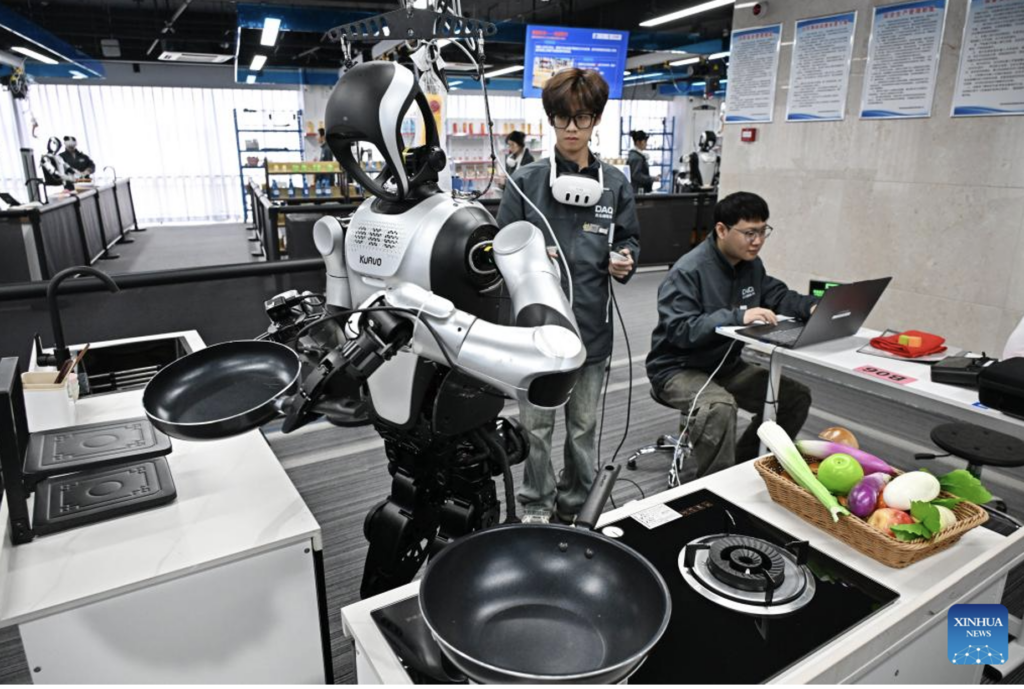
At the Qingdao Humanoid Robot Data Training Center in Laoshan District of Qingdao, humanoid robots are trained for jobs such as intelligent industrial manufacturing, smart home, and commercial services. Data collectors here control robots to complete specific tasks like logistics sorting, supermarket restocking, kitchen operations, and component assembly. Through thousands of repetitions and trials, massive amounts of motion data are generated, endowing robots with a smarter “intelligent brain,” and helping humanoid robots enter all walks of life to serve thousands of households.

https://www.cas.cn/syky/202602/t20260226_5102870.shtml

https://doi.org/10.1186/s40168-026-02339-3

A research team at the CAS Qingdao Institute of Bioenergy and Bioprocess Technology has developed RamEx, an integrated analysis framework for Ramanome big data. This platform, tailored to the characteristics of Raman spectroscopy data, establishes a one-stop workflow from data reading and standardized preprocessing to downstream data mining, centered on automated quality control algorithms and efficient parallel computing processes. It also demonstrates a systematic analysis of microbial metabolomical heterogeneity and metabolic pattern differentiation at the single-cell level.

Raman genomics deep analysis can track the dynamic changes in the composition of macromolecules such as lipids, proteins, and nucleic acids in different cells, thus revealing the differentiation and succession patterns of microbial metabolic states at the population scale with single-cell precision. This provides new research ideas and technical pathways for understanding the functional organization and environmental adaptation mechanisms of complex communities.

http://english.cas.cn/newsroom/research-news/202602/t20260224_1151116.shtml

https://link.springer.com/article/10.1186/s40168-026-02339-3

Scientists from the CAS Qingdao Institute of Bioenergy and Bioprocess Technology have developed a novel computational tool, RamEx, designed to resolve the computational bottleneck in high-throughput microbial Ramanomics.

RamEx streamlines the full Ramanomic analysis pipeline, from data preprocessing and automated quality control to advanced data mining. An Iterative Convolutional Outlier Detection (ICOD) algorithm tackles spectral noise in an unsupervised manner to dynamically identify and eliminate spectral artifacts, ensuring high-quality input for downstream analysis.

The platform’s performance was validated using diverse datasets, including pathogenic bacteria, probiotics, and yeast fermentation systems. Notably, RamEx successfully captured phenotypic heterogeneity in genetically identical yeast cells by detecting subtle metabolic fluctuations and tracking the dynamic accumulation of intracellular macromolecules, including lipids, proteins, and nucleic acids.

Back to …