> 100 g/L trans-aconitic acid in an engineered A. niger cell factory

https://www.sciencedirect.com/science/article/pii/S2950155526001278

https://www.cas.cn/syky/202611/t20261119_5124597.shtml

Efficient Microbial Synthesis of Trans-Aconitic Acid

Trans-aconitic acid (tAA) is a C6 tricarboxylic acid containing an unsaturated double bond. It shows broad application prospects in fields such as bio-based plasticizers and biopesticides.

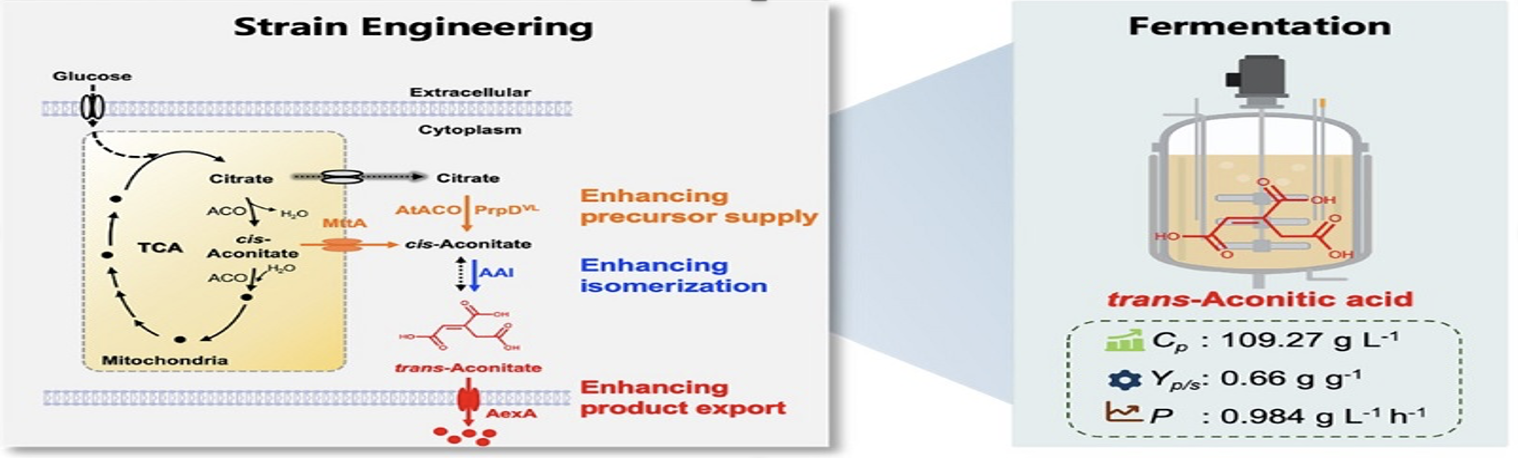
A research team at the CAS Qingdao Institute of Bioenergy and Bioprocess Technology has made significant progress in the green microbial production of trans-aconitic acid. Using the industrial citric acid-producing strain *Aspergillus niger* as a chassis, the team analyzed its metabolic differences compared to industrial strains of *Aspergillus terreus*. They employed a multidimensional metabolic engineering strategy centered on “identifying bottlenecks and achieving multi-module synergy.” By reconstructing heterologous biosynthetic pathways, enhancing precursor supply, and introducing specific efflux proteins to promote product secretion, the team successfully engineered an *A. niger* cell factory capable of highly efficient trans-aconitic acid synthesis. In a 50L fermenter, this engineered strain achieved a trans-aconitic acid titer of 109 g/L—a leading level in the field of microbial synthesis.
more insights

https://www.cas.cn/syky/202611/t20261119_5124596.shtml

https://onlinelibrary.wiley.com/doi/10.1111/pce.71047

Cyanobacteria are among the oldest photosynthetic microorganisms on Earth, having evolved diverse adaptive capabilities to cope with environmental changes. When faced with high-salinity environments, many cyanobacteria can actively synthesize small, hydrophilic compounds—such as sucrose and trehalose—to withstand such stress. This characteristic offers a new perspective for developing cyanobacterial photosynthetic cell factories to produce sugar-based compounds.

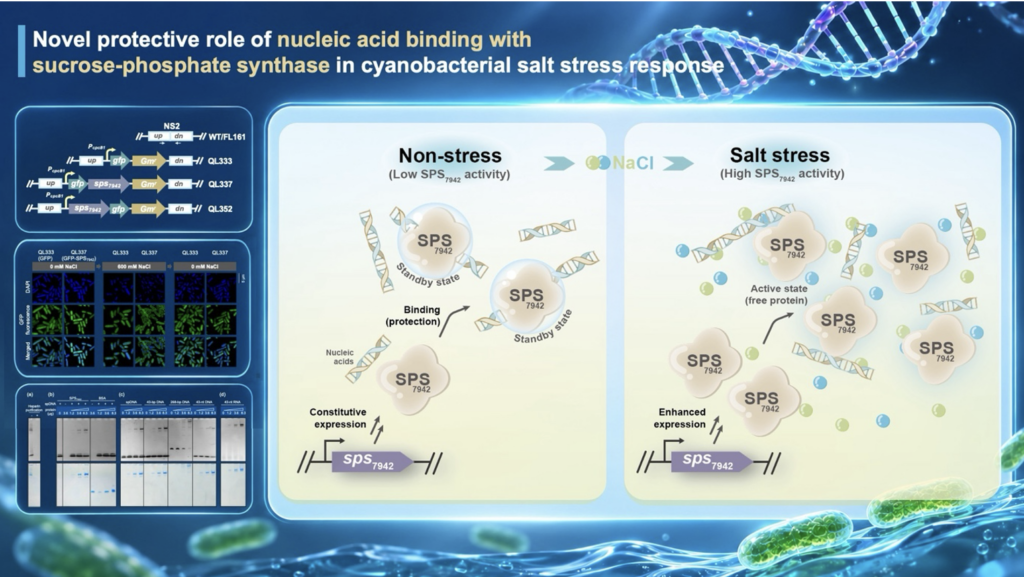
The CAS Qingdao Institute of Bioenergy and Bioprocess Technology has made progress in understanding how cyanobacteria adapt to high-salinity environments. Previous research by the team revealed that sucrose synthesis in cyanobacteria is induced by the effects of high salt-ion concentrations. The key regulatory point in this process is the enzyme sucrose-phosphate synthase (SPS), the activity of which is rapidly enhanced through direct activation by salt ions. In more recent, in-depth studies, the research team discovered that this enzyme can interact with nucleic acids. This interaction is non-specific to the type of nucleic acid and is reversible; furthermore, whether or not the interaction occurs is closely linked to the salinity of the environment.

The study indicates that this interaction does not significantly affect the catalytic activity of sucrose-phosphate synthase and is not involved in the regulation of its enzymatic activity. Instead, binding to nucleic acids effectively enhances the protein’s stability and its resistance to enzymatic degradation. The researchers propose that the interaction between nucleic acids and sucrose-phosphate synthase may provide a “hidden” protective mechanism. This helps the cell maintain a “standby” level of the enzyme under non-stressed conditions, ensuring that the cell can rapidly shift into a stress-response and sucrose-synthesis state when exposed to high-salinity environments.


https://j.people.com.cn/n3/2026/1116/c95952-20519299.html

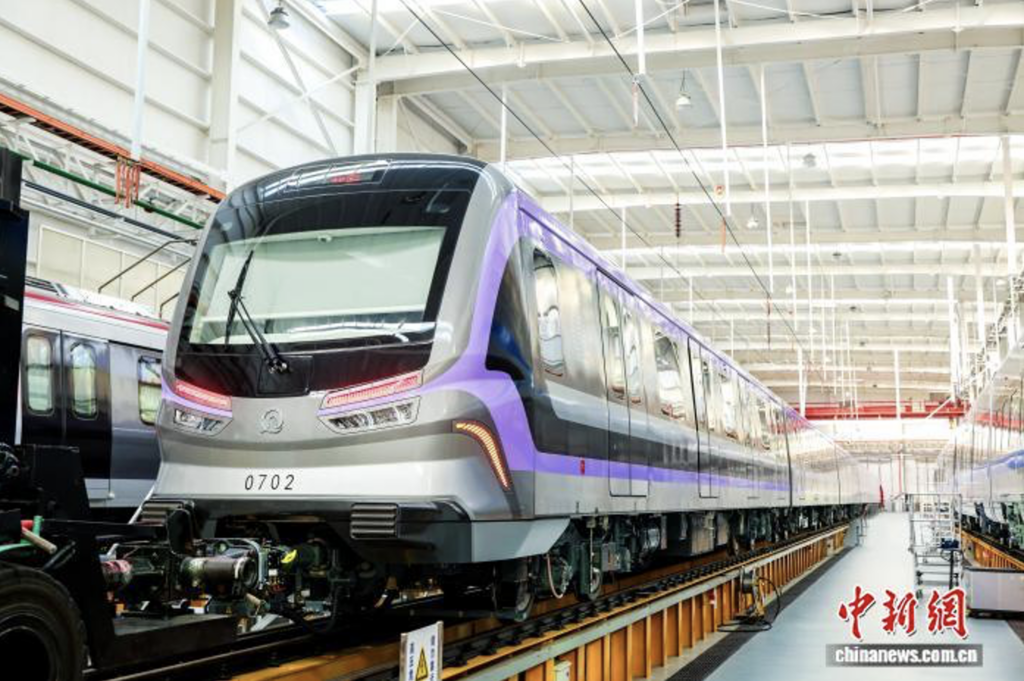
The first train for Qingdao Metro Line 7 rolled off the production line on the 12th in Chengyang District, Qingdao, Shandong Province. Featuring smart sensing, smart control, smart operation, and smart maintenance, the train serves as a prime example of advanced rail transit equipment powered by artificial intelligence (AI).

Developed jointly by CRRC Qingdao Sifang Co., Ltd. (“CRRC Sifang”) and the Qingdao Metro Group, this fully automated, smart train is built upon the standardized technical platform for Chinese subway rolling stock. It was designed specifically to meet the smart operation requirements of the Qingdao Metro system. The train has a maximum operating speed of 100 km/h, consists of a six-car configuration, and has a maximum passenger capacity of 1,862.

The train integrates “Zhuolun”—an industrial-grade large language model developed by CRRC. Leveraging AI-driven enhancements, the train achieves “GoA4” (Grade of Automation 4) fully automated operation.

In terms of smart sensing, the train is equipped with advanced “eyes” and an “AI brain.” The vehicle is equipped with over 2,600 monitoring and measurement points. By leveraging both an onboard high-performance computing platform and a ground-based computing center, a smart system that integrates sensing and computation has been established. This system collects real-time data on the vehicle’s status as well as its internal and external environment, utilizing AI algorithms to provide early warnings for potential malfunctions and to perform intelligent analysis of anomalies. Through advanced AI-powered video analysis, the system can intelligently identify irregularities—such as issues with doors, windows, or displays, as well as unusual passenger behavior—enabling a rapid response.

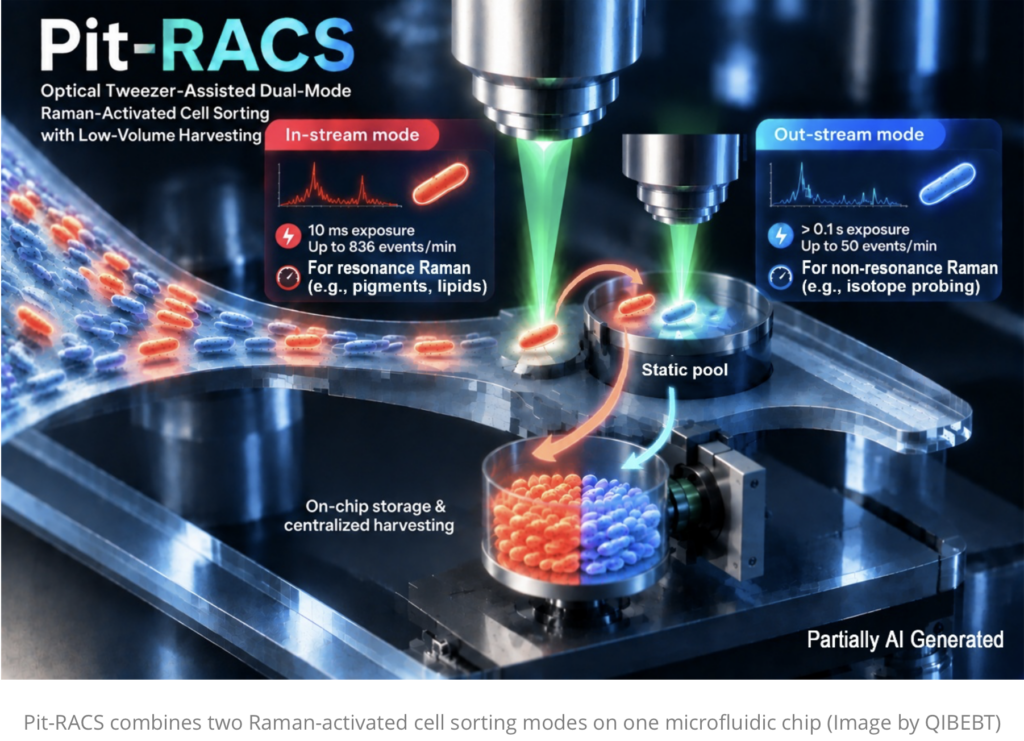
Researchers from the CAS Qingdao Institute of Bioenergy and Bioprocess Technology (QIBEBT), together with collaborators, have developed a Raman-activated cell sorting platform that combines rapid cell sorting with sensitive measurements of weak Raman signals and small-volume cell collection.

Called Pit-RACS, the optical-tweezer-assisted platform operates in two modes on the same microfluidic chip, allowing researchers to adjust the sorting strategy according to the strength of the Raman signal.

Raman-activated cell sorting can identify living cells by their chemical fingerprints without fluorescent labels. Yet researchers have faced a trade-off: fast, flowing systems struggle to measure weak Raman signals, while systems that allow longer measurements sort cells slowly. Collecting the selected cells in a large volume can also make subsequent experiments difficult.

According to the researchers, cells with strong resonance Raman signals are measured and sorted as they flow through the device. In this mode, they sorted up to 836 ± 1 events per minute with a 10-millisecond spectral acquisition time.

For weaker non-resonance signals, optical tweezers move individual cells into a cell-free buffer stream. This allows for longer measurements without interference from nearby cells. This method sorted approximately 50 cells per minute. Switching modes requires no hardware changes.

The platform can also temporarily store selected cells and release them together in approximately 10 microliters of liquid. In the reported tests, the collected cells were over 97% pure and could proceed to cultivation or genomic analysis without an additional concentration step.

“Raman signals vary greatly between biological targets. We designed the two modes so researchers can choose the measurement time their question requires while using the same sorting platform,” said Prof. MA Bo, corresponding author of the study.

To demonstrate industrial strain screening, the researchers sorted a mutant library of Yarrowia lipolytica and identified a strain with 77.4% higher β-carotene yield than the control. In another demonstration, they combined heavy-water labeling with Pit-RACS to enrich phosphate-solubilizing microorganisms from river water. They used the concentrated output directly for metagenomic sequencing, revealing 12 species of phosphate-solubilizing bacteria across nine genera.

Back to …