
https://www.cas.cn/syky/202611/t20261109_5123749.shtml
https://onlinelibrary.wiley.com/doi/10.1002/smll.76352
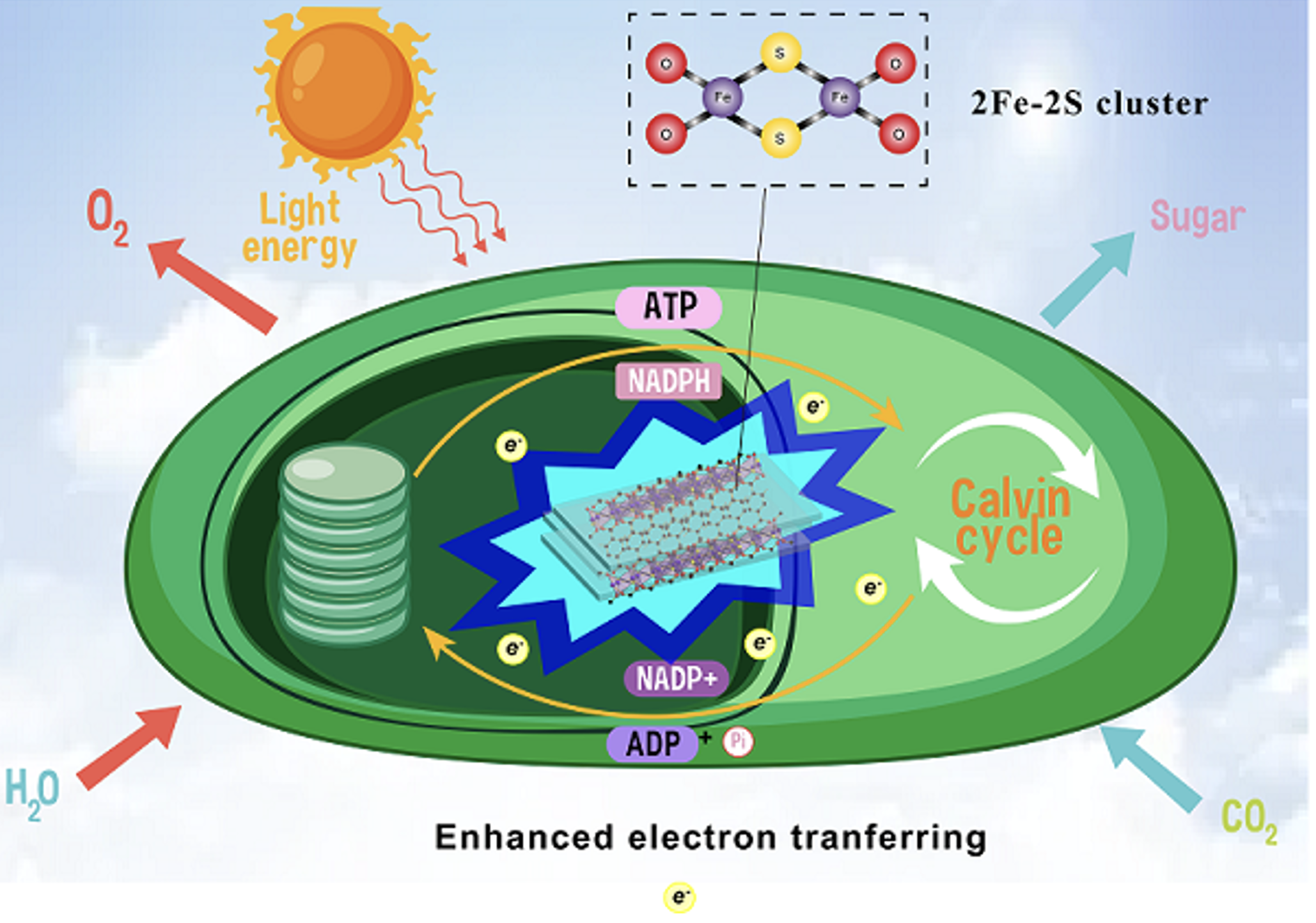
Using a hydrothermal synthesis strategy and terephthalic acid as a linking ligand, the research team successfully disrupted the dense, continuous lattice of iron and sulfur atoms found in conventional iron-sulfide minerals, resulting in a nanosheet-structured framework containing discrete Fe-S clusters. Various characterization techniques confirmed that this design establishes a structural link between condensed-phase iron-sulfide minerals and molecular-scale Fe-S clusters, offering a novel synthetic route for the stable construction of artificial Fe-S clusters. Research has revealed that OISF possesses excellent redox activity, oxygen stability, and electron-transfer capability. It can transfer electrons to a variety of electron acceptors, with its redox processes being tunable through chemical conditions. Structural analysis indicates that this electron-transfer mechanism is linked to the dynamic formation of S-S bonds within the independent iron-sulfur clusters located between the layers. Leveraging these properties, the research team integrated OISF with isolated chloroplasts to create an OISF-chloroplast composite system. Experiments demonstrated that this system exhibited a 1.54-fold increase in carbon-fixation activity over a 24-hour period compared to isolated chloroplasts alone. This suggests that the electron-transfer capacity of OISF may effectively interface with the electron-transport chain of the dark reactions, thereby promoting carbon assimilation via the Calvin cycle in chloroplasts. Furthermore, foliar application of OISF was shown to significantly enhance the growth of spinach, highlighting its potential as a novel type of nano-fertilizer.
Scheme: Schematic illustration of the construction of the organic iron-sulfur framework (OISF) and its role in promoting chloroplast dark reactions.