
https://j.people.com.cn/n3/2026/1111/c95952-20518077.html
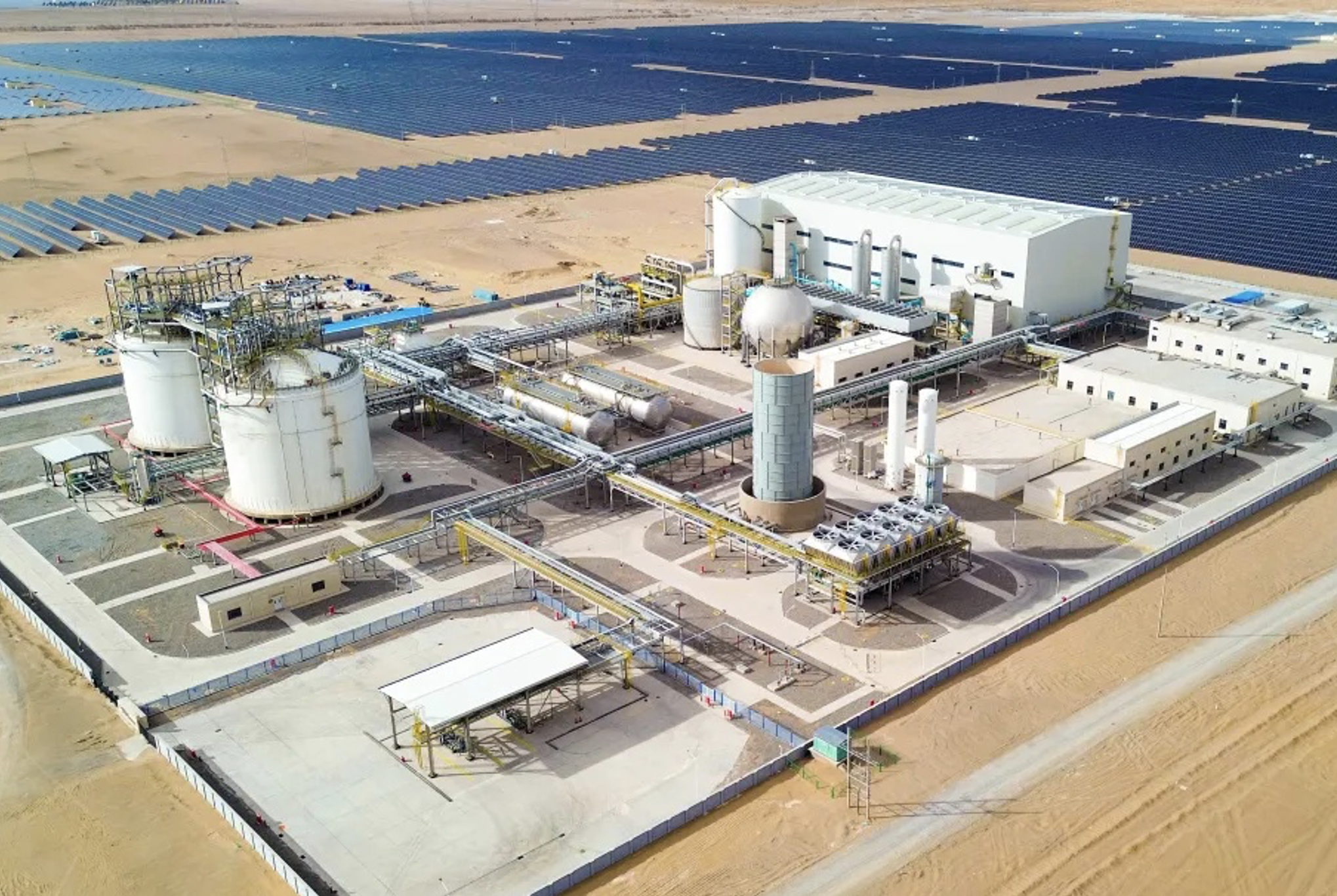
According to the China Green Development Investment Group Co., Ltd. (“China Green Development”), a 60-megawatt (MW) liquid-air energy storage national demonstration project—the largest of its kind in the world, invested in and constructed by the company—has been connected to the power grid and has begun generating electricity.
The project functions essentially as a massive “mobile battery” that utilizes liquid air for charging and discharging. The technology is backed by fully independent intellectual property rights, and the equipment is 100% domestically manufactured. Both its energy storage power output and capacity rank first globally in the field of liquid-air energy storage. The project fills several gaps in the practical application of large-scale liquid-air energy storage worldwide and provides a replicable model for the large-scale deployment of long-duration energy storage technologies in China, as well as for the development of a complete industrial supply chain.
Located in Golmud City, Qinghai Province, the project is a “new-type” energy storage demonstration initiative under the National Energy Administration and represents a key technological equipment breakthrough in the energy sector. It employs ultra-low-temperature liquefaction (at -194°C) as its core technology, using air as the working medium to store and release both electrical and thermal (cooling) energy under atmospheric pressure and cryogenic conditions. According to Li Bo, a project manager at the energy storage company China Green Development (CGD), the liquid-air energy storage project utilizes cryogenic, multi-stage thermal energy storage technology. During periods of low power grid demand, electricity is used to power compressors, which compress purified air into a high-pressure, high-temperature state. This air is then cooled via inter-stage heat exchangers, liquefied within a cooling unit, and stored in cryogenic tanks. Simultaneously, the thermal energy generated during the compression process is captured by a circulating water system and stored as hot water in high-pressure spherical tanks.
According to Li, during periods of peak electricity demand, the liquid air is pressurized and routed back into the cooling unit, where it is heated and vaporized by the stored thermal energy before being directed to a heat exchanger connected to an expansion turbine. At the same time, the air is further heated via a heat exchanger using the hot water stored in the high-pressure spherical tanks. The resulting high-pressure, high-temperature air is then expanded within the turbine, converting its energy to drive a generator and produce electricity. This power is stepped up to the appropriate voltage and fed into the grid, effectively shifting electricity from periods of low demand to times of high demand. This approach offers an effective solution to the challenges posed by the significant output fluctuations of wind and solar power, as well as the difficulty of consuming such energy locally.