
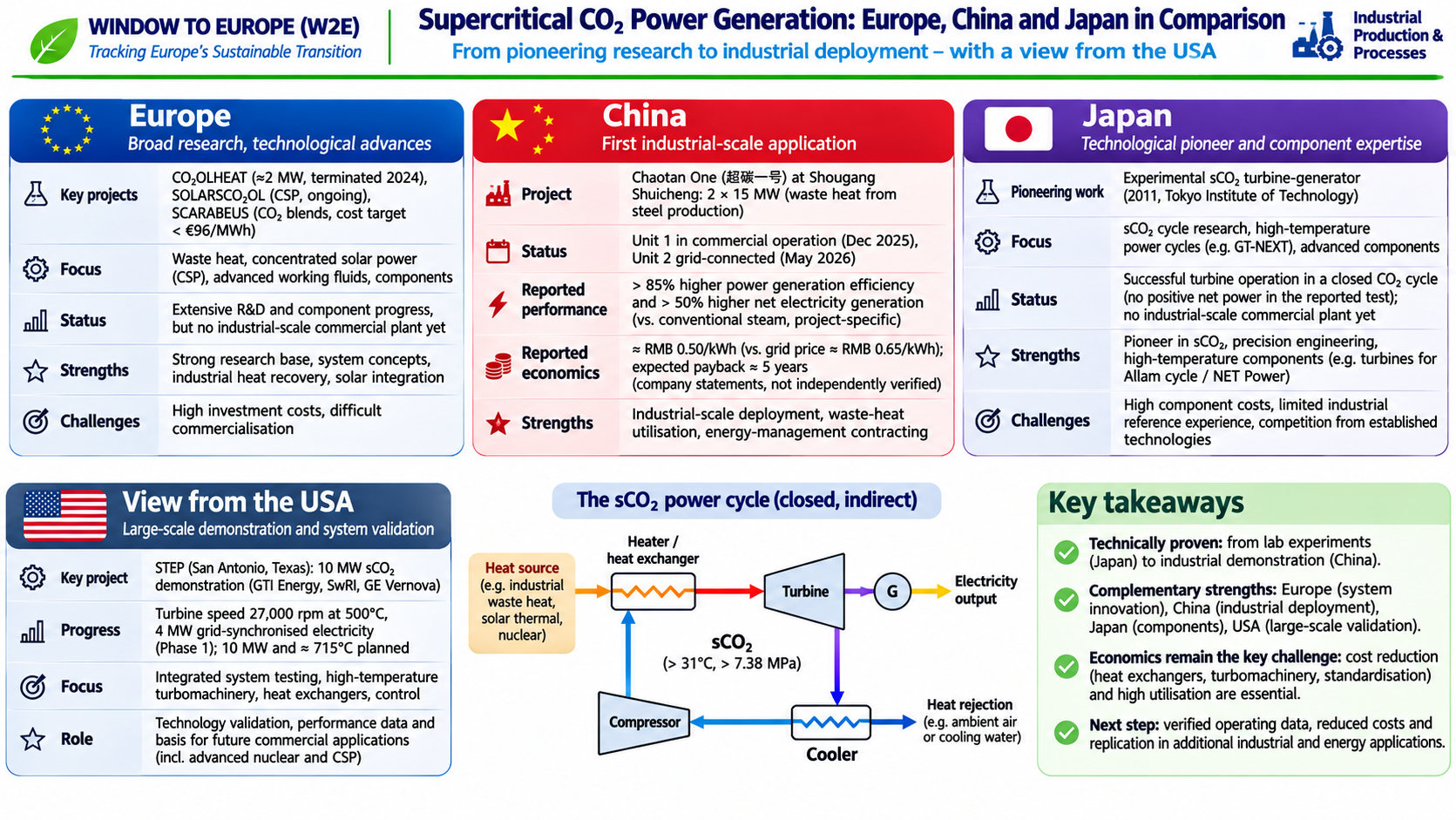
From pioneering research to industrial deployment – technology, economics and future prospects
In brief
Supercritical carbon dioxide (sCO₂) is emerging as a promising alternative to steam in advanced power generation systems. Japan demonstrated pioneering experimental turbine operation in 2011, Europe has developed innovative cycles for industrial waste heat and concentrated solar power, and China has now introduced the technology in an industrial-scale steelworks application. The United States is pursuing a major 10 MW demonstration programme.
The key question is no longer whether sCO₂ power generation is technically feasible, but whether it can become economically competitive with established technologies. [1–4]
Why supercritical CO₂?
Above its critical point of approximately 31°C and 7.38 MPa, carbon dioxide exhibits properties that make it an attractive working fluid for thermodynamic power cycles.
Its high density allows compact turbomachinery, while favourable compression characteristics can improve cycle efficiency. Compared with conventional steam systems, sCO₂ cycles may offer advantages in equipment size, operational flexibility and water consumption.
In the indirectly heated power cycles discussed here, CO₂ circulates in a closed system. It is not consumed as a fuel or converted into another chemical product. The environmental benefit comes from more efficient conversion of heat into electricity, particularly when using industrial waste heat or renewable thermal energy.
However, these advantages depend strongly on operating temperature, cycle configuration, heat exchanger performance and system costs. [5]
China: Industrial-scale demonstration
China has achieved an important milestone with the Chaotan One (超碳一号) project at Shougang Shuicheng Steel in Guizhou.
Developed by the Nuclear Power Institute of China, part of China National Nuclear Corporation (CNNC), together with Jigang International and Shougang Shuicheng, the project comprises two 15 MW sCO₂ power units recovering waste heat from steel production.
The first unit entered commercial operation in December 2025, and the second was connected to the grid in May 2026.
According to Shougang, the system improves power generation efficiency by more than 85% and net electricity generation by more than 50% compared with conventional sintering waste-heat steam technology. These are project-specific comparative figures, not the absolute thermal efficiency of the power cycle. [2, 6]
The project is particularly interesting from an economic perspective. Chinese reports indicate electricity generation costs of approximately RMB 0.50/kWh, compared with a reported grid electricity price of RMB 0.65/kWh for the steelworks.
Jigang International has also reportedly estimated a payback period of approximately five years.
These figures suggest promising economics, but they should be treated cautiously. Independently verified capital expenditure, comprehensive operating costs and long-term performance data are not yet publicly available.
An important feature is the project’s energy-management contracting model: Jigang International reportedly assumed responsibility for investment, construction and operation, while the steelworks provides the heat source and uses the electricity. [7, 8]
China’s achievement therefore combines technological demonstration with an industrial deployment model.
Europe: Advanced research, but difficult commercialisation
Europe has developed a broad research portfolio covering sCO₂ cycles, high-temperature components, industrial waste heat and concentrated solar power (CSP).
Three projects illustrate both the technological opportunities and the challenges.
CO2OLHEAT was designed to demonstrate an approximately 2 MW sCO₂ power system using industrial waste heat. However, the project was terminated in January 2024, illustrating the difficulty of bringing first-of-a-kind industrial systems to demonstration. [9]
SOLARSCO2OL aims to integrate a megawatt-scale sCO₂ power block into the La Africana solar thermal power plant in Spain. The concept combines solar thermal energy, thermal storage and flexible power generation. Its projected economic advantages still require confirmation through operating results. [10]
SCARABEUS, coordinated by Politecnico di Milano, explored an alternative approach: modifying the working fluid by blending CO₂ with selected additives.
The project investigated CO₂ mixtures suitable for high-temperature CSP applications and the potential to reduce power-cycle investment and operating costs. Its original economic target was electricity generation below €96/MWh, rather than a verified commercial electricity price. [11]
Germany contributes through research on turbomachinery, heat transfer, advanced cycles and thermal energy storage, including work at the University of Stuttgart and the German Aerospace Center (DLR). [12]
European techno-economic studies also highlight the challenge of competing with established steam systems.
A German techno-economic assessment published in 2026 reported that the investigated sCO₂ configurations for concentrated solar power had electricity generation costs at least 9% higher than the reference steam cycle. This finding illustrates that higher thermodynamic efficiency does not necessarily translate into lower electricity generation costs. [16]
Europe therefore has substantial technological expertise, but industrial-scale competitiveness remains to be demonstrated.
Japan: An early technological pioneer
Japan played an important role in reviving interest in sCO₂ power generation.
In 2011, researchers led by Motoaki Utamura at Tokyo Institute of Technology reported pioneering experimental turbine-generator operation using supercritical carbon dioxide.
The experiment demonstrated turbine operation in a closed CO₂ cycle. However, mechanical and electrical losses prevented positive net power generation in the reported test. The work nevertheless provided important experimental evidence for subsequent development. [1, 13]
Japanese industrial expertise also contributed to related technologies. Toshiba developed turbine components for the American NET Power project, based on the Allam cycle.
The Allam cycle uses CO₂ in a different, directly heated power generation process and should not be confused with the indirectly heated closed sCO₂ cycles discussed here. [14]
Japan has continued research into advanced high-temperature power cycles, including the GT-NEXT concept, which explores the potential of high-temperature gas-turbine systems for efficient power generation. [17]
Nevertheless, Japan has not yet demonstrated a comparable commercial industrial waste-heat installation at the scale of China’s Chaotan One project.
The reasons are not conclusively documented. High component costs, limited industrial reference experience and competition from established steam and organic Rankine cycle technologies are plausible factors.
Japan’s future contribution may therefore lie particularly in advanced components, precision engineering and high-efficiency thermal systems.
View from the USA
The United States is pursuing one of the most ambitious sCO₂ demonstration programmes.
The Supercritical Transformational Electric Power (STEP) project in San Antonio, Texas, led by GTI Energy together with Southwest Research Institute and GE Vernova, is designed to demonstrate an integrated 10 MW electric power cycle.
Supported by the US Department of Energy, the project validates high-temperature turbomachinery, heat exchangers, system control and operational performance.
In its first testing phase, the facility achieved a turbine speed of 27,000 rpm at 500°C and generated 4 MW of grid-synchronised electricity. The 10 MW output and operation at approximately 715°C represent subsequent programme objectives. [3, 4]
Unlike China’s industrial waste-heat project, STEP is primarily a flexible technology demonstration facility.
Its results should help establish the engineering and operating data required for future commercial applications.
The United States is also investigating sCO₂ cycles for advanced nuclear energy systems and concentrated solar power.
Economics: Where can costs fall?
Despite the technological progress, economic competitiveness remains the principal challenge.
The most important cost-reduction opportunities include:
- Heat exchangers: More compact, standardised and cost-effective high-pressure designs.
- Turbomachinery: Improved efficiency, manufacturing processes and component reliability.
- Cycle simplification: Avoiding additional compressors, heat exchangers and control systems where their efficiency benefits do not justify their costs.
- Standardisation: Repeated manufacture of proven modular systems instead of individually engineered demonstration plants.
- High utilisation: Continuous industrial waste heat offers more operating hours over which to recover capital costs.
European research on sCO₂ heat exchangers and the SCARABEUS programme identifies component design and cycle configuration as important cost factors. US STEP development similarly focuses on integrated performance and reliable operation. [5, 11, 15]
Regional advantages differ.
China currently benefits from large industrial applications and experience with full-scale demonstration. Japan has strengths in precision components and high-temperature engineering. Europe combines advanced research with substantial opportunities for industrial heat recovery and solar thermal integration. The United States contributes large-scale testing infrastructure and system validation.
There is, however, no universally applicable learning curve or reliable global forecast showing when sCO₂ electricity will become cheaper than conventional steam-based generation.
The answer will depend on the heat source, operating temperature, plant size and competing technologies.
Outlook
Supercritical CO₂ power generation has progressed from laboratory experiments to industrial demonstration.
Japan contributed important pioneering research. Europe has developed innovative working fluids, components and system concepts. The United States is validating integrated high-temperature power cycles. China has taken a significant step towards industrial application.
The next phase will be determined less by record efficiencies than by verified investment costs, operating reliability, maintenance requirements and electricity generation costs.
For Europe, industrial waste heat and the integration of sCO₂ cycles with thermal energy storage appear particularly promising.
China’s Chaotan One project offers an important reference point. Whether it marks the beginning of a broader commercial breakthrough will depend on transparent operating data and successful replication.
The decisive competition is shifting from thermodynamic performance to economically viable industrial deployment.
References
[1] Tokyo Institute of Technology (2011). Carbon dioxide: Supercritical power.
https://www.titech.ac.jp/english/news/2011/025711
[2] Shougang Group (2025). World’s first commercial supercritical CO₂ power generation unit begins operation at Shougang Shuicheng (Chinese).
https://www.shougang.com.cn/m1/sgyw/20251224/13936.html
[3] GTI Energy (2024). STEP Demo Pilot Achieves Phase 1 Testing Milestone.
https://www.gti.energy/step-demo/achieves-phase-1-testing-milestone/
[4] Southwest Research Institute. Supercritical Transformational Electric Power Pilot Plant.
https://www.swri.org/markets/energy-environment/power-generation-utilities/advanced-power-systems/supercritical-transformational-electric-power-pilot-plant
[5] GTI Energy. STEP Demo Technology.
https://www.gti.energy/step-demo/step-demo-project/technology/
[6] CNNC (2025). Supercritical CO₂ power generation demonstration at Shougang Shuicheng.
https://en.cnnc.com.cn/2025-12/31/c_1152376.htm
[7] Dazhong Daily (2026). Jigang International and the industrial application of supercritical CO₂ power generation(Chinese).
https://www.sdxc.gov.cn/sy/jrywsy/202601/t20260124_17351951.htm
[8] Shougang Group (2026). Corporate reporting on the Chaotan One project and its energy-management contracting model. Specific report dated 8 January 2026; direct article URL still to be verified.
[9] European Commission, CORDIS. CO2OLHEAT – Project results, Grant Agreement 101022831.
https://cordis.europa.eu/project/id/101022831/results
[10] SOLARSCO2OL Consortium. Project objectives and demonstration concept.
https://www.solarsco2ol-project.eu/
[11]