
https://www.cas.cn/cm/202611/t20261104_5123462.shtml
At 7.38 megapascals (MPa) and 31.0 degrees Celsius, carbon dioxide enters a state where the distinction between liquid and gas vanishes, allowing it to flow with both high density and low viscosity. Leveraging these unique properties, the use of supercritical carbon dioxide (sCO2) as a working fluid—replacing water vapor—has become a major focus of international research in power generation.
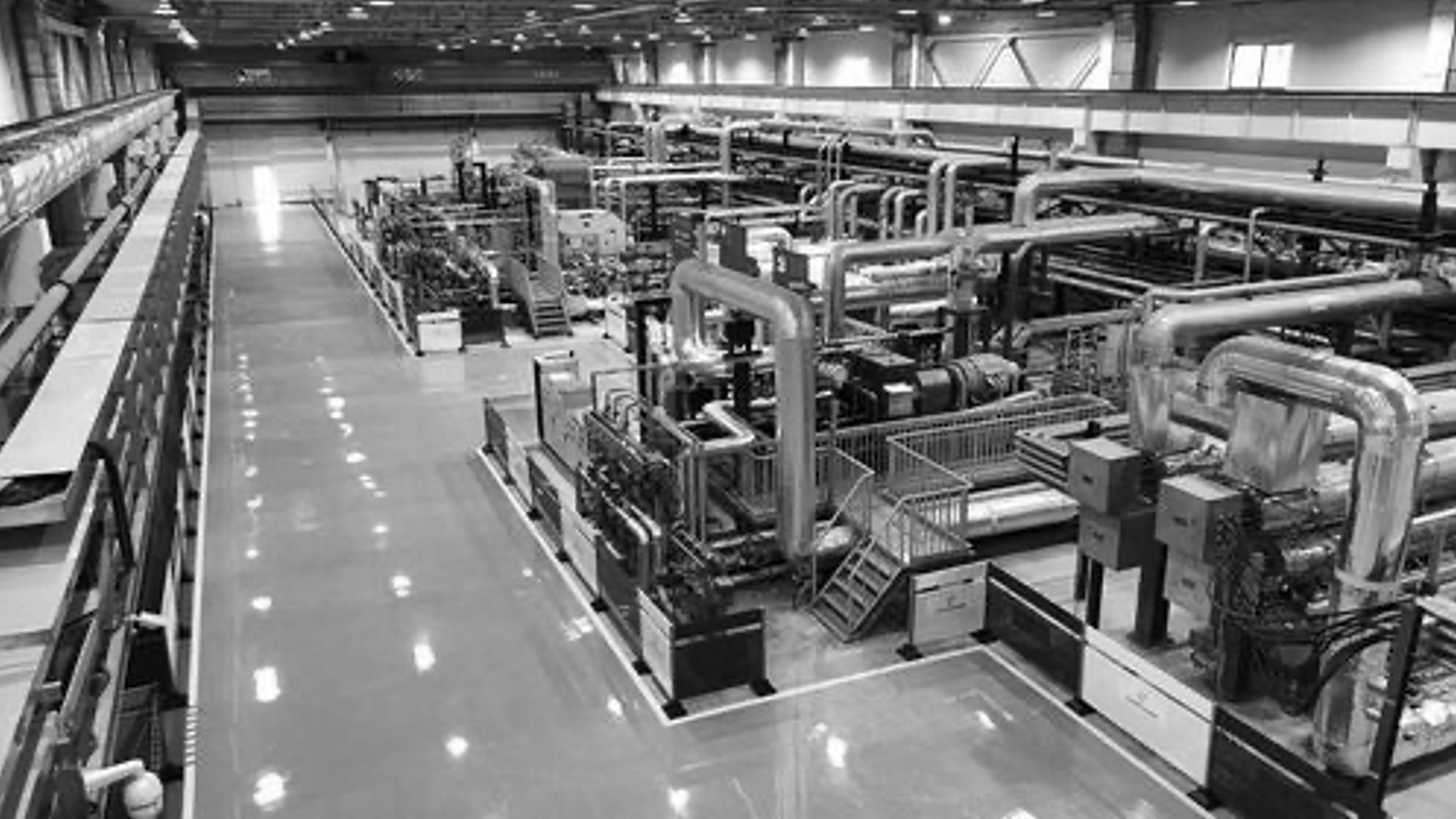
Recently, China’s first high-parameter, multi-functional, megawatt-scale low-carbon supercritical carbon dioxide cycle test system was completed and successfully passed inspection at the Shanghai base of the CAS Institute of Engineering Thermophysics (IET). The facility is now open to universities, research institutes, and enterprises across China. Performance testing by an authoritative third-party organization confirmed that the system, operating at 24 MPa and 600°C, achieved a power output of 2.28 megawatts (MW) with a power-generation efficiency of 32.05%—the highest efficiency publicly reported anywhere in the world to date.
The “Fourth State”: A Power-Generation Logic Without Boiling Water
A supercritical state can be understood as a “fourth state” of matter, distinct from the solid, liquid, and gaseous phases. When carbon dioxide enters a supercritical state, it is neither a liquid nor a gas; it possesses the high density of a liquid while maintaining the low viscosity of a gas.
In traditional power plants, water is heated to its boiling point (100°C), and the resulting steam drives a turbine to generate electricity—this is the fundamental principle behind conventional power generation. Supercritical carbon dioxide (sCO2) does not undergo a “boiling–condensing–reboiling” phase transition, regardless of how much it is heated or cooled; its advantage lies in eliminating the complexities and energy losses associated with these intermediate processes.
Compared to traditional water vapor, using supercritical carbon dioxide as a working fluid for power generation represents a disruptive upgrade in power generation technology. Its strengths can be summarized as “compact, responsive, and highly efficient.
First, it allows for more compact equipment: due to its high energy density, an sCO2-based system can reduce the required footprint by more than half for the same power output. Second, it offers rapid response and broad adaptability; the system’s simple architecture allows for flexible start-up and shut-down, and it can be integrated with heat sources across a wide range of temperatures—from industrial waste heat and concentrated solar power to advanced nuclear energy. Third, it holds significant potential: theoretical calculations indicate that when the heat source temperature reaches 650°C or higher, the cycle efficiency can exceed 50%.
The concept of supercritical carbon dioxide power generation was first proposed in the 1960s, but it could not be implemented at the time due to limitations in materials and manufacturing capabilities. Interest was “reignited” in the early 21st century. In 2004, a research report from the Massachusetts Institute of Technology (MIT) systematically demonstrated the technology’s potential applications, including in the nuclear energy sector. Subsequently, in 2016, the U.S. Department of Energy invested heavily in a 10-megawatt-scale demonstration project, designed for high-temperature heat sources reaching 700°C. The European Union, Japan, and South Korea soon followed suit, sparking a global surge in research.
In China, foundational research in this field began around the time of the “11th Five-Year Plan,” but it initially faced practical challenges: there were virtually no off-the-shelf core components available domestically, and a lack of high-level technical validation platforms. To address these hurdles, a low-carbon supercritical carbon dioxide cycle test system was approved in 2018 as a key component of the “High-Efficiency and Low-Carbon Gas Turbine Test Facility”—a major national scientific and technological infrastructure project. Xu Xiang, deputy general director of this major national scientific and technological infrastructure project and director of the Energy and Power Research Center at the Institute of Engineering Thermophysics, stated: “To seize opportunities while starting from essentially the same baseline as others, we must pursue independent innovation—mastering the entire chain from design methodology to equipment manufacturing.”
Tackling the “Three Limits”
Supercritical carbon dioxide has a very ‘temperamental’ nature. While it boasts high density and excellent flow characteristics, its physical properties shift drastically near the critical point. Furthermore, the system requires significant heat recuperation, necessitating a larger heat-exchange surface area packed into a much smaller volume to ensure efficient heat transfer.
In their quest to approach the limits of the critical point, the team had to overcome a convergence of “three limits.”
The first is the heat-exchange limit. The team focused on the design and manufacturing of Printed Circuit Heat Exchangers (PCHE). This is a compact, highly efficient micro-channel heat exchanger—essentially built using the same logic as semiconductor chip fabrication, where intricate, tiny flow channels are “etched” into metal plates. By stacking hundreds of these etched metal core plates and welding them into a single, integrated unit, the team created a system capable of handling massive heat loads and high pressures within a compact volume, ensuring both safe operation and efficient heat exchange under extreme conditions.
The second is the rotational speed limit. The turbines and compressors operate at tens of thousands of revolutions per minute—several times faster than conventional steam turbines—posing entirely new challenges for rotor dynamics, bearings, and sealing systems. In particular, given the high carbon dioxide pressure, the absence of phase change, and the extremely stringent requirements for leakage control, the sealing materials must also provide a cooling function. To address this, the team developed a new algorithm for calculations and experimental verification, discovering that the cooling capacity required for the seals was far greater than what had previously been estimated based on empirical methods.
A third challenge lies in control limits. Wang Bo explains that near the critical point, the physical properties of the working fluid—such as its density—undergo drastic changes. This makes the compressor’s operating point prone to drifting; the slightest oversight could cause the system to enter an unstable region, such as experiencing “surge.” There was no existing precedent for how to operate the system safely while staying as close as possible to the critical line; the team had to rely on repeated trial-and-error experiments to eventually develop a comprehensive control strategy.
Through extensive testing and calculation—and by persisting despite repeated setbacks—the team has steadily moved closer to the “limit” they envisioned.
The 32.05% Benchmark: A Test of System Integration
The greatest hurdle for supercritical carbon dioxide (sCO2) power generation is not any single component, but rather the integration of the entire system. The processes of compression, expansion, recuperation, and cooling are like members of an orchestra; if even one instrument plays out of tune, the entire performance falls apart.
As the “conductor” of this orchestra, the 32.05% net power generation efficiency was measured during continuous, stable operation. This figure confirms the successful synergy across the entire design methodology, all core components, and the control strategies.
In a typical test rig, it is rare to have more than two non-standard (custom-designed) components. However, as an open, major public platform for scientific and technological infrastructure, this low-carbon sCO2 cycle test system must accommodate the diverse experimental conditions and modes required by various users. Consequently, almost every component lacked a pre-existing, mature design; each one had to be custom-engineered by the research team in collaboration with domestic manufacturers. The purpose of this test system is to validate the technology, ensure stable operation, and generate data. It serves to accumulate engineering experience for high-parameter, large-capacity commercial units—experience that is far more valuable than the raw numbers themselves.
Currently, on the global stage, the entire field is transitioning from experimental validation toward commercial demonstration. In recent years, the pace of development in China has accelerated significantly: in December 2021, a 5 MW test unit completed a 72-hour trial run; by December 2025, the first 15 MW commercial supercritical carbon dioxide (sCO2) power generation unit—utilizing waste heat recovery—was successfully put into operation in Liupanshui, Guizhou Province. The successful acceptance of this test system marks a critical milestone for China in the realm of system integration verification. Moving forward, efforts will focus on achieving “higher parameters, larger capacities, and greater integration,” with the ultimate goal of developing standardized, replicable products. Furthermore, in terms of practical application, the technology will be explored and demonstrated across various sectors—including advanced nuclear energy, concentrated solar power, industrial waste heat recovery, and energy storage—to ensure it flourishes in diverse operational environments.
Image: Low-carbon supercritical carbon dioxide (sCO2) cycle test system. Image provided by the CAS Institute of Engineering Thermophysics (IET)