
https://j.people.com.cn/n3/2026/1020/c95952-20510343.html
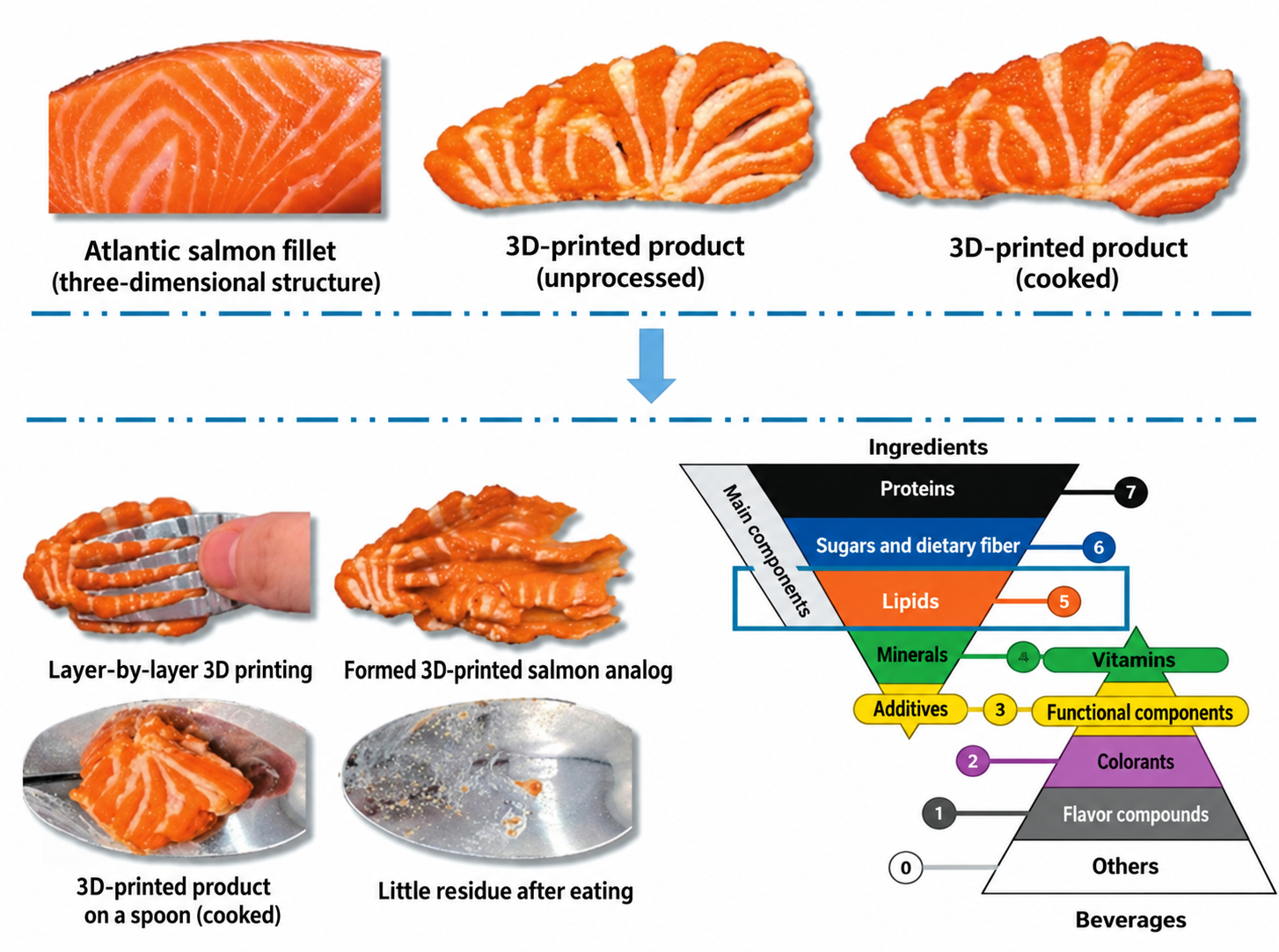
The Food Nutrition and Functional Food Innovation Team at the CAAS Institute of Food Science and Technology has developed a salmon alternative using a “dual-protein” modification method. By creating a multi-emulsion gel system—combining walnut protein and egg white protein—and utilizing extrusion-based 3D printing technology, the team has produced a protein-rich, easy-to-swallow salmon substitute.
The core advantage of 3D-printed food lies in the ability to precisely construct its shape and structure according to a specific design. The key to achieving such “intricate modeling” is the “ink” used in the printing process.
The research team employed a dual-protein approach. Walnut meal—a byproduct left over after extracting oil from walnuts—is an excellent source of plant-based protein, with a protein content reaching 45%. However, on its own, it lacks strong gelling properties, making it difficult to shape via 3D printing. To address this, the researchers introduced egg white protein. Egg white protein is highly effective at forming a stable gel network, acting as a “framework” into which the walnut protein can be integrated.
Using a 3D printer capable of handling two materials simultaneously, the team extruded protein-based “inks” in different colors. By combining a yellow-hued mixture (walnut protein and egg white protein) to simulate muscle tissue with a white-hued mixture (isolated soy protein and egg white protein) to simulate fat, they were able to accurately replicate the characteristic red-and-white striped pattern of salmon.
Flavor Is Key
Next, the researchers compared steaming with oven-baking. The results showed that samples prepared via baking contained significantly higher levels of key flavor compounds and were superior in terms of color, aroma, and ease of swallowing. Specifically, baking at 100°C for 3 minutes proved most effective, yielding the highest sensory evaluation scores. By adjusting the baking duration, the firmness of the food can be precisely controlled to meet international standards for dysphagia-friendly foods—specifically levels 5 and 6—thereby addressing the needs of elderly individuals with varying swallowing capabilities.
Testing by a specialized institution confirmed that this salmon alternative has a protein content of 22%. It features a soft, moist texture that holds together well without crumbling, fully satisfying the textural requirements for “safe-to-swallow” foods.