http://english.cas.cn/newsroom/research-news/202609/t20260907_1192699.shtml
https://bpspubs.onlinelibrary.wiley.com/doi/10.1111/bph.70631
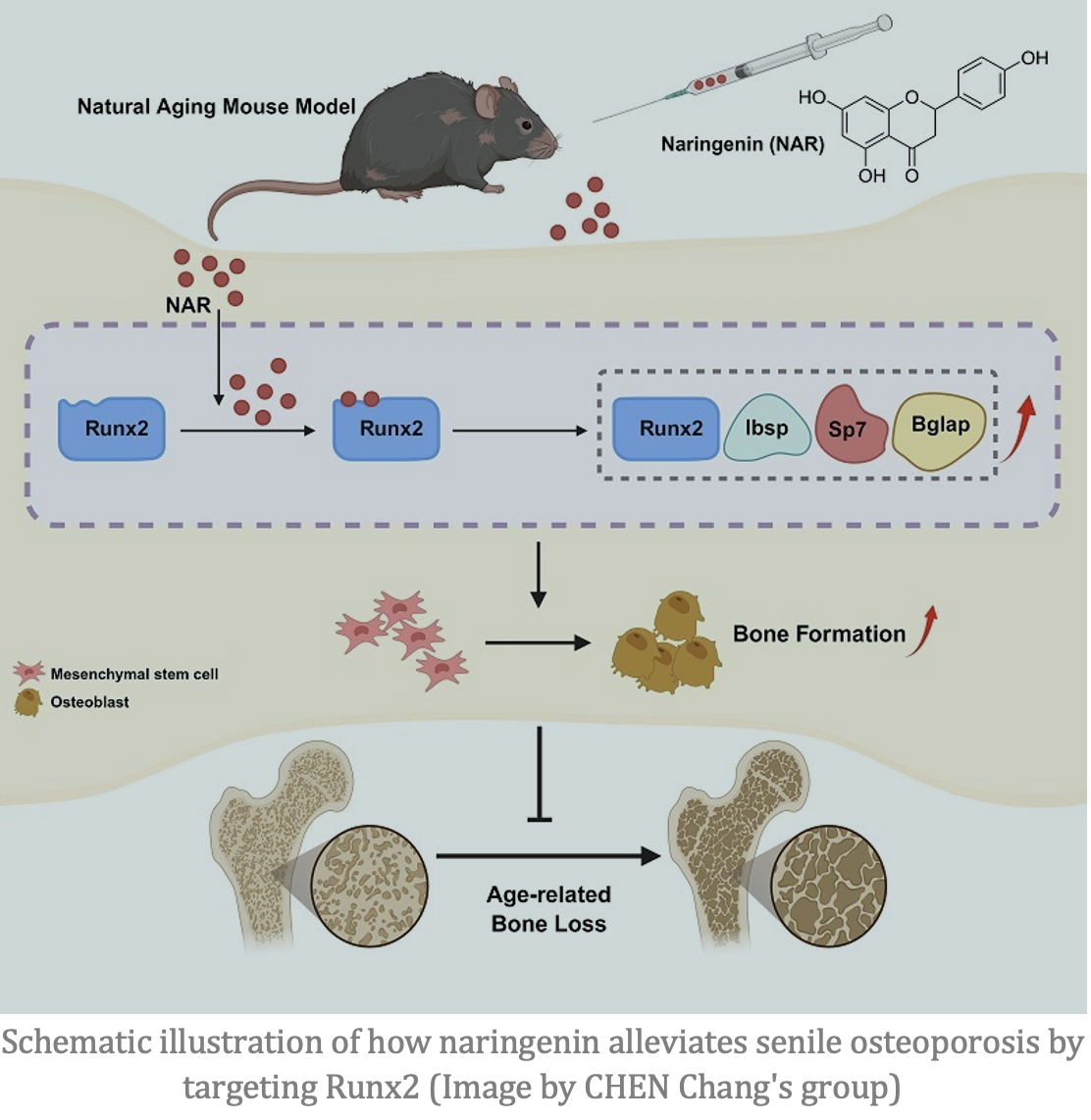
Prof. CHEN Chang at the CAS Institute of Biophysics and colleagues have identified the molecular mechanism by which naringenin, a naturally occurring dietary flavonoid, protects against age-related bone loss, suggesting its potential as a natural candidate for treating senile osteoporosis. They also identified Runx2, a key transcription factor in osteogenic differentiation, as a direct molecular target of naringenin.
Naringenin is a flavonoid derived from plants and commonly found in the diet. It is known for its anti-inflammatory, antioxidant, and metabolic regulatory activities. Previous studies have suggested that naringenin may benefit bone health, but its direct molecular targets and effects in age-related osteoporosis remained unclear.
Using a physiologically relevant natural aging mouse model, the researchers found that ndrigenin treatment significantly increased bone mineral density, preserved trabecular microarchitecture, and strengthened the skeleton. Histomorphometric analyses further showed that Naringenin accelerated the mineral apposition rate and bone formation while reducing osteoclast activity and bone resorption.
Similarly, Naringenin stimulated osteogenic differentiation and mineral deposition in cultured cells. These findings demonstrate that NAR exerts a dual action on bone remodeling by simultaneously enhancing bone formation and limiting bone resorption.
To elucidate the underlying mechanism, the researchers combined RNA interference, naringenin-biotin affinity pull-down and mass spectrometry with molecular docking and molecular dynamics simulations, surface plasmon resonance, drug affinity responsive target stability, and cellular thermal shift assays. The results showed that Naringenin interacts directly with Runx2 and promotes its osteogenic function.
These results reveal an unrecognized mechanism underlying naringenin’s skeletal effects and highlight this dietary flavonoid as a promising natural product for preventing and treating senile osteoporosis.