
http://english.cas.cn/newsroom/research-news/202609/t20260908_1192772.shtml
https://academic.oup.com/ismecommun/article/6/1/ycag211/8740006?searchresult=1
According to researchers from the researchers from the CAS Institute of Hydrobiology, China’s South-to-North Water Diversion Project maintains its edge through a mutually reinforced cycle with bacteria, whereas a short‑term dominant species lacks such a close partnership and is far less resilient.
Algae and bacteria engage in ubiquitous interactions—ranging from symbiosis to parasitism—that form one of the most fundamental ecological relationships. These interactions go beyond mere physical proximity, relying on sophisticated bidirectional chemical communication, material exchange, and signal transduction. Specific manifestations include coordinated nutrient exchange, mutual provision of growth factors, quorum sensing‑mediated signaling, and occasional predation or lysis of partners for resource acquisition.
Among algae, diatoms stand out as globally dominant primary producers, contributing about 20% of global primary production. Their distinctive bio‑silica frustules not only mediate the marine silicon cycle but also increase particulate organic carbon export through the tight coupling between the silica pump and the biological carbon pump, thereby influencing global climate regulation.
Conventional research has attributed diatom population dynamics primarily to abiotic conditions and the inherent physiological traits of diatoms themselves, while overlooking the phycosphere as a key modulator of diatom performance. The mechanisms by which specific diatom species maintain long‑term or transient dominance in phytoplankton communities remain poorly understood.
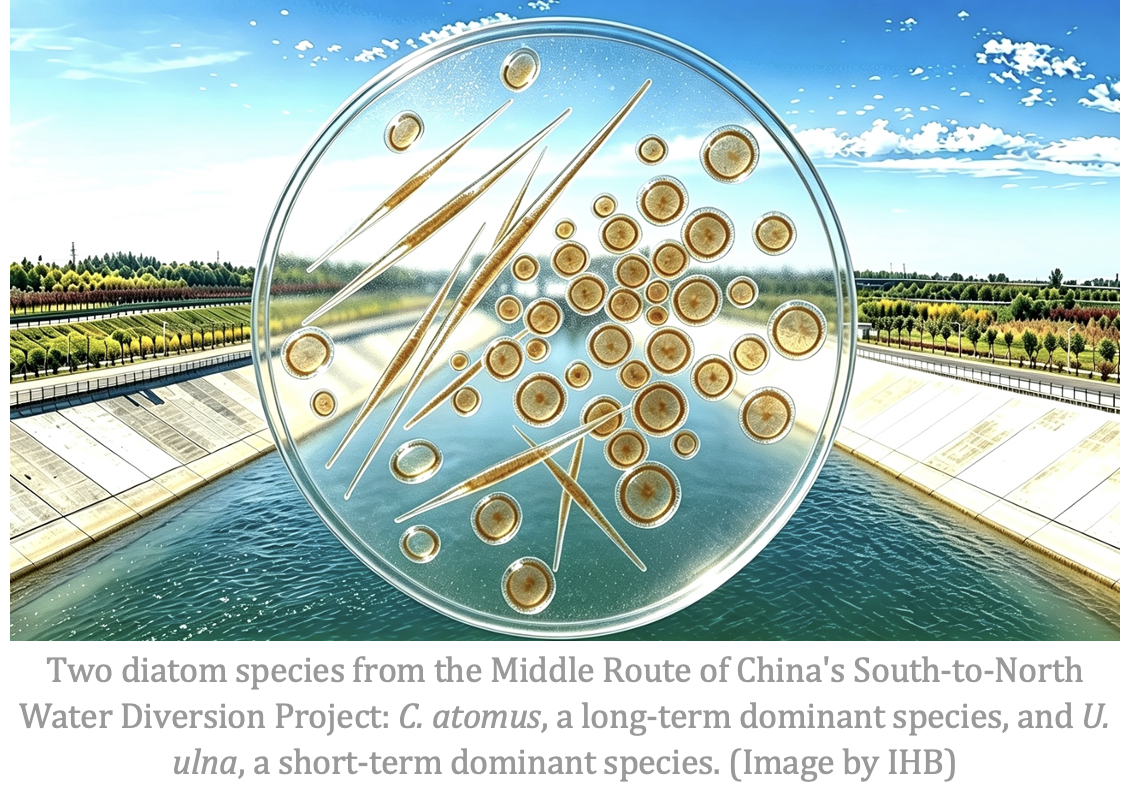
A research team led by Professor BI Yonghong from the IHB has isolated and purified two diatom species from the Middle Route of China’s South‑to‑North Water Diversion Project: Cyclotella atomus, a long‑term dominant species, and Ulnaria ulna, a short‑term dominant species. The team then characterized the community structure, interaction networks, and metabolic potential of their phycosphere‑associated microorganisms.