https://english.news.cn/20260813/860798b1c5e44b4e829ddbdf3a405242/c.html
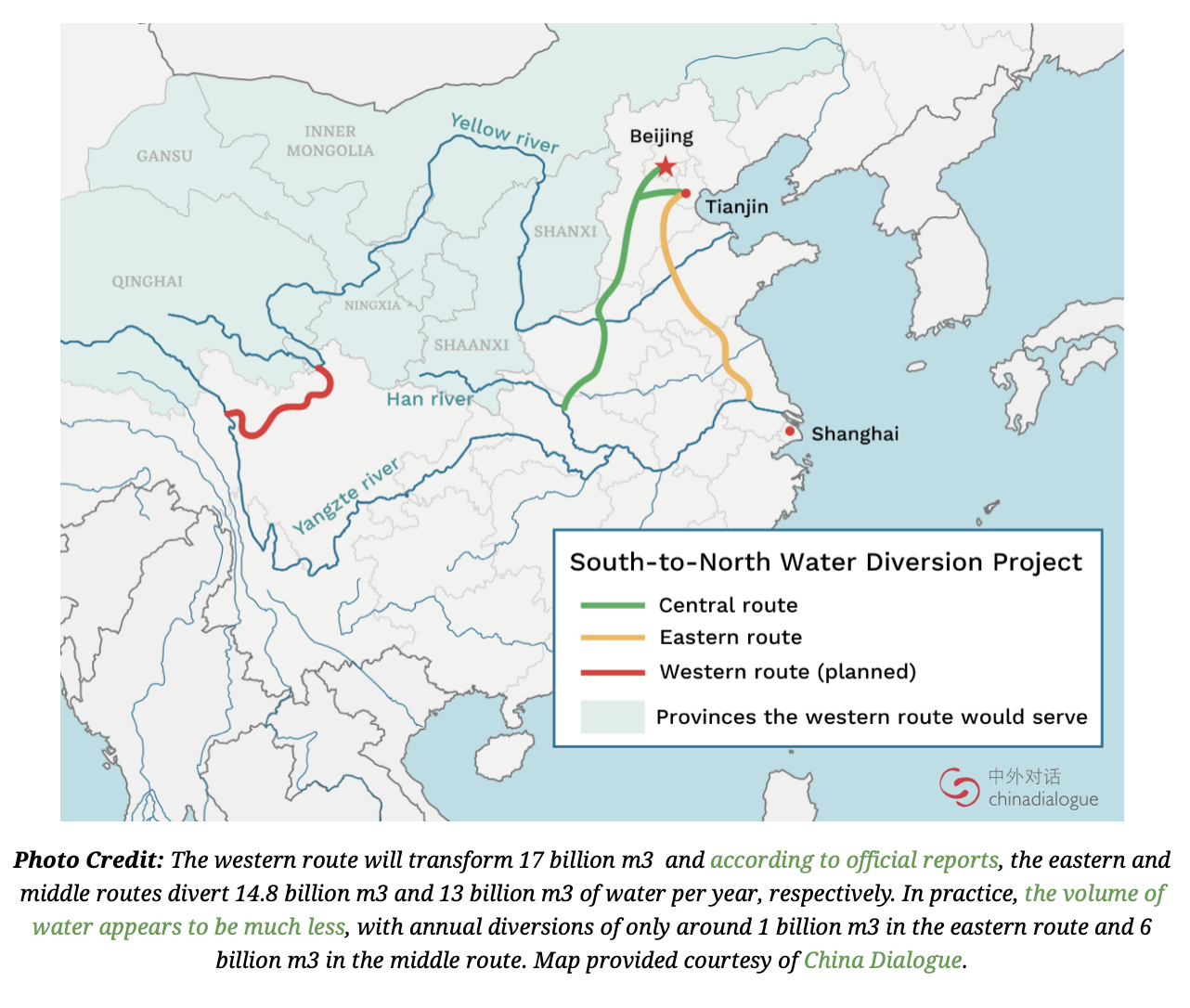
The mega South-to-North Water Diversion Project transports water over long distances from the country’s water-rich south to its northern regions, where hundreds of millions of people once faced “absolute water scarcity” as defined by United Nations standards. Designed with three routes, the project stretches across four of China’s major river basins: the Yangtze, Huaihe, Yellow and Haihe. The project’s middle route, the most prominent of the three as it supplies water to the Chinese capital Beijing, begins at the Danjiangkou Reservoir.
The Danjiangkou Reservoir is a primary source for China’s South-to-North Water Diversion Project, the largest in the world. It coordinates automatic monitoring stations on the ground and unmanned vessels on the water surface, as well as drones up in the skies and remote-sensing satellites in space to ensure comprehensive oversight of the reservoir’s water quality. Primarily located in central China’s Hubei Province, the reservoir supplies a large proportion of Beijing’s drinking water, traveling more than 1,200 kilometers north via the extensive water diversion project.
To date, 23 automatic water quality monitoring stations have been established to thoroughly examine water quality in the Danjiangkou Reservoir area and 16 major inflow rivers. At a monitoring station adjacent to the Taocha Canal Head, the starting point of the project’s middle route, multiple automated instruments operate quietly and efficiently. They continuously track 19 water quality indicators, including ammonia nitrogen, permanganate, total phosphorus, total nitrogen and heavy metals, as well as six meteorological readings. Water pumps automatically collect samples every four hours, generating six sets of monitoring data per day that are uploaded to the backend system in real time. If any anomalies arise, the sampling unit automatically preserves a retention sample in a tank for 24 hours, allowing laboratory staff to retrieve it for further testing.
Equipped with an online intelligent plankton monitoring system, the station channels water samples through pipes to an automated microscope, which captures images for algorithm-based analysis, displaying real-time algae density and species distribution on screen to facilitate the rapid identification of potential harmful algae proliferation. Nearby, transparent water tanks house small Chinese medaka fish, serving as a water quality biosafety early warning system. Sensors in the tanks monitor their swimming frequencies and movement trajectories in real time, a station worker said, explaining that changes in the fish’s physiological state can signal the presence of trace toxins in the water.
Along the reservoir shore, an eye-catching small orange unmanned vessel floats on the water. Equipped with an intelligent microscope and autonomous monitoring devices, it can obtain key indicators such as water temperature, pH levels and dissolved oxygen in real time.
In recent years, the middle route of the water diversion project has consistently maintained surface water quality at Class II or above. In the Danjiangkou Reservoir area, freshwater jellyfish, also known as the “panda in the water” for their extreme sensitivity to water quality, have been frequently spotted in recent years, serving as vivid testimony to the reservoir’s water quality.