https://www.cas.cn/syky/202608/t20260810_5118164.shtml
https://academic.oup.com/mbe/article/43/8/msag190/8747691
Pigs serve as important model animals for studying species evolution, complex traits, and human diseases. With the advancement of whole-genome sequencing technology, numerous genetic variants associated with domestication, economic traits, and diseases have been identified. However, many key regulatory variants reside in non-coding regions of the genome, making it difficult for traditional linear genome annotations to clearly identify their target genes.
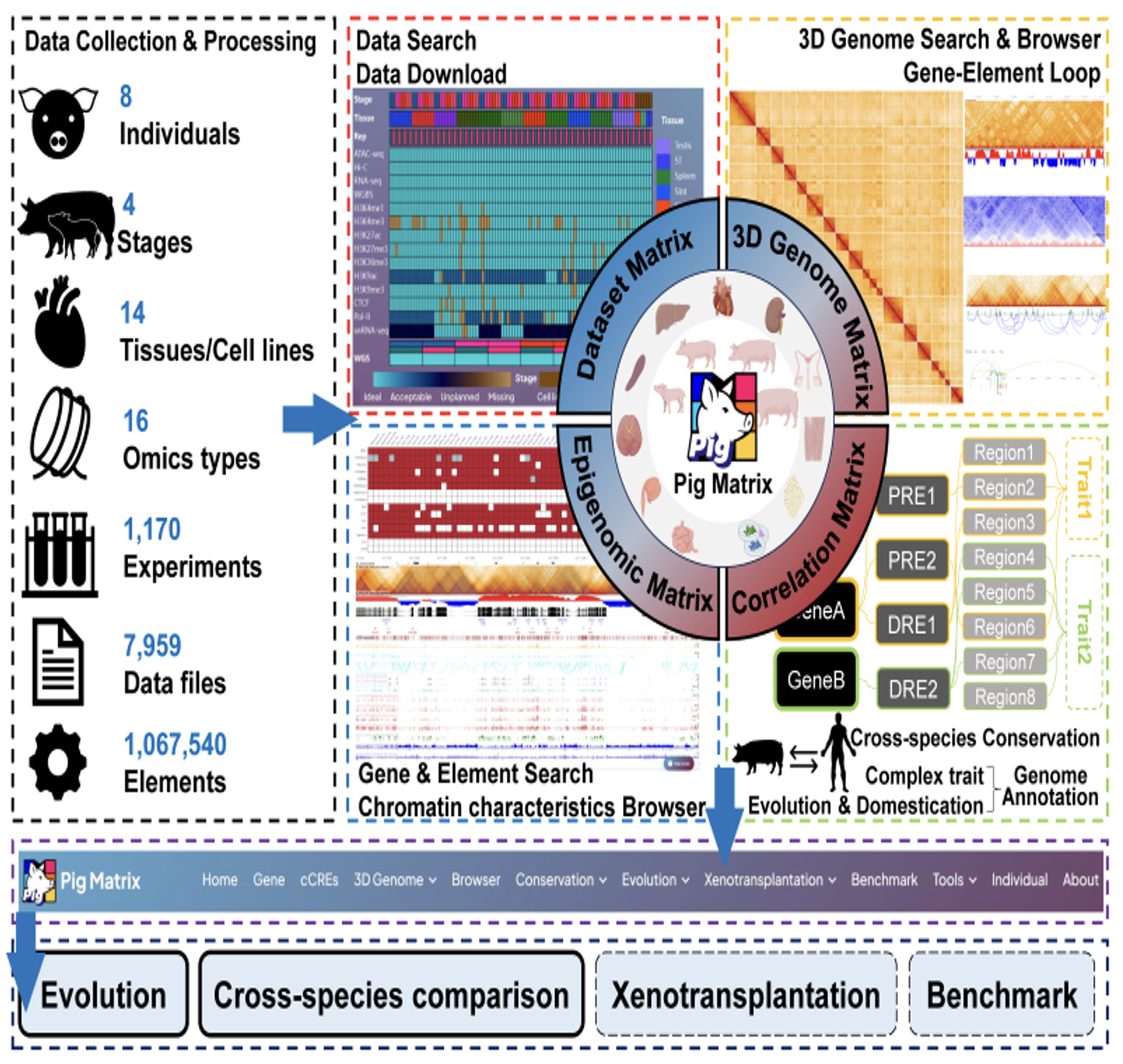
A research team—including scientists from the CAS Kunming Institute of Zoology has constructed “Pig Matrix,” a 3D regulatory genome database for domestic pigs. Based on matched multi-omics data generated under a unified experimental design, the database systematically integrates genomic, transcriptomic, epigenomic, and 3D genomic information. Pig Matrix incorporates 94 biological samples from eight domestic pigs with well-characterized genetic and phenotypic profiles, covering four developmental stages, eleven tissue types, and three commonly used porcine cell lines. The database integrates a total of 1,170 experimental datasets across 16 library types. Because the primary data stem from a unified sample system, experimental workflow, and analysis pipeline, Pig Matrix minimizes batch effects associated with diverse data sources, providing a reliable foundation for cross-omics integrative analysis.
By integrating data on chromatin accessibility, histone modifications, and 3D chromatin interactions, the database enables precise linking of candidate *cis*-regulatory elements to both proximal and distal target genes. Additionally, Pig Matrix features a built-in 3D epigenome browser and integrates resources such as signals of domestication selection, a pig-human comparative module, specialized xenotransplantation resources, and benchmark datasets for AI research.
The study establishes systematic associations linking genetic variants, regulatory elements, and 3D chromatin interactions to potential target genes. It provides a data foundation and analytical tools for research into domestic pig domestication and adaptive evolution, the genetic mechanisms of economic traits, pig-human comparative genomics, and xenotransplantation.