
https://j.people.com.cn/n3/2026/0729/c95952-20482907.html
With “drones” and “robots” included in the “No. 1 Central Document” of the 15. Five-Years Plan, new quality productive forces in agriculture are vigorously developing in rural areas, and digital technologies are shifting from concept to reality.
Shaanxi Province is one of China’s leading fruit-growing regions, accounting for approximately one-quarter of the nation’s total apple production. However, because many orchards are located in hilly or valley areas, introducing large-scale agricultural machinery is difficult, and rising labor costs have become a significant burden. For years, fruit harvesting relied primarily on manual labor.
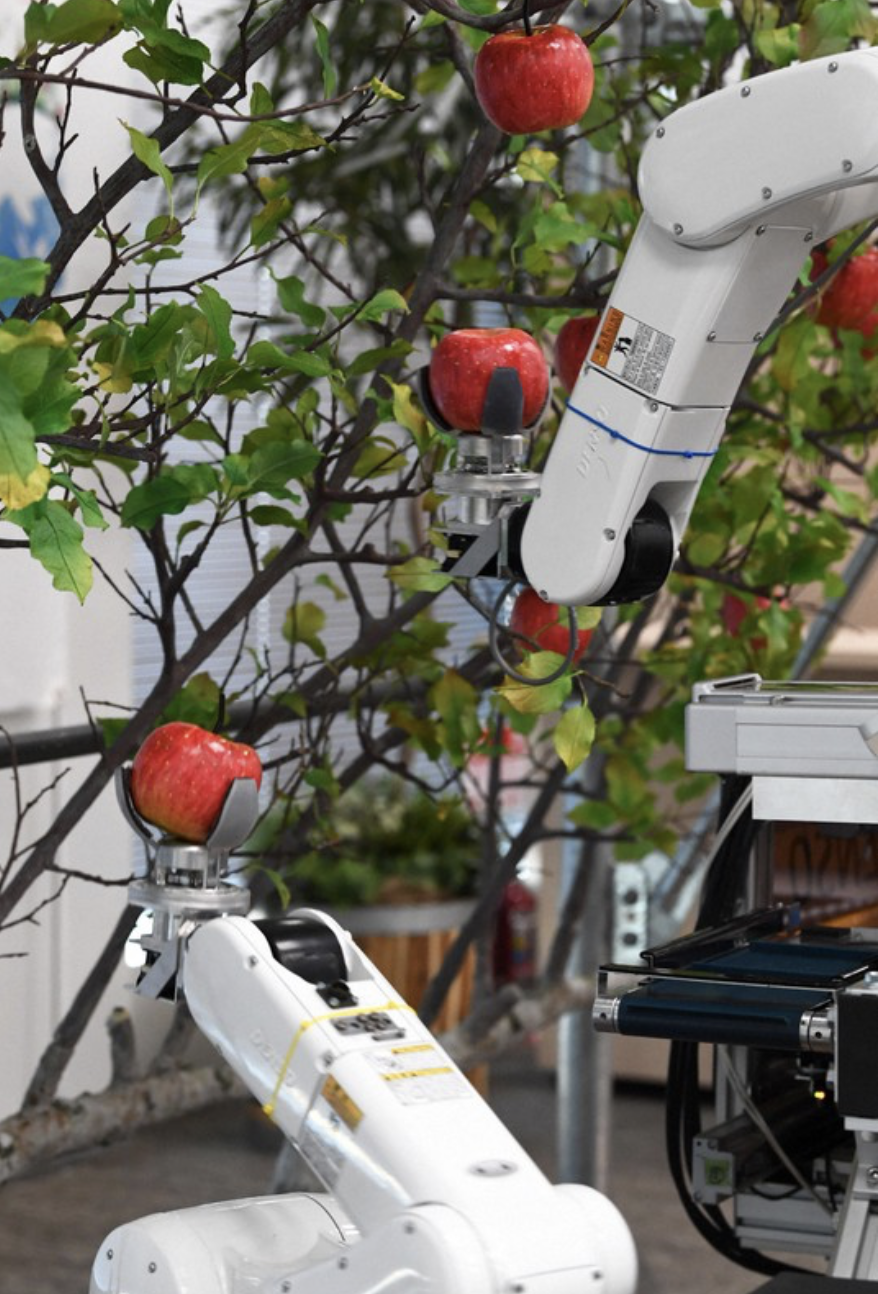
A research team led by Professor Yang Fuzeng of the College of Mechanical and Electronic Engineering at Northwest A&F University now developed a “twin” apple-harvesting robot system. It consists of two semi-humanoid robots—one large and one small—mounted on a shared crawler-type mobile platform. The taller “elder brother robot” harvests apples located more than 1.5 meters above the ground, while the shorter “younger brother robot” handles apples at lower levels. This coordinated teamwork between the “sibling robots” enables the harvesting of the entire fruit tree.
The “elder brother robot” features a robotic arm with more joints and greater flexibility, allowing it to perform harvesting tasks from various angles and postures while navigating around branches and foliage. Meanwhile, the “younger brother robot” utilizes a Cartesian-coordinate industrial robotic arm, offering a wider operating range and faster movement speeds. The key technology behind the “Twin” robot lies in the vision systems mounted on its head and robotic arms. These systems act as the robot’s “eyes,” scanning the shape of the fruit trees and the color and size of the fruit with high precision, then transmitting this information in real-time to the robot’s “brain.”
The robot’s “brain” uses algorithms to recognize and analyze images, identifying not only apple trees, branches, and fruit but also sorting out fruit damaged by pests or disease. It selects only high-quality apples and sends harvesting commands to the robotic arms. This sequence of “high-precision recognition, smart sorting, and flexible harvesting” technologies has enabled a shift from conventional “bulk harvesting” to “selective harvesting.”
According to the research team, the current “Twin” robot can harvest one apple in an average of 7.5 seconds. Once put into practical use, it is expected to harvest approximately 800 apples per hour. To cope with the complex environments of actual orchards, the team has conducted repeated tests in a facility replicating hilly terrain; they have achieved a maximum climbing angle of 15 degrees and continue to work on improving the robot’s ability to navigate over ditches and steps.
Demonstration trials conducted in orchards spanning over 33 hectares in Shaanxi Province have already showcased the vision of a three-dimensional, unmanned orchard. On the ground, inspection robots navigate the orchard to check for pests and disease and monitor harvesting progress. Additionally, two transport robots coordinate with the harvesting robot to rapidly move the picked fruit. Meanwhile, drones fly at low altitudes, using remote-sensing cameras to scan conditions on the ground.
Shaanxi Province is currently accelerating the adoption of smart breeding, digital twin orchards, and smart agricultural machinery designed for hilly and mountainous regions. New technologies—such as full-supply-chain big data management and green, low-carbon production methods—are being introduced to expand the coverage of smart orchards. In September 2024, the “Yan’an Apple Full-Mechanization Experimental Base”—China’s first facility of its kind—was established in Huangling County, Shaanxi Province. Planned and designed by Professor Yang’s team, the facility is implementing orchard robots across the entire production process, ranging from tilling and weeding to pesticide spraying, fruit bagging, and harvesting. In October 2025, “twin” robots conducted their first field demonstration in Huangling County, Yan’an City, showcasing the limitless potential of future orchards.