
https://www.cas.cn/syky/202607/t20260706_5114651.shtml
https://www.science.org/doi/10.1126/science.aee6277
High-fidelity geometric modeling of the physical world requires real-time, dense, and differentiable deformation fields on manifold surfaces. Neural Dynamical Systems (NDS)—based on a combination of adaptive step-size integration and embedded neural networks—can support this task but typically face latency issues in the range of hundreds of milliseconds.
Phase-change memory (PCM) is a promising emerging storage technology characterized by high speed, low power consumption, CMOS compatibility, and multi-state storage capabilities. The precise, controllable multi-state storage and conductance drift characteristics of PCM can serve as functional computational features for NDS; this enables high-density storage and highly parallel computing while maintaining high precision, thereby enhancing the efficiency of high-fidelity geometric modeling.
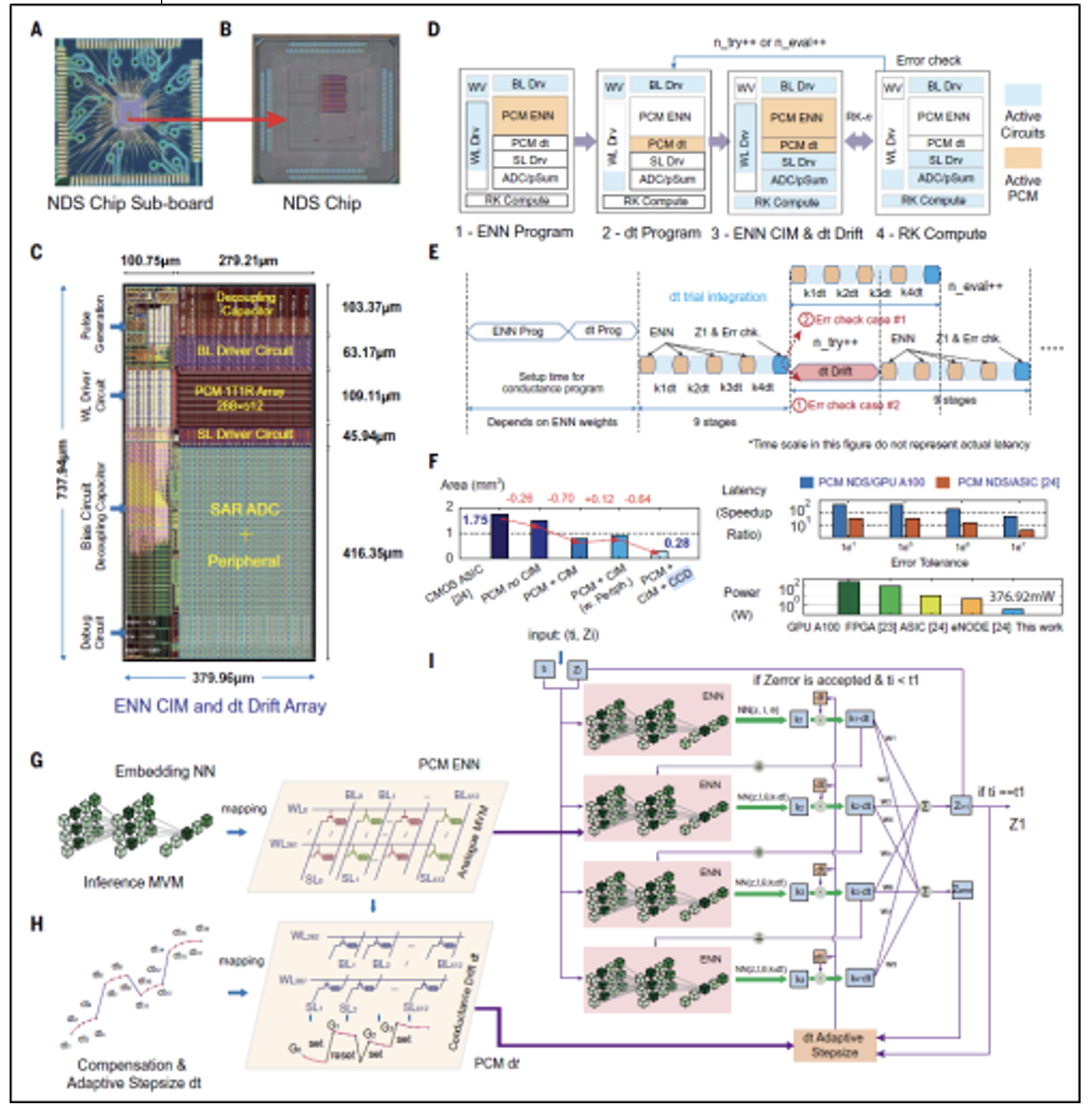
Recently, a research team including the CAS Shanghai Institute of Microsystem and Information Technology (SIMIT) developed a sub-10-millisecond in-memory computing chip for NDS by leveraging the precise, controllable conductance drift and multi-level in-memory computing capabilities of PCM.
The chip implements a greedy algorithm search function through a “SET-RESET-DRIFT” mapping scheme, bypassing the latency, area, and power overheads associated with frequent read/write operations, data buffering, and multiplication operations in traditional digital circuits. It utilizes 40nm 1T1R (one-transistor, one-resistor) phase-change cells for in-memory computing; the blade-shaped small electrode of the phase-change cell has a thickness of 3nm, the device yield exceeds 99.99999%, and the conductance allows for high-precision tuning across more than 16 levels.
Performance tests demonstrate that, at an error tolerance of 10⁻⁷, the chip achieves a single-iteration computation latency as low as 2.12 milliseconds. Compared to state-of-the-art dedicated NDS acceleration hardware, the chip delivers a 3.82 to 36.27-fold increase in computing speed and an 11.75 to 24.73-fold reduction in power consumption. In applications involving synchronized cerebral cortex surface reconstruction and 3D manifold mesh generation, the NDS system on this chip delivers overall performance 50.38 to 478.18 times higher than that of the industry-leading A100 GPU.