
https://j.people.com.cn/n3/2026/0622/c95952-20469351.html
The complex road infrastructure of Chongqing—a city set amidst mountains—shapes its unique traffic environment. At the same time, this environment serves as an ideal testing ground for evaluating the performance of smart connected vehicle technologies. In the challenging terrain of a mountainous city—characterized by steep gradients and complex topography—smart vehicles face issues such as limited sensing capabilities, positioning drift, signal attenuation, and unstable vehicle-following performance. Consequently, achieving “accurate perception, precise positioning, rapid decision-making, and stable driving” has become a critical challenge for the industry to solve.
The Chongqing Key Laboratory of Smart Connected Vehicles and Vehicle-Road Coordination, established primarily by Chongqing University of Posts and Telecommunications, is addressing these challenges. The laboratory focuses on areas such as reliable perception in complex traffic environments, high-precision positioning, safe and cooperative control, vehicle-road-cloud integration, and testing and verification, while continuing to conduct fundamental research and tackle core technical hurdles.
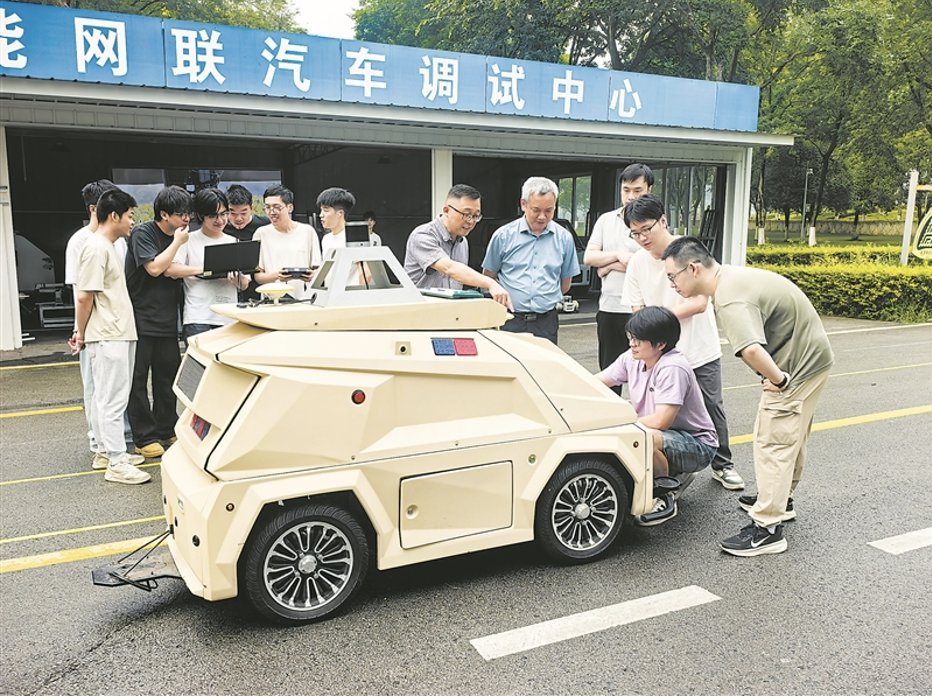
The laboratory’s 2,000-square-meter smart connected vehicle testing facility features a full range of road scenarios—including standard roadways, parking zones, gravel paths, and slopes—where various autonomous vehicles operate. Garages lining the track are neatly organized with experimental apparatus and equipment, where researchers conduct their studies and calibration work in an orderly manner. According to Li Yongfu, head of the laboratory and a professor at the College of Automation at Chongqing University of Posts and Telecommunications, conventional algorithms work well on flat terrain but fail in Chongqing’s landscape. Multi-level interchanges make route planning extremely complex. Furthermore, GPS signals are frequently interrupted by high-rise buildings, and continuous tunnels combined with steep slopes can instantly render vehicles reliant on optical sensors ‘blind.’ To promote the large-scale application of autonomous driving technology in mountainous cities, research must resolve core, fundamental challenges: maintaining safe, smooth, and efficient operation for smart connected vehicles amidst uncertain sensing, unstable positioning, communication latency, and frequent traffic disturbances.
Rather than rushing to modify the code, the laboratory’s researchers took a methodical approach to modeling. They began by examining the intricate interrelationships within the “vehicle-road-cloud-human-environment” system and conducted a deep analysis of vehicle behavior under complex disturbances. This process was akin to dissecting the city’s traffic system; it required not only identifying traffic bottlenecks but also understanding their root causes and grasping the interactions between vehicles at those locations.
Using an EV700 autonomous logistics vehicle—an L3 autonomous vehicle—conducted at the Chongqing Lianglu Cuntan Bonded Port Area, the researchers captured the autonomous logistics vehicle parking precisely at the cargo loading and unloading point—an impressive feat given that the bonded port area features visibility-blocking containers and poses significant challenges for satellite signal reception—demonstrating the vehicle’s exceptional operational stability and precision.
To date, the autonomous driving technology framework developed by the laboratory—which encompasses the full spectrum of sensing, positioning, decision-making, and control—has successfully passed comprehensive validation on actual open roads. Furthermore, they are providing reproducible and actionable technical solutions aimed at the large-scale adoption of autonomous driving in areas such as last-mile urban delivery, logistics within industrial parks, and port cargo transport.
Sudden changes in speed pose the greatest danger when driving in mountainous cities. On long downhill stretches or loop ramps, in particular, even slight braking by a lead vehicle causes a ripple effect that amplifies as it travels back through the convoy. This not only impacts traffic efficiency but also frequently leads to congestion. To address the driving challenges posed by the unique road conditions of mountainous cities, the laboratory’s research team is focusing on—and working to overcome—technical hurdles related to cooperative control for smart connected vehicle platoons.
This technology effectively equips every vehicle with a “predictive decision-making brain”; instead of waiting to see the brake lights of the vehicle ahead, following vehicles can accurately adjust their movements in advance based on shared driving status data.
To verify the technology’s practical viability, the laboratory’s researchers collaborated with entities such as Chongqing Changan Automobile Co., Ltd. and China Merchants Chongqing Communications Technology Research & Design Institute Co., Ltd. to conduct large-scale demonstration tests at the Chongqing Dianjiang Automotive Proving Ground and the Jinfeng Testing Base of China Merchants Vehicle Inspection & Testing Technology Research Institute Co., Ltd. The data demonstrated the technology’s value: when used during platoon driving involving smart connected vehicles from various brands and platforms, the technology reduced the frequency of braking events by approximately 60% in scenarios such as tunnels and steep gradients, while cutting overall energy consumption by about 6.5%.