https://doi.org/10.1016/j.cell.2026.05.042
https://www.cas.cn/cm/202606/t20260618_5112815.shtml
Sunlight fuels life but generates singlet oxygen (1O2), which causes photodamage and triggers signaling and antioxidative defense pathways in chloroplasts where photosynthesis takes place.
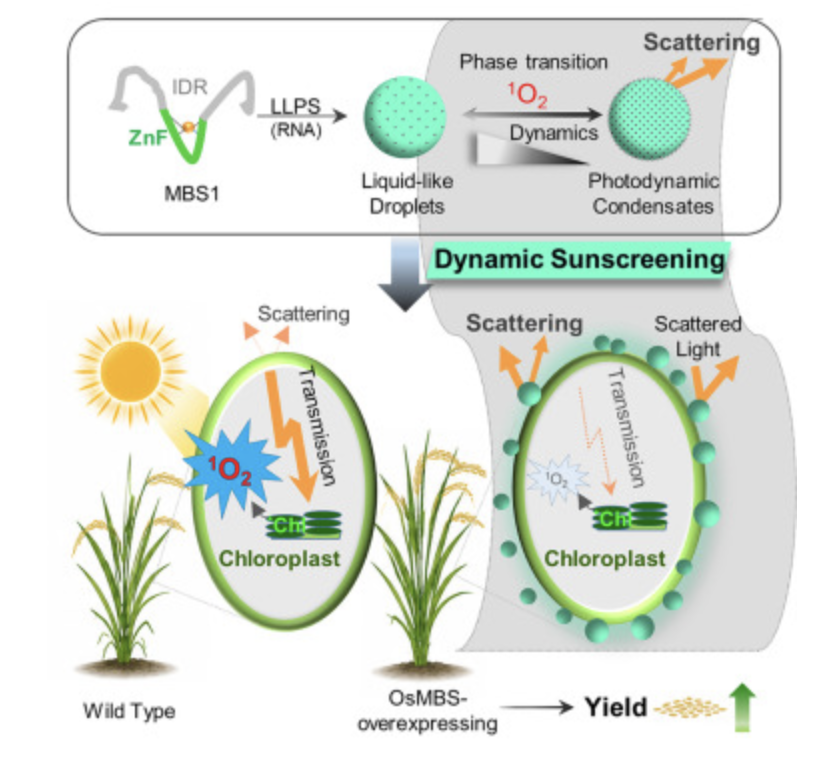
A team at the CAS Institute of Genetics and Developmental Biology has shown that a key mediator of 1O2 responses, METHYLENE BLUE SENSITIVITY1 (MBS1), is conserved from plants to animals and comprises a zinc-finger (ZnF) domain flanked by intrinsically disordered regions. MBS1 plays a critical role in ¹O₂ sensing through ZnF conformational change and phase transition from liquid-like droplets to lower-dynamic condensates. These chloroplast-associated condensates under high light attenuate light penetration to shield chloroplasts from photodamage.
In rice, MBS1-overexpressing lines exhibit enhanced high-light tolerance and yield in 4-year field trials.