https://j.people.com.cn/n3/2026/0528/c95952-20461419.html
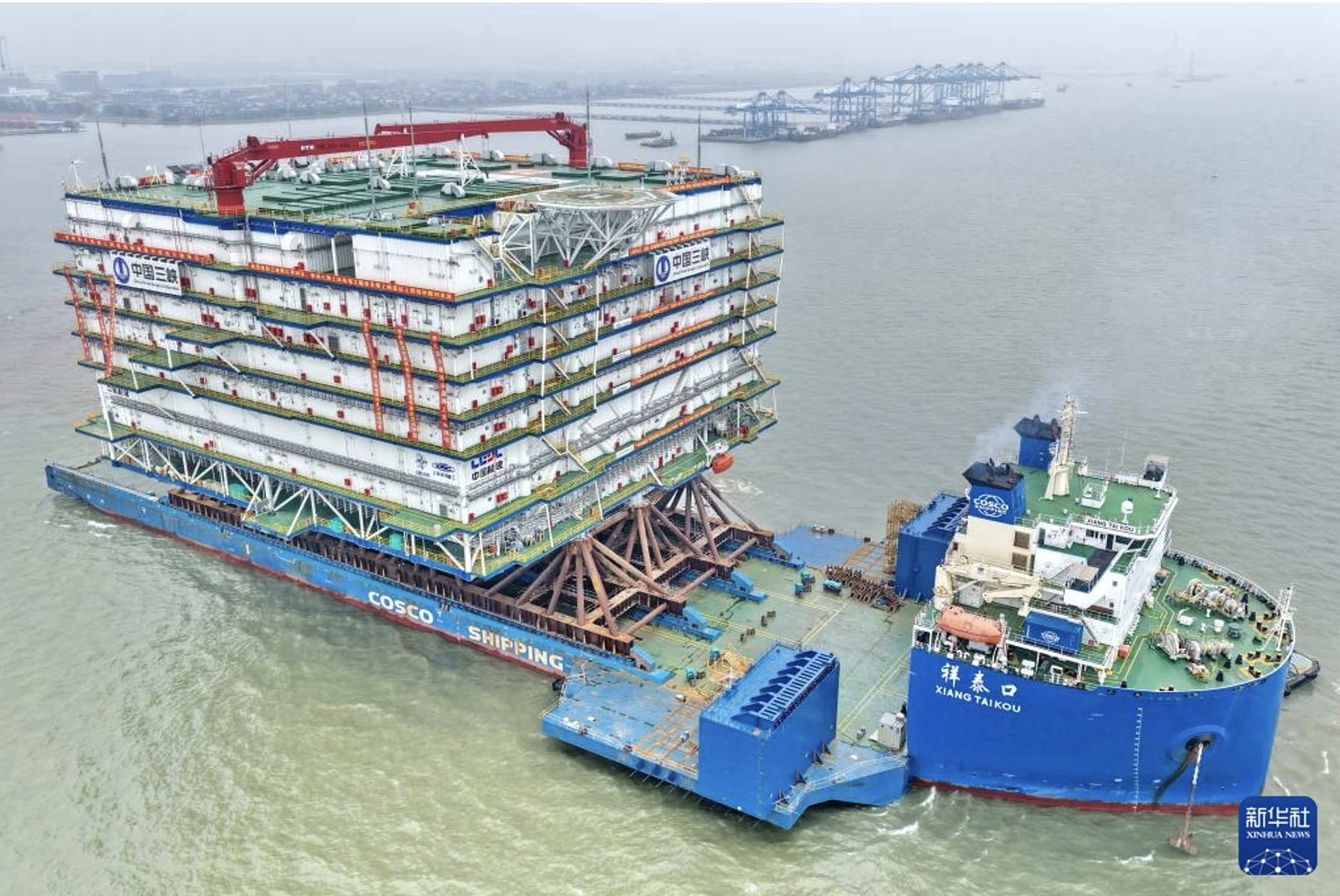
The “Heart of the Sea Wind”—the world’s largest offshore converter station—officially set sail on May 27 from Zhenhua Wharf in Nantong, Jiangsu Province, bound for its offshore installation site off the coast of Yangjiang, Guangdong Province.
The “Heart of the Sea Wind” is a flexible DC converter station designed for offshore wind power generation; it boasts the world’s highest voltage class and largest transmission capacity. Its departure and subsequent installation mark China’s entry into the era of ultra-high-voltage DC transmission for offshore wind power, providing a standardized and replicable technical solution for the development of deep-sea wind farms.
The “Heart of the Sea Wind” serves as the converter station for the CTG Yangjiang Qingzhou Phase 5 and Phase 7 offshore wind farms. Measuring 85.5 meters in length, 82.5 meters in width, and 44 meters in height, its footprint covers an area equivalent to a standard soccer field, while its height rivals that of a 15-story residential building. Its total weight reaches approximately 25,000 tons. The interior integrates a vast array of precision equipment—including electrical systems, HVAC and ventilation units, and fire safety apparatus—all designed to withstand the harsh environmental conditions unique to offshore settings, such as high-salinity mist and extreme humidity. To meet these challenges, the project team implemented extensive reinforcements and upgrades to the equipment, incorporating corrosion-resistant and seismic-resistant designs to ensure long-term, stable power generation capabilities in deep-sea environments.
Given that offshore wind farms are situated far from land, the efficient and stable transmission of generated electricity back to the shore remains a critical challenge in the development of deep-sea wind power resources. The “Heart of the Sea Breeze” serves as the “heart” of the entire offshore wind farm; by converting the 66-kilovolt (kV) alternating current generated by the wind turbines into ±500 kV high-voltage direct current—and utilizing flexible DC transmission technology—it enables the stable transmission of approximately 6 billion kilowatt-hours (kWh) of clean electricity annually to demand centers with significantly lower energy loss and higher efficiency.
According to the project schedule, the “Heart of the Sea Breeze” is expected to complete a voyage of approximately 1,090 nautical miles and arrive off the coast of Yangjiang, Guangdong Province—located over 70 kilometers offshore—in about one week. Once the Three Gorges Yangjiang Qingzhou Phase 5 and Phase 7 Offshore Wind Farms are fully completed, they will supply approximately 6 billion kWh of clean electricity annually to the Guangdong-Hong Kong-Macao Greater Bay Area (a cluster comprising nine cities—Guangzhou, Foshan, Zhaoqing, Shenzhen, Dongguan, Huizhou, Zhuhai, Zhongshan, and Jiangmen—along with the two Special Administrative Regions of Hong Kong and Macao). This contribution is equivalent to an annual reduction of approximately 4.93 million tons of carbon dioxide emissions.