https://www.cas.cn/syky/202604/t20260428_5108292.shtml
https://www.pnas.org/doi/10.1073/pnas.2532127123
Researchers at the CAS Suzhou Institute of Biomedical Engineering and Technology have discovered a significant correlation between sweat pH and sweat secretion rate, and the sweat secretion rate directly affects the dilution effect of glucose bypass transport in cells. Glucose oxidase activity exhibits a significant pH dependence. The team constructed a pH-assisted correction model to achieve dynamic compensation for changes in enzyme activity and the sweat dilution effect, and combined it with a two-point calibration method to establish an individualized prediction model, accurately converting sweat signals into blood glucose concentration.
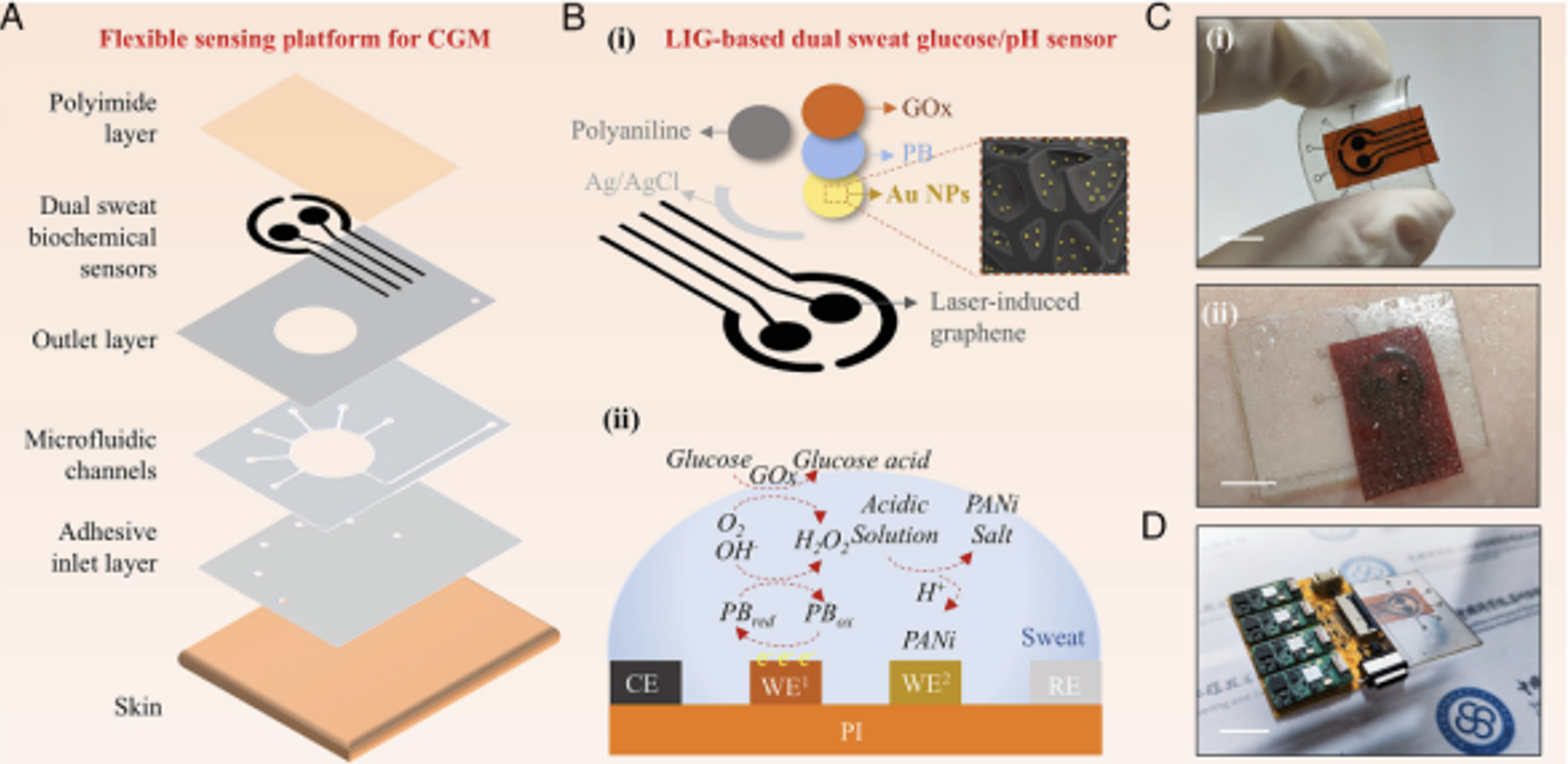
The team constructed porous electrodes based on laser-induced graphene and enhanced electrochemical activity by in-situ deposition of gold nanoparticles. They integrated a dual glucose and pH sensing unit, a microfluidic sweat collection structure, and a wireless data module to form a flexible monitoring system that can be attached to the skin. Exercise validation results showed that prediction accuracy was significantly improved after pH model correction.
This study is the first to systematically establish a dynamic correlation framework between sweat pH, secretion rate, and paraglucose cell transport during exercise, providing a feasible pathway for non-invasive continuous blood glucose monitoring in exercise scenarios. This strategy is also expected to be extended to the detection of other sweat biomarkers transported via paraglucose pathways, laying the foundation for the development of wearable non-invasive health monitoring technologies.
The relevant research results were published in the *Proceedings of the National Academy of Sciences of the United States of America* (PNAS). This research was supported by the National Natural Science Foundation of China and the International Partnership Program of the Chinese Academy of Sciences.