http://english.cas.cn/newsroom/research-news/202604/t20260428_1158214.shtml
https://www.pnas.org/doi/10.1073/pnas.2530496123
Researchers from the CAS Qingdao Institute of Bioenergy and Bioprocess Technology (QIBEBT) have identified a conserved ubiquitin-mediated regulatory mechanism that coordinates metabolic flux among multiple biosynthetic pathways in yeast.
Eukaryotic cells operate under constant resource constraints, requiring them to allocate limited carbon supplies among multiple biosynthetic processes. Pathways responsible for producing carotenoids, sterols, and lipids are particularly interconnected, as they rely on shared metabolic precursors. Yet how cells dynamically balance these competing demands has remained unclear.
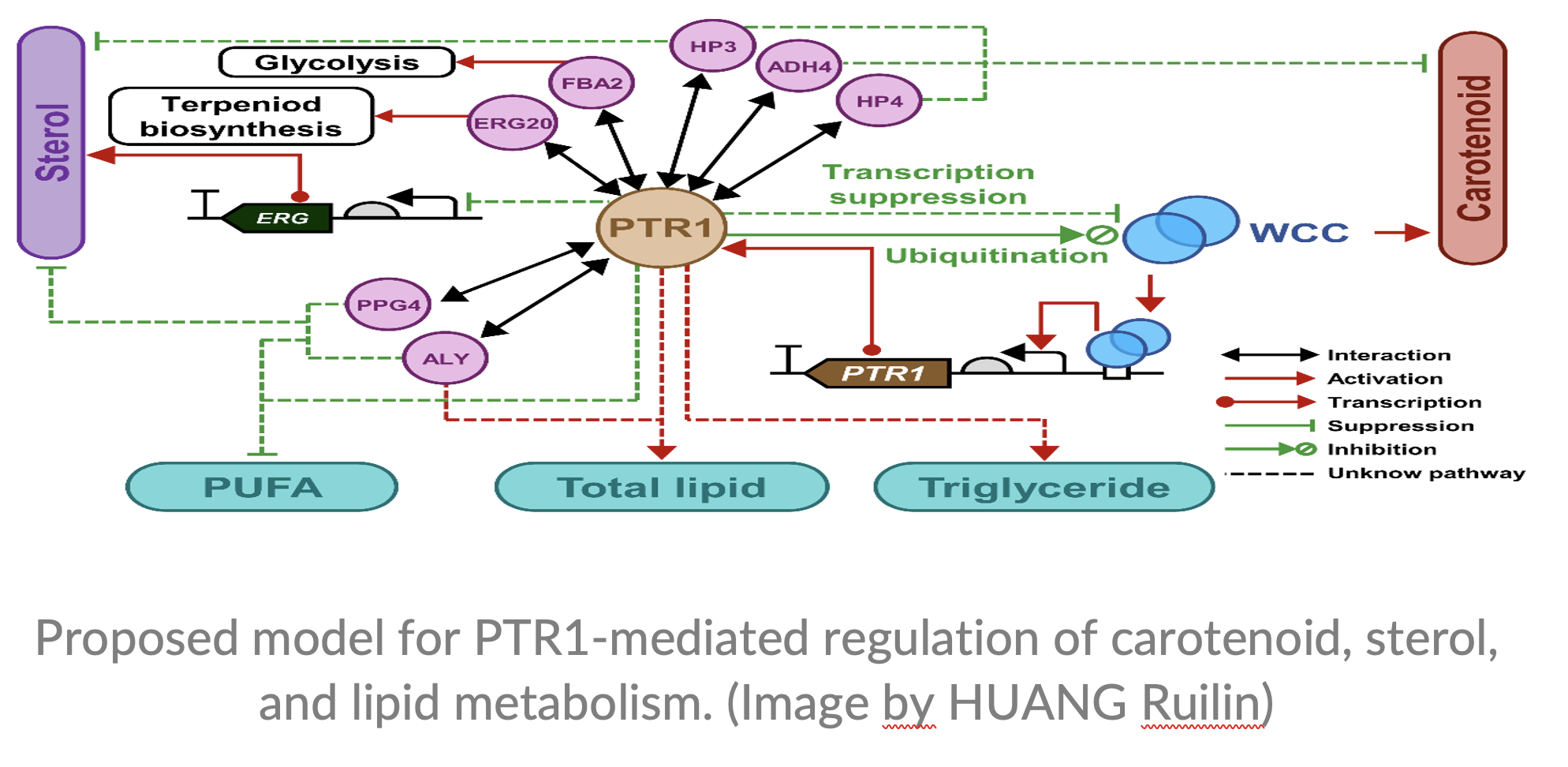
Using astaxanthin-producing Xanthophyllomyces dendrorhous yeast, the researchers identified an E3 ubiquitin ligase, PTR1, as a central regulatory hub that links carotenoid, sterol, and lipid metabolism. Further analysis revealed a PTR1-centered regulatory network that integrates these pathways. PTR1 modulates carotenoid biosynthesis through a reciprocal regulatory loop with the White Collar Complex (WCC), which is a key transcriptional regulator associated with carotenoid production. In addition, several PTR1-interacting proteins were identified, suggesting broader roles in fine-tuning sterol and lipid metabolism. Importantly, PTR1 homologs are conserved across diverse eukaryotic lineages, indicating that ubiquitin-mediated regulation represents an evolutionarily conserved strategy for coordinating metabolic networks.