https://en.people.cn/n3/2026/0306/c90000-20432629.html
https://www.science.org/doi/10.1126/science.adx9237
https://www.cas.cn/syky/202603/t20260306_5103484.shtml
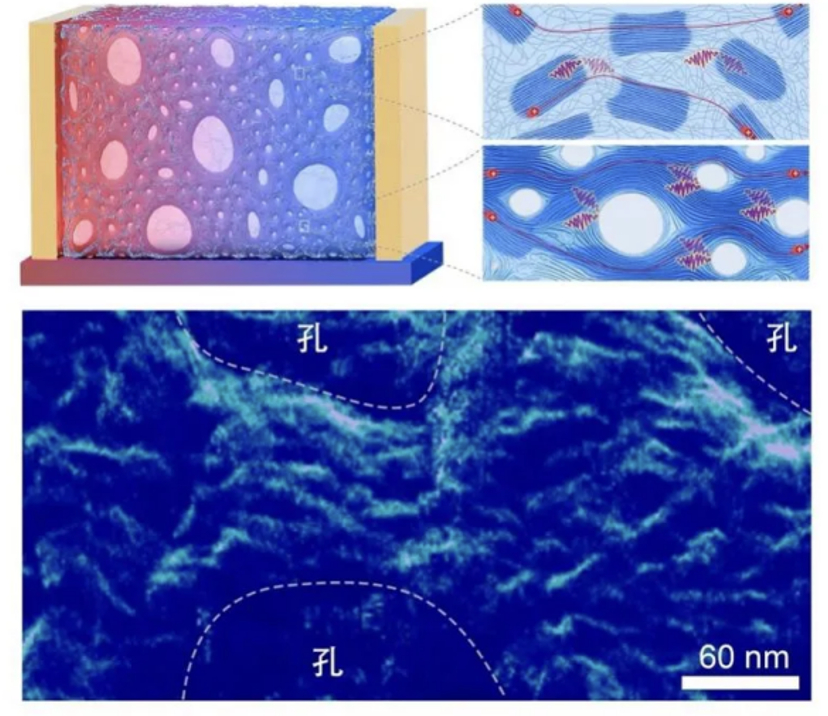
A research team from the CAS Institute of Chemistry and other institutions has developed a plastic thermoelectric film with an irregular multi-level porous structure as a key material support for wearable power generation devices, adhesive cooling, and IoT sensors.
The so-called irregular hierarchical-porous thermoelectric polymer (IHP-TEP) was built from a 70/30 blend of selenium-substituted diketopyrrolopyrrole (PDPPSe-12) with polystyrene which produced an interconnected pore network that ranges from 5.9 nm to 1.8 μm (porosity of 0.23 ± 0.01), with narrow throats (5.0 nm to 1.3 μm) packed with fiber-like domains that exhibit strong molecular orientation. It achieves a ZT value of 1.64 at 343 kelvin (about 70 degrees Celsius), establishing a new benchmark for flexible thermoelectric materials in this temperature range.
The unique structure of this new material significantly suppresses heat conduction and creates efficient charge-transport channels that are close to those of an ideal model in thermoelectric materials. The IHP-TEP film is also compatible with spray-coating technology, enabling large-area, low-cost manufacturing similar to newspaper printing.
The new material’s flexibility allows it to adhere to various curved surfaces, offering broad application prospects in wearable devices and the Internet of Things. For instance, it offers a power supply solution for sensors deployed in diverse environments. Wherever a temperature difference exists, whether on the human body, a building’s exterior or in the field, it can consistently power the sensors. The flexible nature of organic materials allows them to be adhered to various curved surfaces, greatly expanding their application scenarios. Unlike previous processes that required 100 repetitions to produce high-performance flexible thermoelectric materials, this new technology is compatible with spray coating processes—it can be as simple as painting, a one-time molding process, or it can be manufactured in large areas at low cost, like printing newspapers. In the future, this material may be woven into clothing fabrics, becoming a portable power source. For a long time, it was believed that synergistic regulation of electro-thermal transport was difficult to achieve in organic materials dominated by weak interactions. This research breaks through this limitation, propelling polymer thermoelectric materials into the realm of practical application.
According to statistics, more than 60% of global energy is lost annually as “waste heat,” and its effective recycling can bring enormous potential for energy conservation and emission reduction.