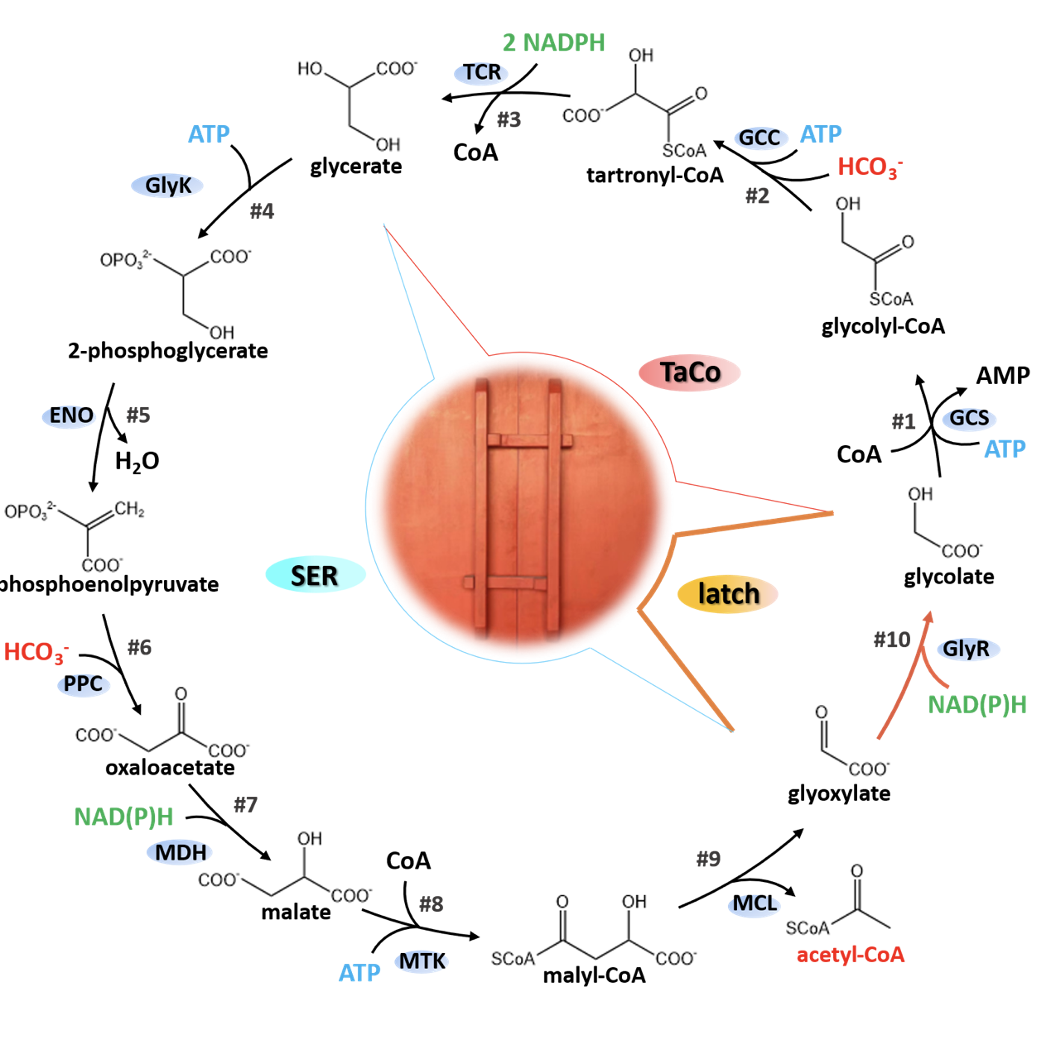
A novel artificial carbon fixation pathway LATCH with 10 enzymatic steps

https://www.sciencedirect.com/science/article/pii/S2950155525000667?via%3Dihub

https://www.cas.cn/syky/202511/t20251125_5089765.shtml

A research team at the CAS Tianjin Institute of Industrial Biotechnology has proposed a novel artificial carbon fixation pathway—LATCH which comprises 10 completely known enzymatic steps. Each cycle converts two molecules of HCO₃⁻ into one molecule of acetyl-CoA, requiring only adenosine triphosphate (ATP) and reduced coenzyme II for energy. Kinetic and thermodynamic modeling analysis shows that it is a linear autocatalytic cycle structure without kinetic traps or thermodynamic barriers, possessing high feasibility and potential for continued development. It can provide insights for improving the efficiency of systems such as photosynthetic microorganisms, plants, and engineered cell factories.

Regarding the selection of parental modules, the research team referenced research on the serine cycle and designed a modified version of the serine cycle, simplifying the pathway structure and bypassing the inefficient steps involving hydroxypyruvate, thus enabling the pathway to function effectively in the heterologous host *E. coli*. Simultaneously, the team replaced the amino acid deamination and transamination steps in the serine cycle with a decarboxylation process, forming an MCG cycle free from formic acid dependence. This cycle can further convert glycerate 3-phosphate produced by processes such as the Calvin cycle and glycolysis into acetyl-CoA in a negative carbon mode. The study also referenced a series of photorespiration bypass concepts developed for recovering the Rubisco byproduct glycolate-2-phosphate, among which the TaCo module, due to its artificial carboxylation reaction, theoretically has a maximum yield of 150%. This study found that by introducing glyoxylate reductase as a key step to act as a “molecular latch,” the natural serine cycle and the artificially carboxylated module TaCo can be recombined, resulting in a functional transformation—from two parent modules dependent on organic substrates to a complete carbon-fixing cycle.

Based on the LATCH cycle formed by module integration, kinetic analysis shows that this pathway is a linear autocatalytic cycle, theoretically avoiding kinetic traps while eliminating the need to establish complex regulatory relationships. Meanwhile, eight steps in the pathway receive thermodynamic support from adenosine triphosphate (ATP), reducing power, or high-energy substrates, and the remaining two lyase-catalyzed processes do not pose thermodynamic bottlenecks. These inherent advantages at the stoichiometric, kinetic, and thermodynamic levels lay the foundation for the continued development and application of LATCH.
more insights

http://english.cas.cn/newsroom/research-news/202604/t20260428_1158214.shtml

https://www.pnas.org/doi/10.1073/pnas.2530496123

Researchers from the CAS Qingdao Institute of Bioenergy and Bioprocess Technology (QIBEBT) have identified a conserved ubiquitin-mediated regulatory mechanism that coordinates metabolic flux among multiple biosynthetic pathways in yeast.

Eukaryotic cells operate under constant resource constraints, requiring them to allocate limited carbon supplies among multiple biosynthetic processes. Pathways responsible for producing carotenoids, sterols, and lipids are particularly interconnected, as they rely on shared metabolic precursors. Yet how cells dynamically balance these competing demands has remained unclear.

Using astaxanthin-producing Xanthophyllomyces dendrorhous yeast, the researchers identified an E3 ubiquitin ligase, PTR1, as a central regulatory hub that links carotenoid, sterol, and lipid metabolism. Further analysis revealed a PTR1-centered regulatory network that integrates these pathways. PTR1 modulates carotenoid biosynthesis through a reciprocal regulatory loop with the White Collar Complex (WCC), which is a key transcriptional regulator associated with carotenoid production. In addition, several PTR1-interacting proteins were identified, suggesting broader roles in fine-tuning sterol and lipid metabolism. Importantly, PTR1 homologs are conserved across diverse eukaryotic lineages, indicating that ubiquitin-mediated regulation represents an evolutionarily conserved strategy for coordinating metabolic networks.

http://english.cas.cn/newsroom/research-news/202604/t20260423_1157877.shtml

https://doi.org/10.1016/j.tibtech.2026.03.017

A team led by the CAS Qingdao Institute of Bioenergy and Bioprocess Technology (QIBEBT) has developed a new “process ramanomics” platform. This technology enables real-time, data-driven control of biomanufacturing.

The researchers validated their approach in polyhydroxyalkanoate (PHA) fermentation, a key route for biodegradable polyesters used in packaging and medical materials. Powered by machine learning, the platform achieved 99.75% accuracy in distinguishing PHB-producing cells from P34HB-producing ones, and quantified total PHA content and monomer composition at the single-cell level with a median absolute deviation below 3.8%, comparable to traditional gas chromatography.

In a pivotal 5,000-liter industrial fermenter trial, traditional offline testing pointed to harvesting at 28 hours when PHA content registered 66.32%. Process ramanomics, however, revealed a compositional shift invisible to conventional methods: the 4HB monomer ratio was 8.67% at 26 hours (within specification) but climbed to 11.28% by 28 hours, exceeding the compliance limit, demonstrating that earlier termination could safeguard product quality.

The platform’s single-cell resolution also showed that the content of intracellular PHA can vary by more than threefold among individual cells. At 26 hours, population heterogeneity was lowest, with 91.54% of cells producing at high levels and a 4HB composition that was within specification. This confirmed that 26 hours was the optimal harvest window.

The scientists further showed that process ramanomics can be applied to different chassis organisms and products. For example, it can be used for protein synthesis in yeast and lipid synthesis in Rhodococcus. This suggests that process ramanomics could serve as a general-purpose analytics engine for next-generation intelligent bioreactors.

https://en.people.cn/n3/2026/0324/c90000-20439477.html

At the Qingdao Humanoid Robot Data Training Center in Laoshan District of Qingdao, humanoid robots are trained for jobs such as intelligent industrial manufacturing, smart home, and commercial services. Data collectors here control robots to complete specific tasks like logistics sorting, supermarket restocking, kitchen operations, and component assembly. Through thousands of repetitions and trials, massive amounts of motion data are generated, endowing robots with a smarter “intelligent brain,” and helping humanoid robots enter all walks of life to serve thousands of households.

Back to …