Green Carbon Journal: call for submissions

Green Carbon is a Quarterly Scientific Open Access Journal published by KeAi and Elsevier https://www.sciencedirect.com/journal/green-carbon

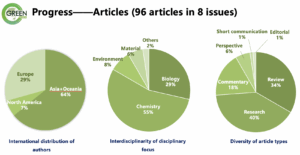
The editorial office is located at the CAS Qingdao Institute of Bioenergy and Environmental Technology, Qingdao, China. The international advisory board has 55 members, including 23 from Europe.

Since September 2093, it has published 108 articles through 9 issues.

Special issue topics included

  • Green biomanufacturing
  • Green chemical catalysis
  • Green photoelectric catalysis
  • C1 conversion
  • Green carbon biomanufacturing

Green Carbon is indexed by CAS, SCOPUS (immediate citescore: 14,9), DOAJ, and under full editorial evaluation for inclusion in the ESCI index.

Until now and probably throughout 2026, Green Carbon operates an APC policy free-of-charge

 Beyond a journal, Green Carbon, through its host institute CAS QIBEBT, has developed into an international academic exchange platform, which has hosted recent conferences on Green Carbon, Phototrophic Prokaryotes, Clostridia and more, see http://english.qibebt.cas.cn

For further information, consult with the Green Carbon website https://www.sciencedirect.com/journal/green-carbon or with the Green Carbon Offices in Germany through https://window-to-china.de/green_carbon/


more insights

https://en.people.cn/n3/2026/0324/c90000-20439477.html

At the Qingdao Humanoid Robot Data Training Center in Laoshan District of Qingdao, humanoid robots are trained for jobs such as intelligent industrial manufacturing, smart home, and commercial services. Data collectors here control robots to complete specific tasks like logistics sorting, supermarket restocking, kitchen operations, and component assembly. Through thousands of repetitions and trials, massive amounts of motion data are generated, endowing robots with a smarter “intelligent brain,” and helping humanoid robots enter all walks of life to serve thousands of households.

https://www.cas.cn/syky/202602/t20260226_5102870.shtml

https://doi.org/10.1186/s40168-026-02339-3

A research team at the CAS Qingdao Institute of Bioenergy and Bioprocess Technology has developed RamEx, an integrated analysis framework for Ramanome big data. This platform, tailored to the characteristics of Raman spectroscopy data, establishes a one-stop workflow from data reading and standardized preprocessing to downstream data mining, centered on automated quality control algorithms and efficient parallel computing processes. It also demonstrates a systematic analysis of microbial metabolomical heterogeneity and metabolic pattern differentiation at the single-cell level.

Raman genomics deep analysis can track the dynamic changes in the composition of macromolecules such as lipids, proteins, and nucleic acids in different cells, thus revealing the differentiation and succession patterns of microbial metabolic states at the population scale with single-cell precision. This provides new research ideas and technical pathways for understanding the functional organization and environmental adaptation mechanisms of complex communities.

http://english.cas.cn/newsroom/research-news/202602/t20260224_1151116.shtml

https://link.springer.com/article/10.1186/s40168-026-02339-3

Scientists from the CAS Qingdao Institute of Bioenergy and Bioprocess Technology have developed a novel computational tool, RamEx, designed to resolve the computational bottleneck in high-throughput microbial Ramanomics.

RamEx streamlines the full Ramanomic analysis pipeline, from data preprocessing and automated quality control to advanced data mining. An Iterative Convolutional Outlier Detection (ICOD) algorithm tackles spectral noise in an unsupervised manner to dynamically identify and eliminate spectral artifacts, ensuring high-quality input for downstream analysis.

The platform’s performance was validated using diverse datasets, including pathogenic bacteria, probiotics, and yeast fermentation systems. Notably, RamEx successfully captured phenotypic heterogeneity in genetically identical yeast cells by detecting subtle metabolic fluctuations and tracking the dynamic accumulation of intracellular macromolecules, including lipids, proteins, and nucleic acids.

Back to …