Nachrichten aus der Chemie (2025) 73, p. 37 – 39 (in English)
Sorting cells by Raman fingerprint
more insights
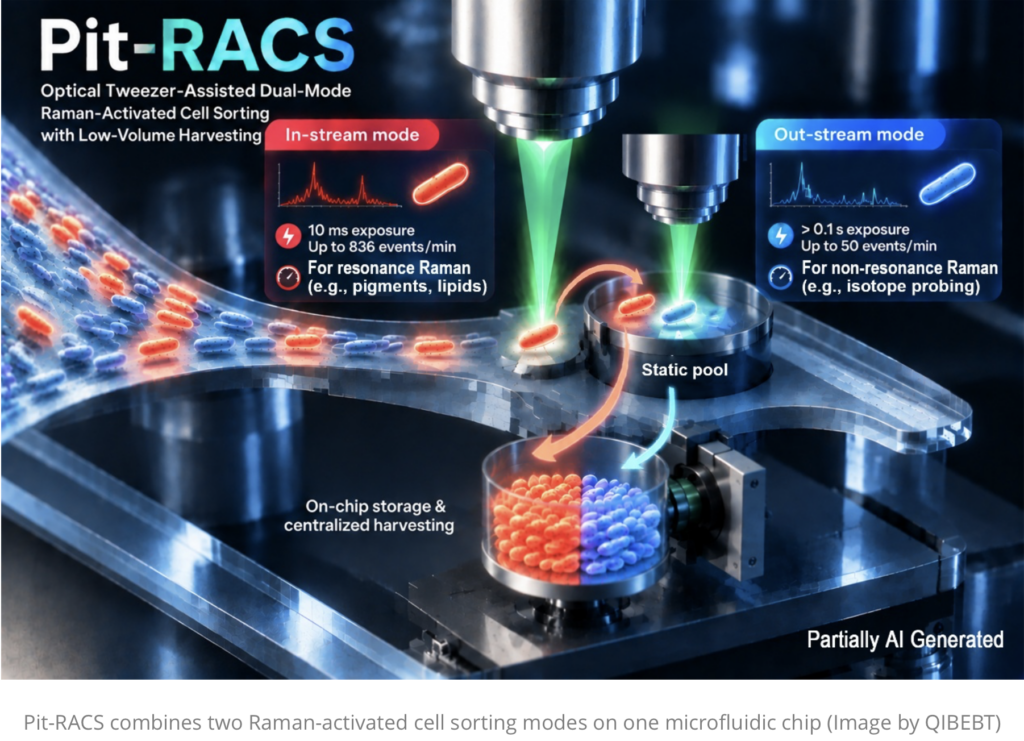
Researchers from the CAS Qingdao Institute of Bioenergy and Bioprocess Technology (QIBEBT), together with collaborators, have developed a Raman-activated cell sorting platform that combines rapid cell sorting with sensitive measurements of weak Raman signals and small-volume cell collection.
Called Pit-RACS, the optical-tweezer-assisted platform operates in two modes on the same microfluidic chip, allowing researchers to adjust the sorting strategy according to the strength of the Raman signal.
Raman-activated cell sorting can identify living cells by their chemical fingerprints without fluorescent labels. Yet researchers have faced a trade-off: fast, flowing systems struggle to measure weak Raman signals, while systems that allow longer measurements sort cells slowly. Collecting the selected cells in a large volume can also make subsequent experiments difficult.
According to the researchers, cells with strong resonance Raman signals are measured and sorted as they flow through the device. In this mode, they sorted up to 836 ± 1 events per minute with a 10-millisecond spectral acquisition time.
For weaker non-resonance signals, optical tweezers move individual cells into a cell-free buffer stream. This allows for longer measurements without interference from nearby cells. This method sorted approximately 50 cells per minute. Switching modes requires no hardware changes.
The platform can also temporarily store selected cells and release them together in approximately 10 microliters of liquid. In the reported tests, the collected cells were over 97% pure and could proceed to cultivation or genomic analysis without an additional concentration step.
“Raman signals vary greatly between biological targets. We designed the two modes so researchers can choose the measurement time their question requires while using the same sorting platform,” said Prof. MA Bo, corresponding author of the study.
To demonstrate industrial strain screening, the researchers sorted a mutant library of Yarrowia lipolytica and identified a strain with 77.4% higher β-carotene yield than the control. In another demonstration, they combined heavy-water labeling with Pit-RACS to enrich phosphate-solubilizing microorganisms from river water. They used the concentrated output directly for metagenomic sequencing, revealing 12 species of phosphate-solubilizing bacteria across nine genera.
Nachrichten aus der Chemie 64, 54-59 (2026)

https://j.people.com.cn/n3/2026/0818/c95952-20489791.html
https://www.recordchina.co.jp/b990111-s50-c20-d0189.html
On August 17, 2026, at Shanghai’s Yangshan Port 8,000 tons of green methanol were used to refuel a cargo ship owned by the French shipping giant CMA CGM.
Green methanol is a key alternative fuel for reducing carbon emissions in sectors such as shipping and the chemical industry. According to Zhu Zhaokai, President of Shanghai Electric Group, this large-scale green methanol refueling operation demonstrates that China has established a complete industrial chain—spanning from large-scale production and onshore/maritime storage and transport to port-side refueling and shipboard utilization and will help drive the global shipping industry toward zero emissions.
The green methanol fuel supplied in this operation was primarily produced at Shanghai Electric’s “Integrated Demonstration Project for Wind Power and Biomass-Combined Green Methanol” in Taonan City, Jilin Province. The production process makes use of various resources, fully utilizing biomass materials—such as corn stalks from Taonan City—and green hydrogen generated from wind power.
Back to …