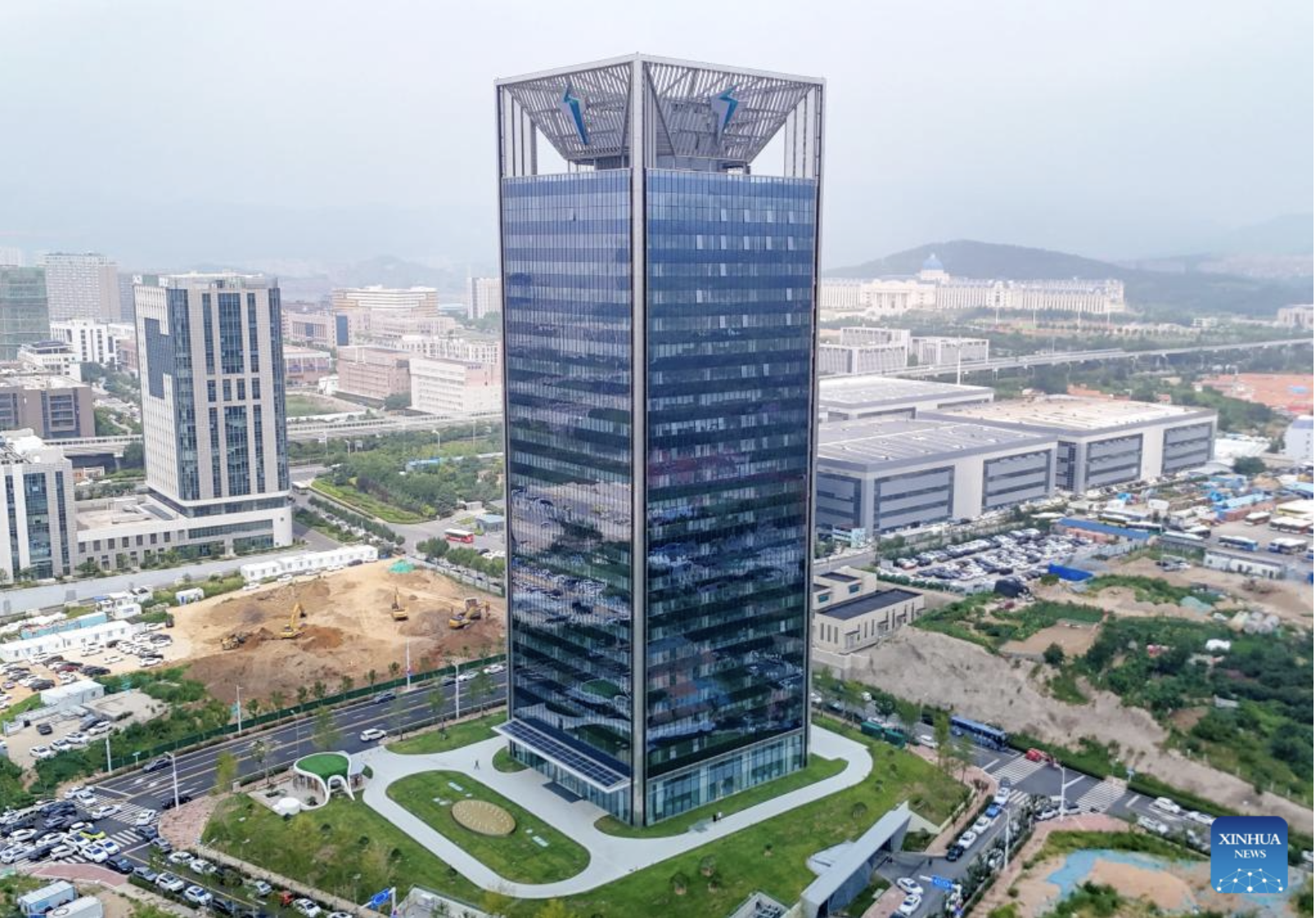
TELD New Energy opens ultra zero-carbon building in Qingdao

https://en.people.cn/n3/2025/0826/c90000-20357342.html

An ultra zero-carbon building, the headquarters of EV charging pile network operator TELD New Energy, was opened in Qingdao. It is quipped with cutting-edge high-tech solutions to achieve 100 percent green energy substitution.

more insights

https://www.sciencedirect.com/journal/green-carbon

The journal, founded only in 2023, has been formally accepted for indexing in the Emerging Sources Citation Index (ESCI), part of the Web of Science Core Collection by Clarivate. This achievement marks important recognition of the journal’s growing quality, editorial standards, and international relevance. ESCI inclusion will significantly enhance the journal’s visibility and provide authors with a broader platform for the dissemination of their research.

https://j.people.com.cn/n3/2026/0203/c95952-20422094.html

A professor at Qingdao University in Shandong Province has developed a groundbreaking system that generates electricity when people blink, supplying power to glasses that allow patients with amyotrophic lateral sclerosis (ALS) to control their wheelchairs simply by moving their eyes.

With conventional eye tracking devices, patients who wanted to operate a wheelchair and move around had to wear a heavy device on their head and be connected to a long electrical cord. Furthermore, alarms of low battery levels did discouraging patients from moving around on their own.

The eye tracking system of the team generates and supplies electricity by attaching dimethylpolysiloxane (PDMS)  to the surface of the user’s eyeball like a contact lens, creating a “micro-friction generator.” When the user blinks or moves their eyeball, friction occurs between the eyeball and PDMS, continuously generating electricity.

In an eyeglass frame worn by the user, transparent electrodes made of indium tin oxide are embedded, acting as a transducer. The transparent electrodes precisely track the distribution and changes of electric charge through electrostatic induction and convert it into a recognizable electrical signal in real time. This signal is then transmitted to an external device via a control circuit, ultimately enabling highly precise control.

Before this technology can leave the lab and be widely applied, however, a series of hurdles must be overcome for industrialization.

An illustration of controlling a wheelchair through blinking and eye movements (photo courtesy of interviewee).

https://doi.org/10.1016/j.biortech.2025.133788

http://english.cas.cn/newsroom/research_news/life/202601/t20260114_1145714.shtml

Breweries typically monitor fermentation by analyzing broth composition. Alcohols, esters, acids and residual sugars are quantified via chromatography-based assays. While reliable, these tests are time-consuming and only yield batch-average results.

A research led by scientists from the CAS Qingdao Institute of Bioenergy and Bioprocess Technology (QIBEBT) has simplified this process and developed a novel workflow dubbed “process ramanomics,” which is based on spontaneous single-cell Raman spectroscopy.

To validate the approach, the researchers tracked an industrial beer fermentation process using the lager yeast Saccharomyces pastorianus, sampling a single production batch over an eight-day period. At each stage of fermentation, they collected high-throughput Raman spectra from individual cells (a “ramanome”) and matched these unique molecular fingerprints to conventional lab measurements of 43 extracellular phenotypes in the fermentation medium.

Using multivariate regression analysis, the team found that ramanomes could accurately predict 19 extracellular phenotypes. This included four higher alcohols, four esters, four amino acids, two organic acids, four mono- and disaccharide substrates, and the alcohol-to-ester ratio—a commonly used indicator tied to beer flavor balance. In practical terms, a single, rapid cellular analysis can now replace multiple time-intensive chemical assays—without sacrificing single-cell resolution details.

Because the models output cell-level predictions, the researchers also tracked phenotypic heterogeneity over time. Different metabolite classes displayed distinct heterogeneity trajectories, and for several phenotypes higher heterogeneity tended to accompany lower metabolite levels—suggesting that dispersion among cells may be a useful process-state indicator.

Back to …