An exosceleton for mounting climbing tested at Taishan mountain, Qingdao

http://j.people.com.cn/n3/2025/0207/c517455-20273369.html

https://www.recordchina.co.jp/b948125-s6-c20-d0189.html

During the Chinese New Year holiday, a mountain climbing support robot jointly developed by Taishan Wenlun Group and Shenzhen Kenqi Technology Co. was test-introduced in the Taishan Scenic Area. Guangming reported.

According to Taishan Wenlun Group, the mountain climbing support robot can be used in a wide range of areas in daily life and work, such as mountain climbing, fitness, running, walking, and climbing up and down stairs. It weighs just 1.8 kilograms and is ergonomically designed with power, electronics and artificial intelligence (AI) algorithms. It can sense every movement of the lower limbs and provide support at the right time.

According to the group, it can operate continuously for more than five hours.  The product is currently in the trial operation phase, and the company plans to launch 200 units on the market in early March.

more insights

http://english.cas.cn/newsroom/research-news/202604/t20260423_1157877.shtml

https://doi.org/10.1016/j.tibtech.2026.03.017

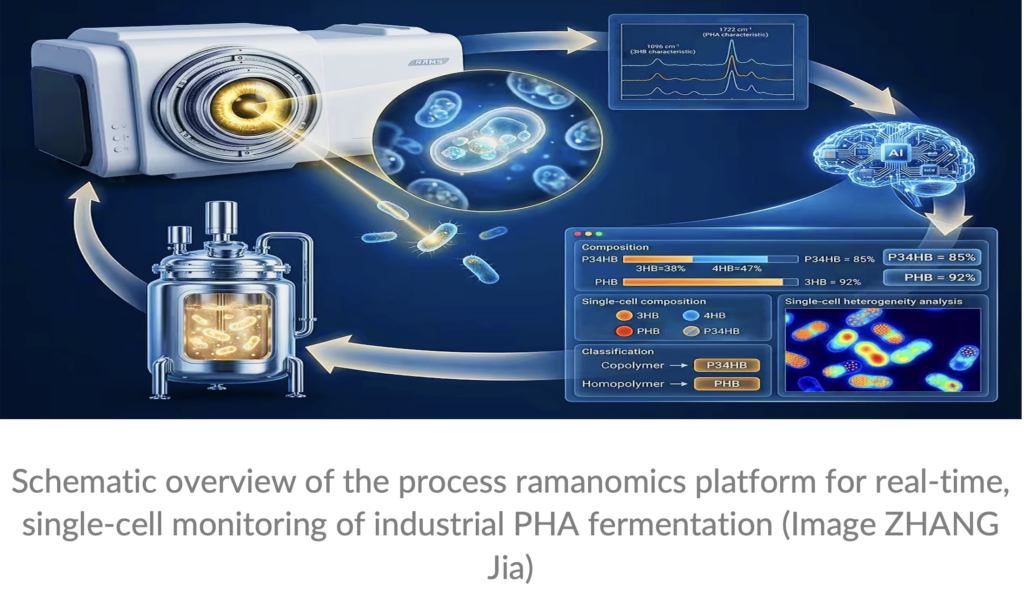
A team led by the CAS Qingdao Institute of Bioenergy and Bioprocess Technology (QIBEBT) has developed a new “process ramanomics” platform. This technology enables real-time, data-driven control of biomanufacturing.

The researchers validated their approach in polyhydroxyalkanoate (PHA) fermentation, a key route for biodegradable polyesters used in packaging and medical materials. Powered by machine learning, the platform achieved 99.75% accuracy in distinguishing PHB-producing cells from P34HB-producing ones, and quantified total PHA content and monomer composition at the single-cell level with a median absolute deviation below 3.8%, comparable to traditional gas chromatography.

In a pivotal 5,000-liter industrial fermenter trial, traditional offline testing pointed to harvesting at 28 hours when PHA content registered 66.32%. Process ramanomics, however, revealed a compositional shift invisible to conventional methods: the 4HB monomer ratio was 8.67% at 26 hours (within specification) but climbed to 11.28% by 28 hours, exceeding the compliance limit, demonstrating that earlier termination could safeguard product quality.

The platform’s single-cell resolution also showed that the content of intracellular PHA can vary by more than threefold among individual cells. At 26 hours, population heterogeneity was lowest, with 91.54% of cells producing at high levels and a 4HB composition that was within specification. This confirmed that 26 hours was the optimal harvest window.

The scientists further showed that process ramanomics can be applied to different chassis organisms and products. For example, it can be used for protein synthesis in yeast and lipid synthesis in Rhodococcus. This suggests that process ramanomics could serve as a general-purpose analytics engine for next-generation intelligent bioreactors.

https://en.people.cn/n3/2026/0324/c90000-20439477.html

At the Qingdao Humanoid Robot Data Training Center in Laoshan District of Qingdao, humanoid robots are trained for jobs such as intelligent industrial manufacturing, smart home, and commercial services. Data collectors here control robots to complete specific tasks like logistics sorting, supermarket restocking, kitchen operations, and component assembly. Through thousands of repetitions and trials, massive amounts of motion data are generated, endowing robots with a smarter “intelligent brain,” and helping humanoid robots enter all walks of life to serve thousands of households.

https://www.cas.cn/syky/202602/t20260226_5102870.shtml

https://doi.org/10.1186/s40168-026-02339-3

A research team at the CAS Qingdao Institute of Bioenergy and Bioprocess Technology has developed RamEx, an integrated analysis framework for Ramanome big data. This platform, tailored to the characteristics of Raman spectroscopy data, establishes a one-stop workflow from data reading and standardized preprocessing to downstream data mining, centered on automated quality control algorithms and efficient parallel computing processes. It also demonstrates a systematic analysis of microbial metabolomical heterogeneity and metabolic pattern differentiation at the single-cell level.

Raman genomics deep analysis can track the dynamic changes in the composition of macromolecules such as lipids, proteins, and nucleic acids in different cells, thus revealing the differentiation and succession patterns of microbial metabolic states at the population scale with single-cell precision. This provides new research ideas and technical pathways for understanding the functional organization and environmental adaptation mechanisms of complex communities.

Back to …