
https://j.people.com.cn/n3/2026/1124/c95952-20522568.html
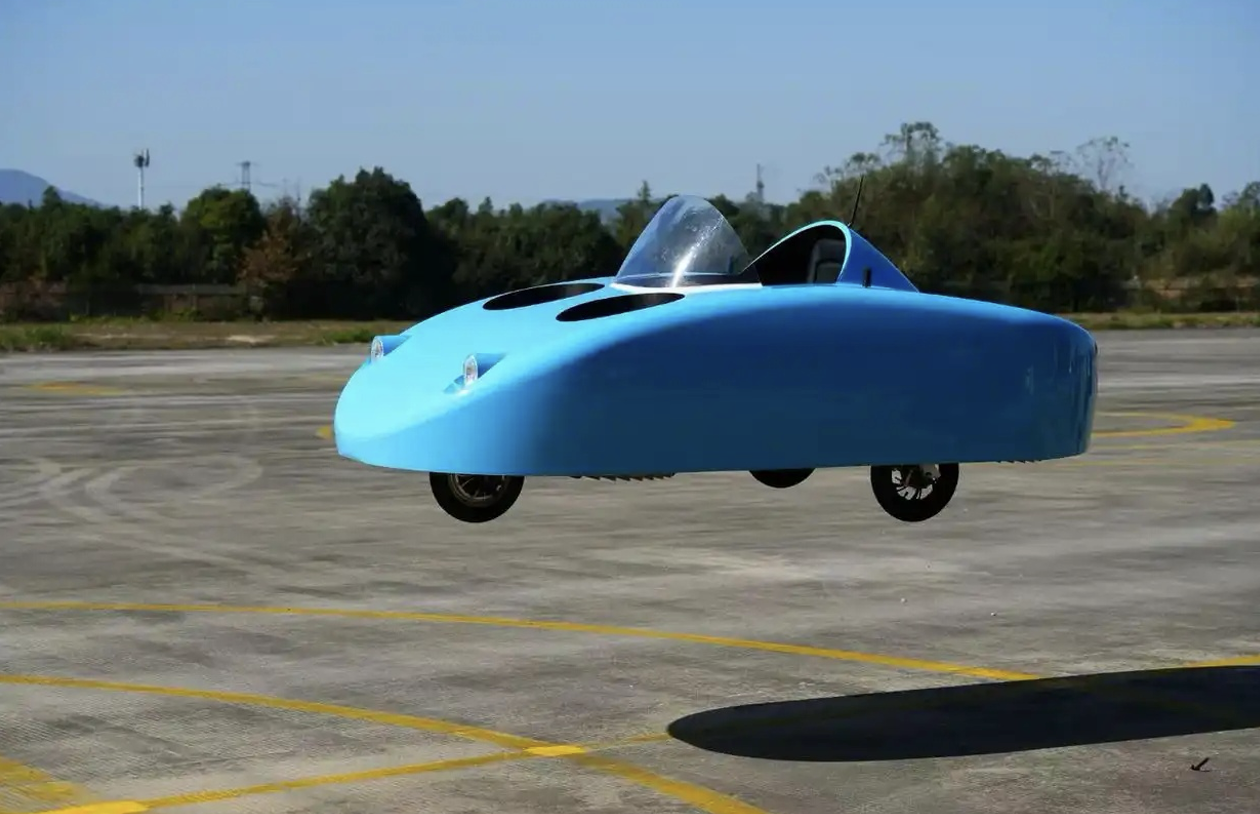
A flying vehicle—characterized by the absence of wings and any externally exposed propellers—conducted a series of test flights in Yiyang City, Hunan Province. This prototype, dubbed a “wingless flying car,” utilizes a multi-stage, vector-controlled ducted-fan propulsion system. It is capable of reaching a top flight speed of 150 km/h and has a range of 300 kilometers. Once landed, it can transition directly to driving on roads, according to a report by Rednet (Hongwang).
The developer, Zhongfei Chuangzhi Manufacturing (Shenzhen) Co., Ltd., states that this is the world’s first prototype of a manned flying vehicle to employ this specific technology. A successful maiden flight had already taken place the previous day, November 21, at Changsha Kaihui Airport.
Data released by the company indicates that this single-seat test model has a maximum takeoff weight of 280 kg and a payload capacity of 120 kg. On the ground, it can reach a top speed of 80 km/h; in the air, it can fly at a maximum altitude of 3,000 meters (with a typical operational altitude of 100 meters) and has a maximum endurance of 2.5 hours. The R&D team has already completed the technical design for a larger model with a maximum takeoff weight of 5.5 tons and a payload capacity of 2 tons. Future plans include the development of a series of models designed to carry 2–4, 6–8, and 12–15 passengers.
Unlike conventional multi-rotor aircraft, which adjust their attitude by varying the rotational speeds of exposed rotors, this “wingless flying car” houses all its power units within enclosed ducts. By integrating thrust-vector control via these ducts, the vehicle generates lift and manages its own attitude. It requires no runway, as it is capable of vertical takeoff and landing (VTOL) and hovering in mid-air. According to the developer, this design avoids the safety risks associated with exposed rotors; furthermore, it generates less noise and consumes less energy during cruise flight compared to multi-rotor aircraft.
The recent test flight was conducted in accordance with testing standards for low-altitude aerial vehicles. A series of validations have already been completed, including operations in complex urban environments, simulations of adverse weather conditions, and transitions between various operating modes. Having passed small-scale testing, the project has now entered a pilot validation phase, a precursor to mass production.