
https://j.people.com.cn/n3/2026/1125/c95952-20522950.html
“The green light has been extended by 10 seconds; you should be able to make it through.” As Mr. Liu drove through the intersection of Yuhui South Road and Wenxueguan Road in Beijing, a voice prompt from his smartphone announced the extension of the green light. Over the past few days, while commuting between Xierqi in Haidian District and Shaoyaoju in Chaoyang District, Mr. Liu has noticed that traffic flow along his route has become smoother. “I used to have to wait for a long time every single time, but I’ve noticed that the wait times have been shorter these past few days,” he remarked.
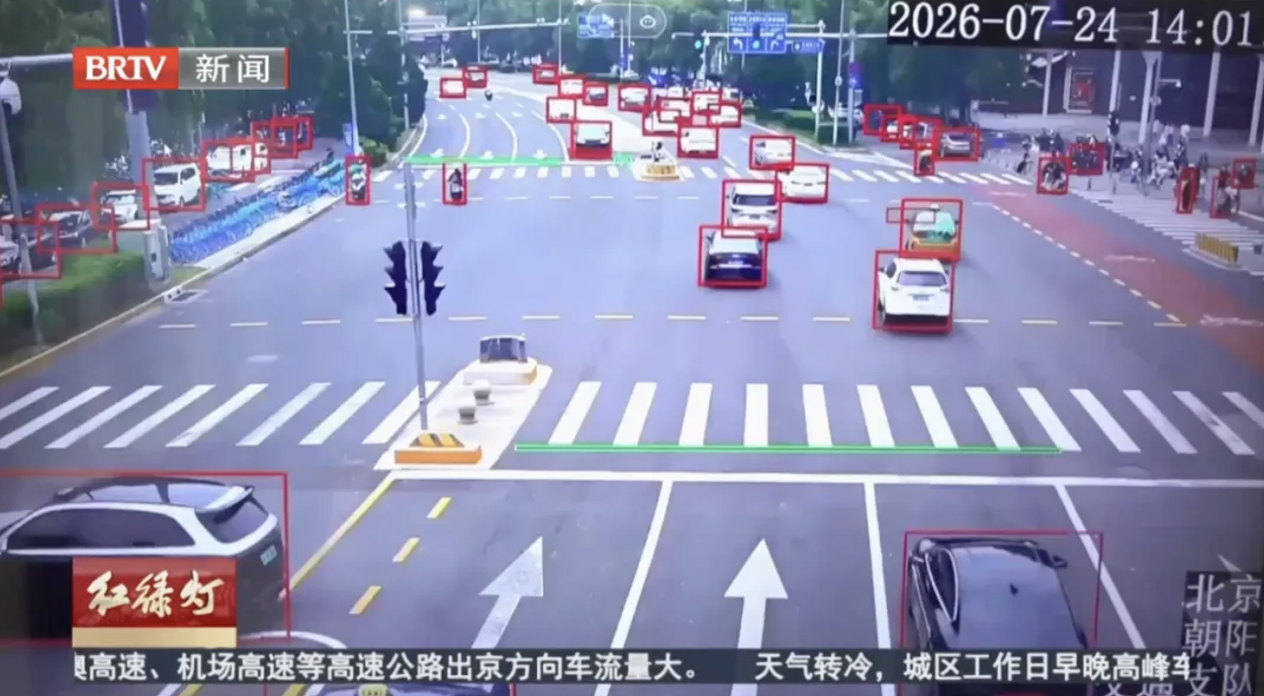
This shift in traffic conditions is the result of a new evolution in intersection signal control technology. On November 16, Amap (Gaode Maps) unveiled its “cloud-controlled traffic light system,” which has now been deployed in Beijing’s Chaoyang and Fengtai districts. The system has upgraded signal timing control at nearly 100 intersections on secondary roads. This marks a transition from a model where “people wait for the lights” to one where “the traffic lights observe the flow of vehicles.”
According to Chen Zhiheng, an engineer for Amap’s cloud-controlled traffic light system, this ‘cloud-control’ system is built upon Amap’s spatial AI technology. It enables real-time sensing and dynamic prediction of traffic flow. By combining vehicle flow data with road network information—and integrating Amap’s accumulated technical expertise with the operational know-how of traffic management authorities—the system can generate proposals for adjusting signal timings. Traffic authorities can then review these proposals and implement them to improve the travel experience for road users.
By leveraging vast amounts of driving data, the cloud-controlled traffic light system is able to calculate more rational allocations for signal timings. Specifically, if we assume a 100-second signal cycle at an intersection, a 50/50 split in traffic volume between the east-west and north-south directions would result in 50 seconds of green light time for each.
Conversely, if the traffic volume ratio shifts to 80/20, the green light durations are adjusted accordingly—to 80 seconds and 20 seconds—thereby maximizing the intersection’s traffic efficiency.
For road users, a flashing ring of light around the traffic signal icon for an upcoming intersection—visible within the AutoNavi (Gaode) Maps app—indicates that the updated signal timing is already in effect.
Mr. Chen explains, “Under the current control policy, adjustments are made approximately every 15 minutes during off-peak hours. During morning and evening rush hours, when traffic volume fluctuates rapidly, the frequency of these adjustments increases automatically.”
Empirical data collected since the system’s implementation shows that the average time vehicles spend stopped at intersections has decreased by 19.4%, while overall traffic efficiency has improved by an average of 19%.
In May of this year, at over 400 intersections in Tongzhou District, the system shifted from a model where vehicles moved in response to pre-set signal timings to one where signal timings are dynamically controlled based on real-time traffic conditions, utilizing detectors mounted on signal poles.
By August, 62 intersections along Chaoyang Road and in the Wangjing area were brought under the management of an “AI traffic police” system, resulting in an average reduction of more than 15% in transit times at major intersections.
With the introduction of this “cloud-controlled traffic signal system,” the optimization of signal management at Beijing’s intersections has evolved into a framework that integrates hardware-based data collection and sensing with cloud-based computational analysis. Through this dual hardware-and-software approach, the city’s traffic signals are transitioning from a fixed-timing model to a smart system that automatically adjusts to traffic volume, continuously enhancing the efficiency of urban road networks.