
https://www.cas.cn/syky/202611/t20261112_5124098.shtml
https://doi.org/10.1021/jacs.6c15075
Hydrogen energy serves as a key energy carrier for achieving carbon neutrality. Methanol—characterized by its safety, low cost, and high hydrogen storage density—offers a mild pathway for on-site hydrogen production. While traditional copper-based catalysts for methanol steam reforming exhibit excellent activity, the hydrogen generated during the reaction triggers a Cu⁺–Cu⁰ redox interconversion, leading to the sintering of copper particles and the eventual deactivation of the catalyst. Existing modification methods often cover the active copper sites, inevitably compromising catalytic activity. Balancing high catalytic activity with long-term operational stability remains a critical challenge in the field of methanol steam reforming.
Recently, a research team at the Institute of Process Engineering, Chinese Academy of Sciences, modified Beta zeolites through amination. By leveraging the strong coordination capability between amino groups and copper ions, the team precisely constructed tri-atomic copper oxide (Cu₃Oₓ) active sites within the zeolite pores. Utilizing a synergistic catalytic system—comprising tri-atomic copper oxide and silanol nests—the team successfully decoupled the methanol activation process from the hydrogen evolution process. This resulted in the development of a methanol steam reforming catalyst that offers high activity, low carbon monoxide byproduct levels, and exceptional stability during repeated regeneration cycles. This synthesis strategy for atomically dispersed catalysts is also applicable to the preparation of cobalt-based and nickel-based single-atom catalysts, demonstrating broad versatility and providing a new paradigm for the design and synthesis of catalysts for methanol steam reforming.
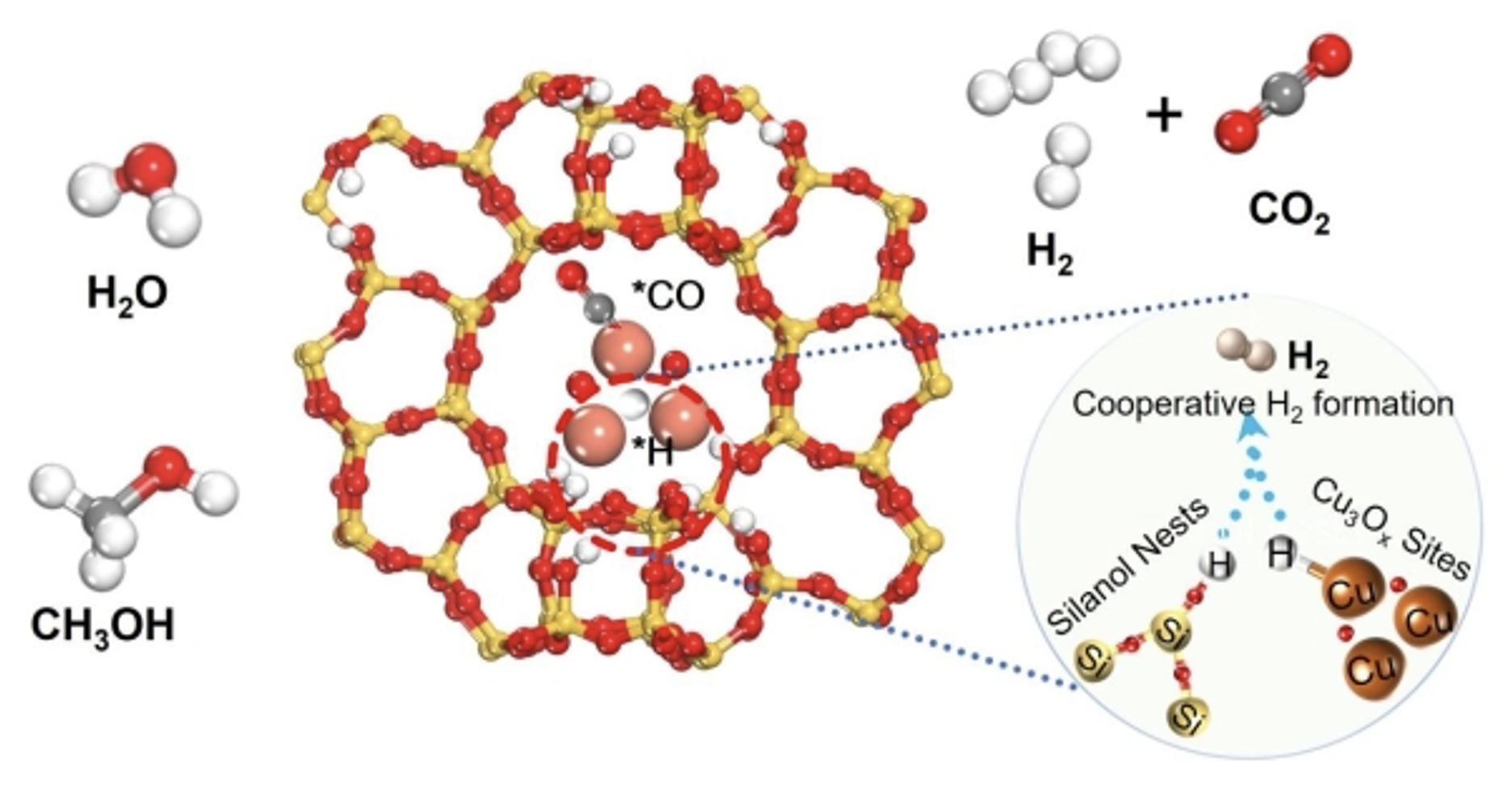
The research team proposed an “anchoring” strategy based on amino-functionalization. By replacing the weak electrostatic adsorption of silanol groups with the strong chelation provided by amino groups, the active metal species can be precisely anchored within the zeolite pores. At a copper loading of 3 wt%, tri-atomic copper oxide clusters (Cu₃Oₓ) can be controllably generated within the 12-membered ring channels of the Beta zeolite. Cu0 can significantly lower the energy barrier for methanol dehydrogenation. Adjacent silanol nests serve as proton-transport channels, allowing hydrogen atoms—generated during methanol dehydrogenation—to migrate from the active copper sites to these nests, where hydrogen evolution takes place. This design spatially decouples the sites for methanol activation and hydrogen evolution, preventing changes in the copper oxidation state that would otherwise be caused by hydrogen accumulation at the copper sites, thereby effectively preserving the structure of the active copper centers.
The zeolite-confined copper-silanol nest synergistic catalyst achieves a methanol conversion rate of nearly 97% at 275°C, with a hydrogen production rate reaching 951 mol H₂·mol Cu⁻¹·h⁻¹ at 280°C, while keeping CO by-products below 50 ppm. The catalyst has demonstrated stable operation for over 600 hours across four regeneration cycles, outperforming both copper nanoparticle and single-atom copper catalysts.
Through a combination of in situ infrared spectroscopy, hydrogen-deuterium exchange experiments, and density functional theory (DFT) calculations, the research team elucidated the reaction pathway: methanol first undergoes dehydrogenation to form adsorbed carbon monoxide, which is subsequently converted into carbon dioxide and hydrogen via the water-gas shift reaction. Compared to single-atom copper, the copper complex provides more hydrogen-adsorption sites and shorter hydrogen-transfer distances, significantly reducing the energy barriers for methanol dehydrogenation and the decomposition of COOH intermediates. Post-reaction analysis shows that the zeolite-confined Cu0 —along with the zeolite crystal and pore structure—remains largely intact. In contrast, copper catalysts prepared via conventional impregnation methods undergo significant copper reduction and particle sintering/agglomeration, leading to a decline in catalytic activity.
This study establishes a versatile synthesis method for zeolite-supported, atomically dispersed metal catalysts and introduces a new design concept: the spatial decoupling of methanol activation and hydrogen-evolution sites. This approach overcomes the long-standing challenge of balancing activity and stability in traditional copper-based catalysts, offering a valuable reference for the development of catalysts for hydrogen production via methanol reforming.
Figure: Schematic diagram of the reaction mechanism for hydrogen production via methanol steam reforming, using tri-copper oxide clusters anchored within silanol nests of a molecular sieve.