
https://j.people.com.cn/n3/2026/1120/c95952-20521342.html
A research team led by Professor Jian Yang at the university’s School of Life Sciences—in collaboration with various domestic and international research institutions—has completed the largest genome-wide association study (GWAS) to date on educational attainment within East Asian populations. The study analyzed genetic data from approximately 450,000 East Asian participants.
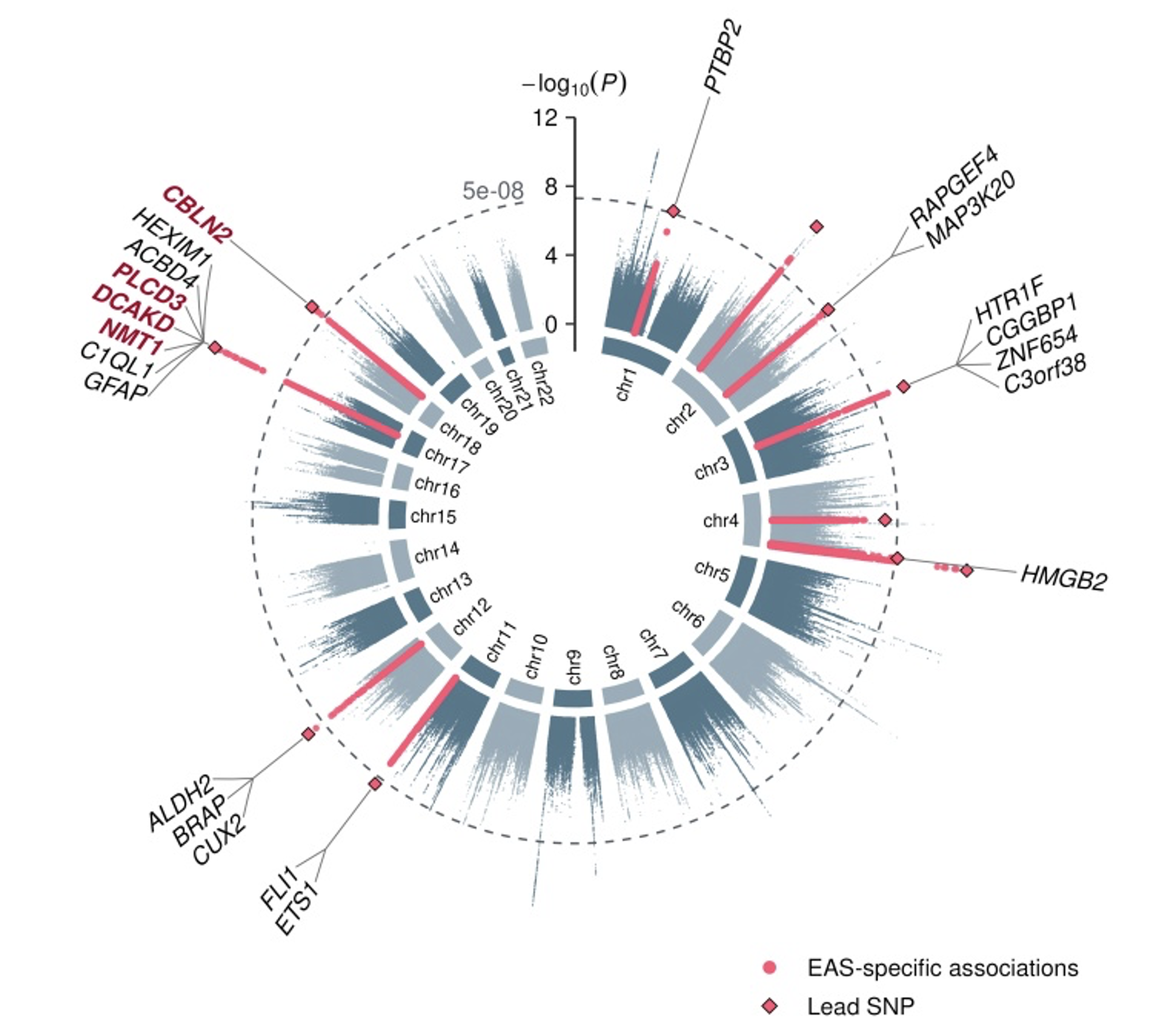
The research team integrated genetic data from multiple cohort studies—including those from China, Japan, and South Korea—covering a total of 448,558 East Asian participants. Using years of schooling as the primary metric, the team examined the genetic basis of educational attainment, comparing similarities and differences between East Asian and European populations, while also analyzing the relevant genes and cell types.
The study yielded several significant findings. The team identified 33 independent association signals that reached genome-wide significance. Furthermore, the genetic correlation for educational attainment between East Asian and European populations was found to be 0.77; this indicates that while more than 70% of the genetic influences are shared between the two groups, there are also differences specific to each population. Furthermore, the study identified 11 genetic association signals specific to East Asian populations. A prime example is the *CBLN2* locus; this gene is involved in the formation of dendritic spines on neurons and is closely linked to cognitive function.
In addition, the research team identified 28 high-confidence candidate genes from 33 associated loci. The analysis revealed that these genetic signals are most strongly associated with excitatory neurons in the cerebral cortex. Moreover, this association varies not only across different brain regions but also exhibits spatial heterogeneity within individual brain regions.
The research team emphasizes that these findings do not imply that genetic testing can be used to predict a child’s academic performance. Educational attainment is influenced by factors such as home environment, educational resources, and the specific historical or social context; genetics can only account for a portion of the variation observed within a population. Most of the associated genetic variants have only a minor effect, and a statistical association does not necessarily imply a causal relationship. These findings must not be used to label individuals.
According to Professor Yang, educational attainment has become an important trait in genetic research due to its broad genetic links to various neuropsychiatric disorders and cognition-related traits. Uncovering its genetic basis provides clues for understanding the mechanisms underlying conditions such as autism, schizophrenia, and depression, and may help identify potential targets for drug development—ultimately contributing to human health.