
https://www.cas.cn/syky/202610/t20261029_5123069.shtml
https://www.cas.cn/cm/202610/t20261029_5123071.shtml
https://www.nature.com/articles/s41586-026-11202-2
A research team around scientists from the University of Science and Technology of China has utilized a stepwise surface-synthesis approach to fabricate metallic carbon nanoribbons composed exclusively of five-membered and seven-membered carbon rings. They confirmed that these one-dimensional, sub-nanometer-wide structures—formed by carbon atoms linked via covalent bonds—are capable of highly efficient electron transport.
Both diamond and graphite are composed of carbon atoms; their distinct properties arise from the different ways these atoms are connected. Graphene consists of a honeycomb network of six-membered rings, and theoretical models had previously predicted that structures composed of five- and seven-membered carbon rings might exhibit metallic conductivity. However, the precise synthesis of such nanoribbons—ensuring they retain their metallic character at a sub-nanometer scale—remained an experimental challenge.
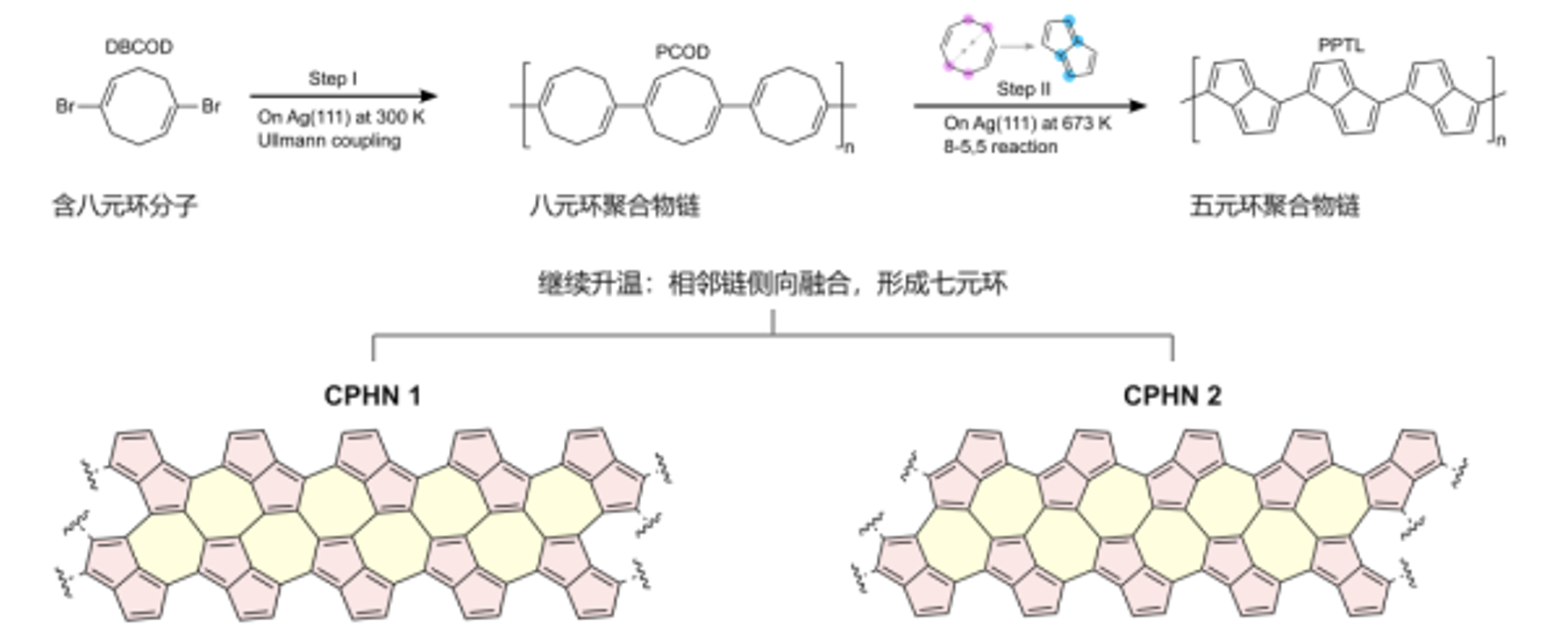
The team began with relatively stable precursor molecules containing eight-membered carbon rings, linking them into chains on a silver surface. Through heating, the eight-membered rings were transformed into pairs of five-membered rings, yielding a poly-pentalene chain—a crucial breakthrough in the synthetic route. Further heating caused adjacent chains to fuse laterally, much like a zipper, creating seven-membered rings between them and ultimately resulting in the five-seven-membered carbon nanoribbons. High-resolution microscopic imaging revealed that, depending on the relative orientation of the two chains, the carbon rings formed two distinct structural configurations, designated as CPHN 1 and CPHN 2.
Following the successful synthesis of these structures, the team compared their electron transport properties. Using the tip of a scanning tunneling microscope (STM), they lifted one end of a nanoribbon, establishing a nanoscale electrical pathway between the STM tip and the silver surface. Low-temperature measurements reveal that the conductance of CPHN 1 reaches a maximum of approximately 0.9 conductance quanta—a value that remains essentially unchanged even as the pulling length is extended to about 4 nanometers. This indicates minimal electron scattering over the measured short distances, characteristic of near-ballistic transport; furthermore, the current-voltage (I-V) curve near zero bias is approximately linear. In contrast, the conductance of CPHN 2 is about two orders of magnitude lower, with current significantly restricted at low voltages.
The research team further introduced a layer of bromine atoms between the nanoribbons and the silver surface to mitigate substrate effects. By measuring standing-wave patterns resulting from electron-wave interference and employing quasiparticle interference (QPI) analysis, the team reconstructed the relationship between electron energy and wavelength. Theoretical calculations show that the energy bands of CPHN 1 cross the Fermi level, indicating metallic behavior, whereas CPHN 2 possesses a band gap of approximately 0.22 eV, classifying it as a narrow-bandgap semiconductor. This explains the observed difference in electrical conductivity between the two structures based on their respective band structures.
This study establishes a synthetic route for metallic carbon nanoribbons composed of five- and seven-membered rings, enabling efficient electron transport within a sub-nanometer carbon framework. By transforming theoretical concepts of five-seven-membered carbon structures into an experimentally testable system, this work provides a new material platform for exploring the relationship between carbon-atom connectivity and metallic properties, as well as for investigating novel physical phenomena.