
In brief
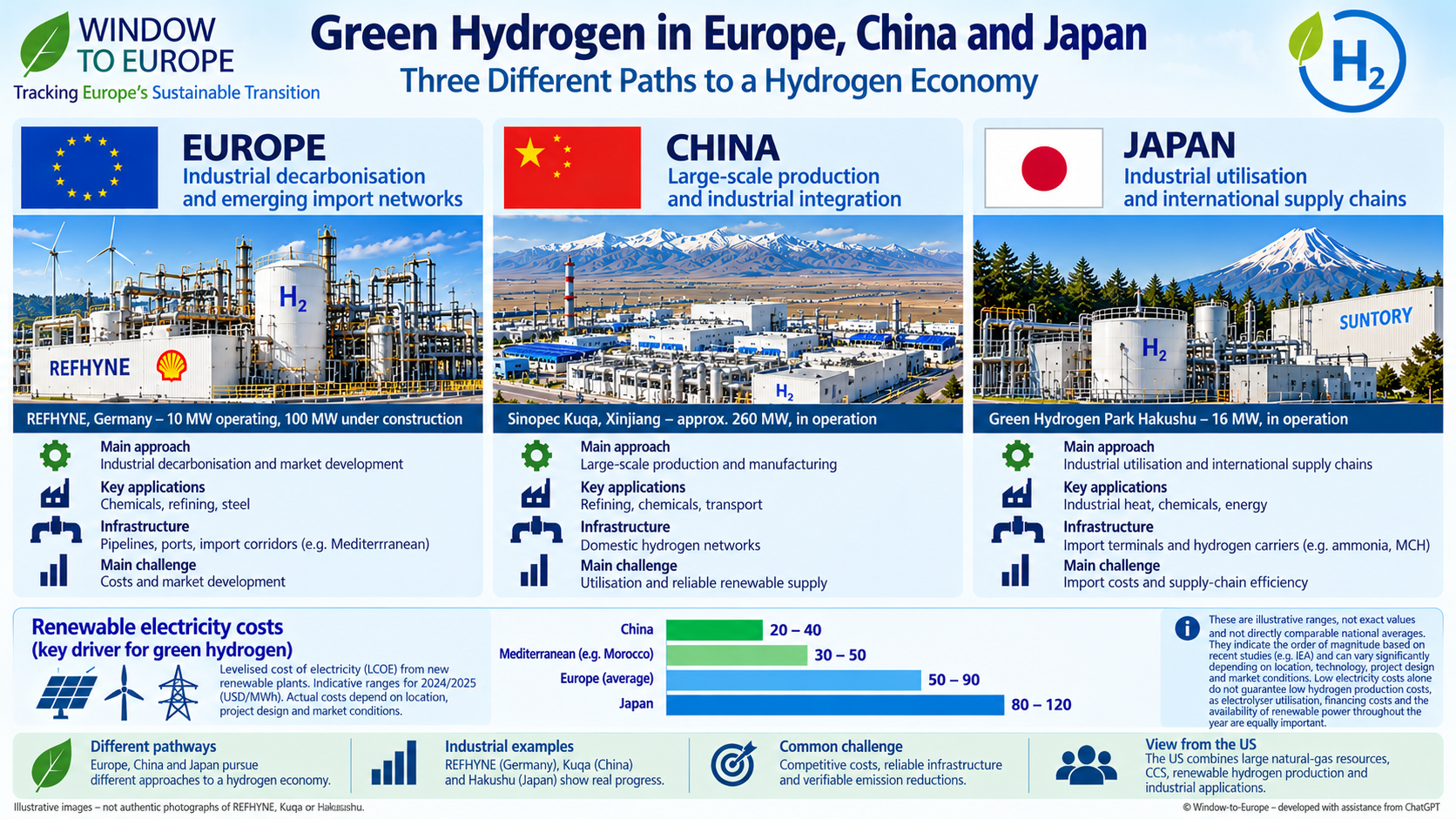
Europe, China and Japan are pursuing different approaches to a hydrogen economy. Europe is concentrating on industrial decarbonisation and developing hydrogen import corridors. China is expanding large-scale electrolysis and electrolyser manufacturing, benefiting from substantial renewable-energy resources and competitive equipment costs. Japan is combining domestic industrial applications with international hydrogen supply chains.
Three projects illustrate these approaches: Shell’s REFHYNE project in Germany, Sinopec’s Kuqa facility in China and Green Hydrogen Park Hakushu in Japan. Their development demonstrates both the progress and the economic challenges of renewable hydrogen.
The most important competitive factor may be the cost of renewable electricity. China enjoys favourable conditions, while Europe is exploring cooperation with Mediterranean countries to gain access to additional low-cost renewable energy resources.
A growing hydrogen economy – but still largely fossil-based
According to the International Energy Agency (IEA), global hydrogen demand exceeded 100 million tonnes in 2025. Almost all hydrogen was still used in established industrial applications, particularly refining and chemical production. Low-emissions hydrogen accounted for less than 1% of global production.
Worldwide installed water-electrolysis capacity doubled during 2025 to exceed 4 GW, with China accounting for nearly three-quarters of new installations. However, installed capacity does not necessarily correspond to continuous production at nominal output.
Source: IEA – Global Hydrogen Review 2026, Executive Summary.
Hydrogen is not necessarily green
Hydrogen can be produced through several technological pathways. The familiar colour terminology provides a convenient description but does not replace a full assessment of greenhouse-gas emissions.
Table 1. Principal hydrogen production pathways
| Type | Production pathway | Environmental considerations |
|---|---|---|
| Grey | Natural gas reforming | Fossil CO₂ emissions |
| Blue | Fossil-based production with carbon capture and storage | Depends on capture rates and methane emissions |
| Turquoise | Methane pyrolysis | Produces solid carbon; climate impact depends on energy source and carbon management |
| Green | Water electrolysis using renewable electricity | Low-emissions production when renewable electricity requirements are fulfilled |
| Renewable by-product H₂ | Chlor-alkali electrolysis using qualifying renewable electricity | Can qualify as renewable hydrogen under appropriate certification |
| Biomass-derived H₂ | Gasification or other biomass conversion processes | Depends on feedstock sustainability and life-cycle emissions |
An interesting industrial example is Nobian’s chlor-alkali plant in Rotterdam. In April 2025, it became the first large-scale European producer to receive ISCC EU certification for renewable hydrogen meeting the EU’s RFNBO requirements. The plant has an annual hydrogen production capacity exceeding 14,000 tonnes. In August 2026, Nobian and Air Products announced a long-term agreement for certified hydrogen from this facility.
Sources: Nobian – RFNBO certification; Nobian – Agreement with Air Products, August 2026.
Europe: Industrial decarbonisation and Mediterranean cooperation
Europe is developing renewable hydrogen primarily for sectors in which direct electrification is difficult or hydrogen is already used as a chemical feedstock. Refining, ammonia production and steelmaking are important examples.
At Shell’s Rheinland refinery in Germany, the REFHYNE 1 project has operated a 10 MW proton-exchange membrane (PEM) electrolyser since 2021. REFHYNE 2, currently under construction, will add 100 MW of electrolysis capacity. The new facility is expected to begin operation in 2027 and produce up to approximately 44 tonnes of renewable hydrogen per day.
Source: European Commission/CINEA – REFHYNE 2, October 2026.
Europe is also developing international supply corridors. A particularly important initiative is the Southern Hydrogen Corridor (SoutH2), a planned approximately 3,300 km pipeline network connecting renewable hydrogen production in Algeria and Tunisia with industrial consumers in Italy, Austria and Germany. More than 65% of the planned infrastructure could use repurposed natural-gas pipelines.
Sources: UNIDO – Southern Hydrogen Corridor; German Federal Ministry for Economic Affairs – Joint Declaration, October 2026.
This cooperation could provide Europe with access to renewable hydrogen produced using abundant solar and wind resources in Mediterranean partner countries. It could also create industrial opportunities in these countries. However, the competitiveness of imported hydrogen will depend on production costs, pipeline investment, financing and reliable industrial demand.
Source: UNIDO – Southern Hydrogen Corridor.
China: Industrial scale and cost competitiveness
China has emerged as the leading market for large-scale water electrolysis. Its advantages include extensive electrolyser manufacturing capacity, competitive equipment costs and considerable experience with industrial-scale projects. The IEA expects China to be among the first markets where renewable hydrogen could become cost-competitive with conventional hydrogen around 2030.
Source: IEA – Global Hydrogen Review 2026.
The Sinopec Kuqa project in Xinjiang illustrates this approach. Commissioned in 2023, the facility has approximately 260 MW of electrolysis capacity and a nominal annual hydrogen production capacity of 20,000 tonnes. Hydrogen produced using renewable electricity is supplied to Sinopec’s Tahe refinery, replacing hydrogen conventionally produced from fossil resources.
Sources: Xinhua – Kuqa project commissioning; Hydrogen Council – Global Hydrogen Compass 2026.
The project initially experienced difficulties in achieving its intended production level. However, the Hydrogen Council’s 2026 project review describes Kuqa as operating steadily. The distinction between installed capacity, actual output and long-term utilisation remains important when evaluating the economics of large hydrogen installations.
Sources: Hydrogen Council – Global Hydrogen Compass 2026; Hydrogen Insight – Initial operating performance.
Japan: Industrial utilisation and international supply chains
Japan has limited domestic renewable-energy resources relative to its industrial energy requirements. Its hydrogen strategy therefore combines domestic technological development and industrial applications with international supply chains for hydrogen and hydrogen derivatives.
An important example is Green Hydrogen Park Hakushu in Yamanashi Prefecture. The facility operates 16 MW of PEM electrolysis capacity, combining a 6 MW system developed by Kanadevia and a 10 MW system supplied by Siemens Energy. Both systems use electrolyte membrane technology developed by Toray.
Source: NEDO – Green Hydrogen Park Hakushu.
Hydrogen is transported through an approximately 2 km pipeline to the neighbouring Suntory Minami Alps Hakushu Water Plant. There, hydrogen-fired boilers generate steam for industrial processes, replacing part of the conventional natural-gas supply.
The facility has a maximum theoretical production capacity of approximately 2,200 tonnes of hydrogen annually. NEDO estimates that this could reduce CO₂ emissions by around 16,000 tonnes per year under the stated operating assumptions.
Sources: NEDO – Green Hydrogen Park Hakushu; TEPCO – Technical overview of the Hakushu project.
Japan is also developing international hydrogen supply chains involving liquefied hydrogen, ammonia and liquid organic hydrogen carriers such as methylcyclohexane (MCH). These technologies offer different solutions for transporting hydrogen over long distances, but conversion and reconversion require additional energy and infrastructure.
The economic and environmental performance of imported hydrogen must therefore be assessed across the complete supply chain, including the original production pathway.
Source: IEA – Global Hydrogen Review 2026.
Three approaches compared
Table 2. Regional hydrogen strategies
| Indicator | Europe | China | Japan |
|---|---|---|---|
| Main strategy | Industrial decarbonisation and market development | Large-scale production and manufacturing | Industrial integration and international supply chains |
| Renewable energy | Domestic production and Mediterranean partnerships | Extensive domestic solar and wind resources | Limited domestic potential; imports of hydrogen and derivatives |
| Key applications | Refining, chemicals, steel | Refining, chemicals, selected transport uses | Industrial heat, chemicals, energy |
| Infrastructure | Pipelines, ports and import corridors | Domestic hydrogen networks | Import terminals, liquid hydrogen, ammonia and MCH |
| Main challenge | Costs, infrastructure and demand | Utilisation and reliable renewable electricity supply | Import costs and supply-chain efficiency |
Table 3. Selected industrial electrolysis projects
| Project | Capacity | Industrial application | Status, October 2026 |
|---|---|---|---|
| REFHYNE, Germany | 10 MW operating; 100 MW under construction | Shell Rheinland refinery | Expansion expected in 2027 |
| Sinopec Kuqa, China | Approximately 260 MW | Tahe refinery | Operating since 2023 |
| Green Hydrogen Park Hakushu, Japan | 16 MW | Steam production at Suntory | Industrial demonstration in operation |
Capacities refer to installed or planned electrolyser ratings, not necessarily actual annual hydrogen output.
Sources: European Commission – REFHYNE; Hydrogen Council – Kuqa; NEDO – Hakushu.
Renewable electricity costs: A decisive competitive factor
The economics of renewable hydrogen depend strongly on electricity costs. Water electrolysis typically requires approximately 50–55 kWh of electricity to produce one kilogram of hydrogen, depending on the technology and system boundaries.
At an electricity price of USD 30/MWh, this corresponds to approximately USD 1.50–1.65 per kilogram of hydrogen for electricity alone. At USD 80/MWh, the electricity cost rises to approximately USD 4.00–4.40 per kilogram. Investment, maintenance, compression, storage and transport costs are additional.
These calculations illustrate why regional electricity prices can strongly influence hydrogen competitiveness.
The IEA’s Electricity 2026 report indicates that electricity prices for energy-intensive industries in the EU were more than 50% higher than those in China in 2025. Japan also faces substantial energy-cost challenges, although industrial electricity prices and the generation costs of new renewable-energy projects should not be treated as identical indicators.
Source: IEA – Electricity 2026: Prices.
Our accompanying infographic therefore illustrates approximate regional cost orders of magnitude rather than precise, directly comparable national averages. The indicative ranges for China, Mediterranean locations, Europe and Japan should not be interpreted as verified project quotations or statistical national benchmarks.
China’s combination of competitive electrolyser manufacturing and extensive renewable-energy resources may offer a substantial advantage. Europe is exploring Mediterranean partnerships to access similarly favourable renewable-energy conditions, while Japan is developing international supply chains to overcome domestic resource limitations.
However, inexpensive renewable electricity alone does not guarantee inexpensive hydrogen. Electrolyser utilisation, financing costs, renewable-power availability and transport requirements are equally important.
Sources: IEA – Global Hydrogen Review 2026; UNIDO – Southern Hydrogen Corridor.
Infrastructure: From production to industrial use
Hydrogen production facilities require matching infrastructure and reliable customers. Pipelines, storage systems, industrial distribution networks and import terminals must develop alongside production capacity.
A gradual transition from conventional hydrogen towards low-emissions and renewable hydrogen may help establish infrastructure and industrial demand. However, such a sequence is not mandatory. Where renewable electricity is already competitive, direct renewable hydrogen production may be economically and environmentally preferable.
Source: IEA – Global Hydrogen Review 2026.
View from the US
The United States offers a fourth perspective. Its extensive natural-gas resources and substantial renewable-energy potential support different hydrogen production pathways, including fossil-based production with carbon capture and renewable hydrogen from electrolysis.
Federal incentives have influenced project development. However, legislation enacted in 2025 shortened the eligibility period for the Section 45V clean hydrogen production tax credit: facilities beginning construction after 2027 no longer qualify.
The American experience demonstrates how regional energy resources, industrial demand, investment conditions and policy stability influence hydrogen development.
Sources: IEA – Global Hydrogen Review 2026; US Internal Revenue Service – Section 45V.
Different pathways towards a common objective
Europe, China and Japan are developing different but potentially complementary hydrogen strategies.
Europe is concentrating on industrial decarbonisation and international cooperation. China is demonstrating the advantages of manufacturing scale and industrial integration. Japan is developing domestic applications and technologies for international hydrogen transport.
Their experiences suggest that the future hydrogen economy will depend less on announcements of installed capacity than on competitive production costs, reliable industrial demand, functioning infrastructure and measurable greenhouse-gas reductions.
The transition to renewable hydrogen will therefore be both a technological and an economic undertaking.
Source: IEA – Global Hydrogen Review 2026.
Further reading
A forthcoming companion article in Window-to-Europe, Green C/H – Hydrogen, will examine technologies for hydrogen production, storage and long-distance transport, including pipelines, liquefied hydrogen, ammonia and liquid organic hydrogen carriers (LOHC).