
https://www.cas.cn/syky/202610/t20261016_5122361.shtml
https://www.science.org/doi/10.1126/science.adz5323
Researchers at the CAS Center for Excellence in Brain Science and Intelligence Technology have discovered that dendritic computation in cortical neurons plays a role in the cognitive processes underlying flexible decision-making. This finding fills a long-standing gap in evidence linking dendritic computation to higher-order cognitive functions.
Neurons in the brain possess numerous branch-like structures known as dendrites. While previous research has shown that apical dendrites can activate and aggregate signals, there has been no direct evidence that they participate in cognitive processes. Most studies have treated neurons as uniform “points” or “simple summation units,” describing their activity solely through firing rates (the frequency of electrical discharges). Due to the difficulty of observing dendrites in living subjects during cognitive tasks, the “point-neuron” model has been the standard.
Although this model facilitates theoretical modeling, it fails to account for the complex, non-linear information transformations required for higher-order cognition.
The research team provided the first experimental confirmation that dendritic computation contributes to cognitive flexibility. To test this, the researchers designed an experiment in which mice were trained to judge the pitch of sounds. When the rules of the task were altered, the mice had to infer the hidden rules based on reward feedback and integrate this with auditory signals to make flexible choices.
Using two-photon imaging with subcellular resolution, the team simultaneously recorded the activity of apical dendrites and cell bodies (soma) in a specific subtype of neurons—those projecting outside the telencephalon—located in layer 5 of the mouse auditory cortex. They then employed optogenetics to selectively inhibit dendritic activity to examine its functional role.
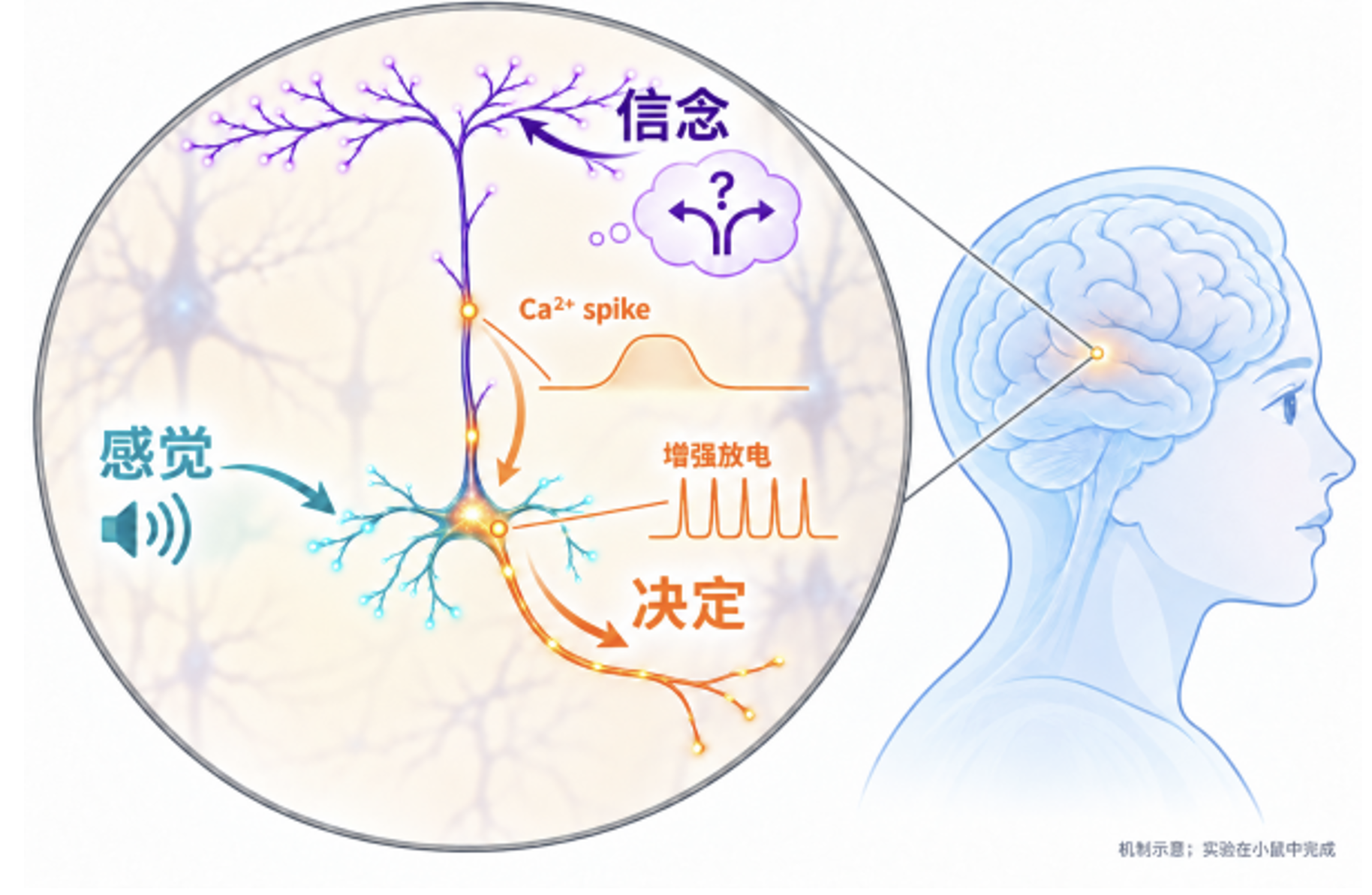
The results reveal a clear division of labor within individual neurons: the apical dendrites are responsible for encoding abstract rules, while the cell body processes sensory information. Through non-linear integration, these components generate global activity that encodes decision-related choice signals. When dendritic activity was suppressed via optogenetics, the choice-related signals in the cell body were significantly weakened, confirming that dendrites participate in the computational processes underlying neuronal decision-making.
This research has revealed that neuronal dendrites can encode “subjective rule inference” during cognitive tasks. Within an individual neuron, dendritic signals undergo non-linear integration with sensory information arriving at the cell body (soma), generating an output signal that drives behavioral decisions—thereby enabling flexible decision-making. This suggests that dendrites serve as the microscopic foundation for the brain’s capacity for flexible thinking.
These findings challenge the traditional view that individual neurons are merely simple network nodes in cognitive computation; instead, they demonstrate that a single neuron can perform the cognitive computations necessary to support flexible behavior. This insight could help scientists develop more efficient and flexible artificial intelligence systems.