In brief
An international research team involving the Max Planck Institute for Sustainable Materials in Düsseldorf and four universities in China and Hong Kong has developed a machine-learning approach for producing high-performance alloys entirely from recycled metal scrap.
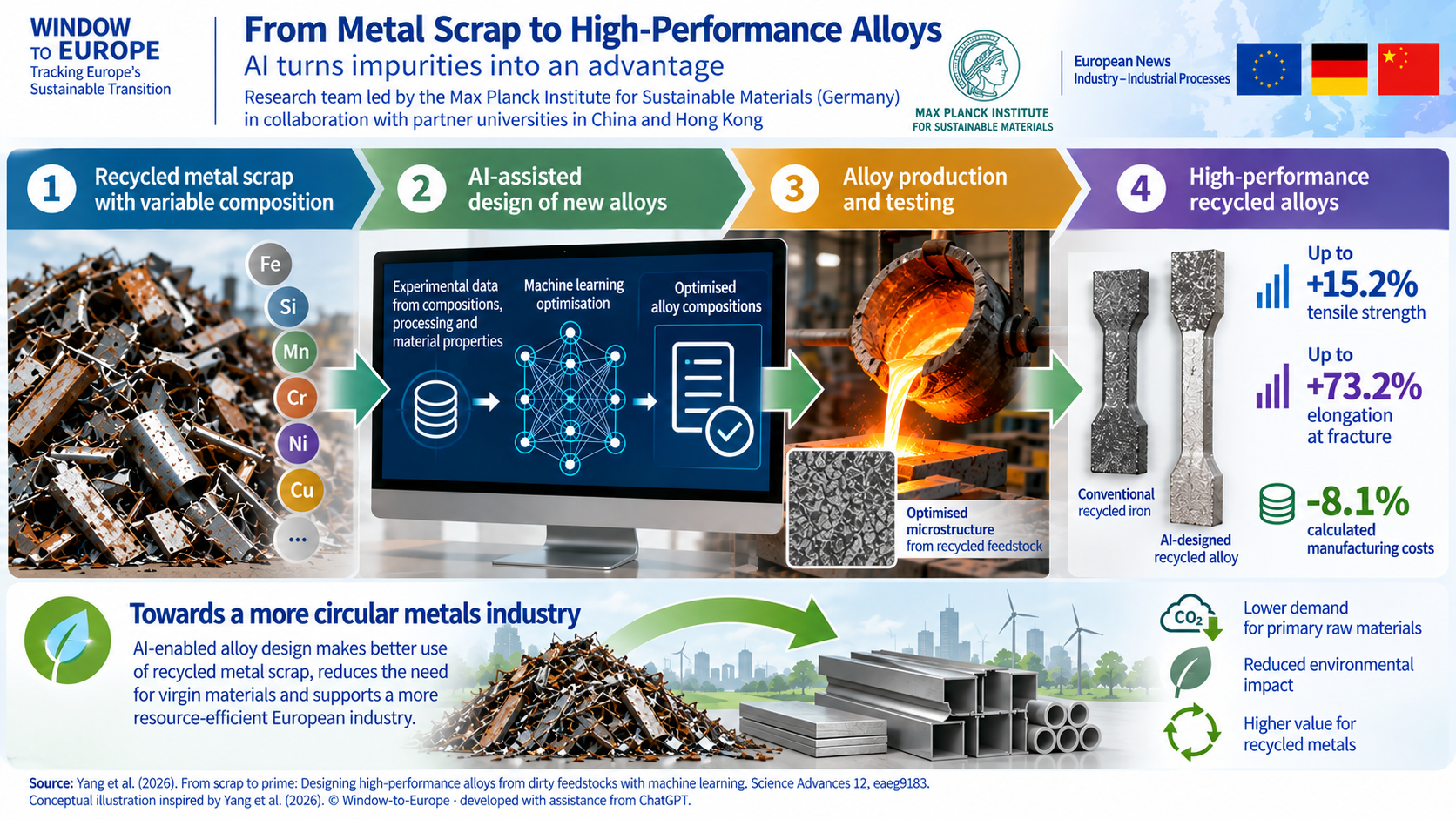
Instead of removing or diluting unwanted elements in the scrap, the researchers deliberately exploit their effects on alloy properties. In experiments with ductile cast iron, 14 of 17 newly designed alloys achieved particularly favourable combinations of strength and ductility. Tensile strength increased by up to 15.2%, while elongation at fracture improved by up to 73.2%, depending on the comparison conditions. Estimated manufacturing costs were 8.1% lower than for a conventional recycling route involving virgin iron.
Published in Science Advances in October 2026, the results demonstrate a promising new strategy for more resource-efficient metal production. Industrial-scale validation remains a future step.
The Problem: Metal Scrap Is Not a Uniform Raw Material
Recycling metals can substantially reduce the energy consumption, greenhouse-gas emissions and raw-material requirements associated with primary metal production. However, recycled feedstocks are often chemically heterogeneous.
Scrap collected from different products and industrial processes contains varying amounts of alloying elements and impurities. These can adversely affect the mechanical properties of recycled metals, making it difficult to manufacture materials that meet demanding industrial specifications.
A conventional solution is to dilute unwanted elements by adding newly produced metal. Although technically effective, this increases material consumption and reduces the environmental advantages of recycling.
Researchers from Germany and China have now demonstrated a fundamentally different approach: rather than adapting the scrap to an existing alloy specification, they adapt the alloy design to the available scrap.
Source: Max Planck Institute for Sustainable Materials, 15 October 2026
Designing Alloys Around Their Impurities
The researchers developed a machine-learning framework that connects chemical composition and processing conditions with the resulting mechanical properties.
Starting from an experimental database, a computational optimisation procedure generates candidate alloy compositions and processing parameters. Neural-network models predict tensile strength and elongation, while additional screening identifies promising combinations.
Selected candidates are then manufactured and tested experimentally. The resulting measurements can be fed back into the database to improve subsequent predictions.
The approach is particularly interesting because it does not depend on completely eliminating undesirable elements. Instead, it identifies combinations in which these elements can be accommodated or even contribute beneficially to the final microstructure.
The researchers refer to this strategy as the design of dirty alloys – materials deliberately engineered to tolerate the chemical complexity of recycled feedstocks.
Original research: Yang et al., Science Advances 12 (2026), eaeg9183
Experimental Results: Stronger and More Ductile Recycled Iron
The team selected ductile cast iron as a model system because of its industrial importance and relatively high tolerance of impurities.
Seventeen new alloy designs were manufactured and experimentally evaluated. Fourteen showed particularly favourable strength–ductility combinations compared with the reference dataset.
The reported improvements included:
- Up to 15.2% higher tensile strength, at comparable elongation.
- Up to 73.2% greater elongation at fracture, at comparable tensile strength.
- 8.1% lower calculated manufacturing costs compared with a conventional route in which recycled material is diluted with virgin iron.
These results are significant because increasing the strength of an alloy often reduces its ductility. The researchers demonstrated that carefully selected compositions and processing conditions can improve this balance while accommodating the impurities present in recycled material.
The cost advantage is also noteworthy. However, it is based on the manufacturing assumptions investigated in the study and should not yet be interpreted as a verified saving in commercial production.
Source: Max Planck Institute – Experimental results and research methodology
A German–Chinese Research Collaboration
The study was conducted by scientists from five research institutions:
- Max Planck Institute for Sustainable Materials, Düsseldorf, Germany
- Shanghai Jiao Tong University, China
- East China University of Science and Technology, China
- Central South University, China
- City University of Hong Kong
Among the authors are Dierk Raabe of the Max Planck Institute and Liuliu Han, a partner-group leader associated with the institute.
The collaboration illustrates how advanced computational methods, experimental metallurgy and materials science can be combined across national research networks.
For Europe, such approaches could become increasingly relevant as industry seeks to reduce dependence on primary raw materials and improve the quality and value of recycled resources.
Source: Max Planck Institute – Participating institutions and publication details
Beyond Cast Iron: A New Approach to Circular Metallurgy?
The researchers suggest that the underlying methodology could eventually be extended to recycled steels, aluminium and copper alloys.
These materials are essential for European transport, energy infrastructure and industrial manufacturing. Their recycling is well established, but the variable composition of scrap remains an important limitation for high-quality applications.
Machine-learning-assisted alloy design could help manufacturers make better use of available secondary materials instead of relying on extensive purification or dilution with primary metals.
Nevertheless, the present work is an experimental demonstration using ductile iron. Its transfer to other alloy systems, adaptation to changing industrial scrap streams and validation under commercial manufacturing conditions remain to be demonstrated.
Original publication: From scrap to prime: Designing high-performance alloys from dirty feedstocks with machine learning
Towards More Sustainable Metal Production
The central achievement of this research is a change in the philosophy of metal recycling.
Instead of regarding every impurity as an obstacle to be removed, the researchers demonstrate that alloy design can exploit the chemical diversity of recycled feedstocks.
If successfully transferred to industrial manufacturing, this approach could increase the value of metal scrap, reduce demand for virgin materials and support a more resource-efficient European metals industry.
The study also offers an example of productive scientific cooperation between Germany and China in a field of considerable importance for the global transition towards a circular economy.