https://www.cas.cn/syky/202609/t20260929_5121187.shtml
https://onlinelibrary.wiley.com/doi/10.1002/anie.2829162
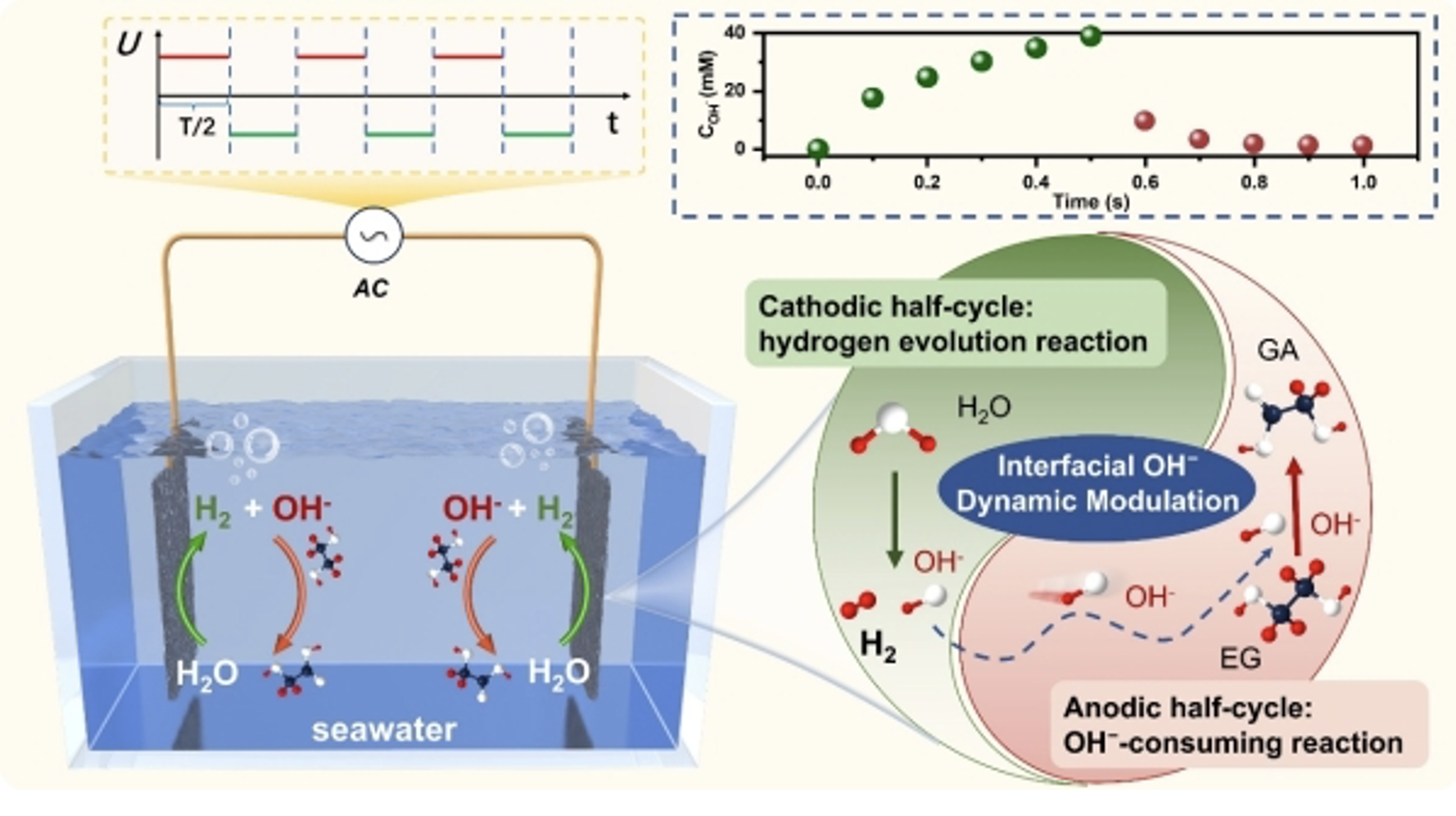
A research team at the CAS Technical Institute of Physics and Chemistry has proposed a strategy using alternating current (AC) instead of traditional direct current (DC) for direct seawater electrolysis. This approach resolves a long-standing industry bottleneck: the degradation of hydrogen production performance caused by localized alkalization and subsequent precipitation triggered by the hydrogen evolution reaction at the cathode.
Leveraging the periodic polarity reversal characteristic of AC, the team enabled the same electrode to function alternately as a cathode and an anode. During the cathodic half-cycle, the hydrogen evolution reaction generates OH⁻ ions, which are subsequently consumed in situ during the anodic half-cycle. This dynamic regulation of OH⁻ concentration at the electrode surface effectively inhibits precipitate formation.
The team conducted proof-of-concept experiments for AC-driven direct seawater electrolysis (AC-DSE) across three different reaction systems; the results demonstrated that AC-DSE effectively suppresses precipitation. By coupling the process with the ethylene glycol oxidation reaction, the system can co-produce glycolic acid—a high-value-added product—alongside hydrogen, thereby further enhancing the economic value of the process. AC-DSE technology eliminates the need for seawater pretreatment and ion-exchange membranes, significantly reducing water-related costs and system complexity.
This technology can be integrated with renewable energy systems—such as offshore wind and photovoltaics—to establish an “offshore power generation and on-site hydrogen production” solution, providing a low-cost, sustainable source of green hydrogen for the upstream hydrogen energy industry.