https://www.cas.cn/syky/202609/t20260922_5120829.shtml
https://www.nature.com/articles/s41596-026-01430-1
The electrochemical CO2 reduction reaction (CO2RR) utilizes electrical energy to convert CO2 into chemical products and fuels, serving as a crucial technological pathway for promoting the carbon cycle and storing green electricity. Copper-based catalysts are widely used in CO2RR; however, under actual electrolysis conditions, they inevitably undergo structural, morphological, and compositional reconstruction. This evolution makes their catalytic activity, selectivity, and long-term stability difficult to predict.
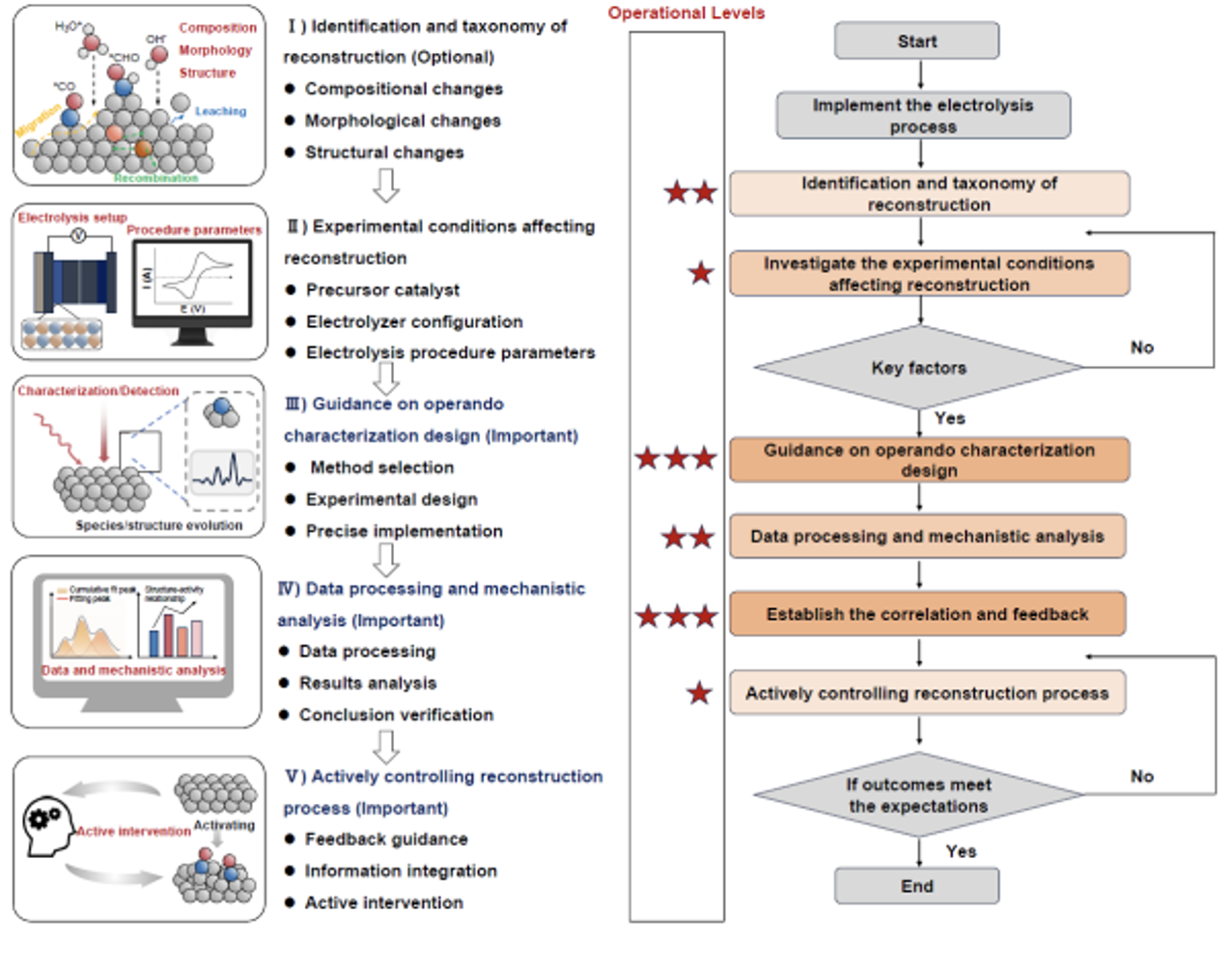
A research team at the CAS Institute of Chemistry has long focused on the construction of CO2RR catalyst systems, the regulation of product pathways, and the study of structure-activity relationships. Recently, the team established a standardized research protocol aimed at transforming the “side effects” caused by catalyst reconstruction—previously viewed passively—into active “regulatory tools.” By implementing a workflow of “reconstruction identification—mechanism understanding—active intervention,” the team actively guides copper active components into a target active state. This approach offers a new methodology for copper-based CO2 electroreduction and dynamic electrocatalysis research in general, advancing catalyst design concepts.
Graph: Experimental control workflow for Cu-based electrocatalytic CO2 reduction: “reconstruction identification—mechanism understanding—active intervention”