https://j.people.com.cn/n3/2026/0922/c95952-20502604.html
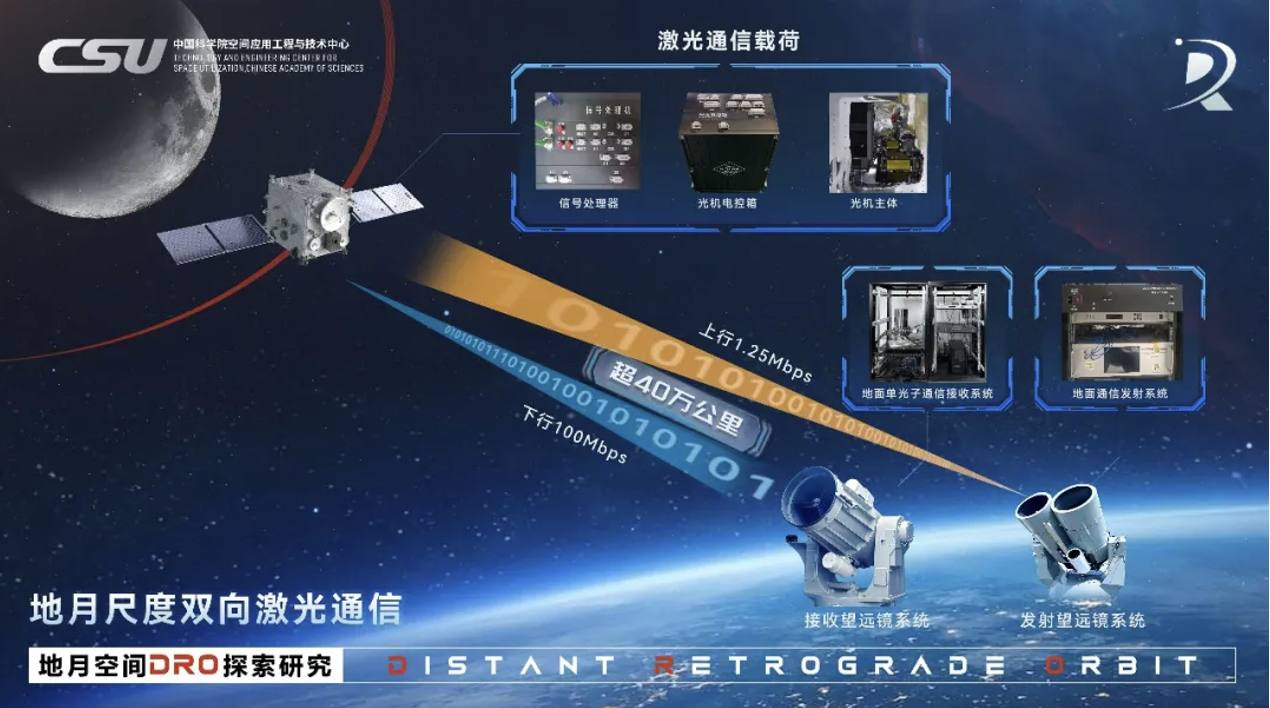
A single laser beam travels back and forth between Earth and lunar orbit, traversing a deep-space distance of approximately 400,000 kilometers. Like an invisible fiber-optic cable, it establishes a high-speed, two-way communication link connecting Earth and the Moon. A Chinese scientific research team recently succeeded in conducting a two-way, high-speed laser communication experiment between Earth and the Moon. With this achievement, China has become the second nation in the world to establish deep-space laser communication technology. This major breakthrough marks the official expansion of China’s space laser communication capabilities from low Earth orbit into the Earth-Moon space environment.
According to Yang Lei, head of the laser communication research team at the CAS Technology and Engineering Center for Space Utilization (Chinese Academy of Sciences), the role of this laser is identical to that of a home LAN cable; both serve as media for transmitting information. It is akin to running an invisible fiber-optic broadband line between Earth and the Moon. Because it enables high-speed data transmission across a distance of roughly 400,000 kilometers, it might be called a ‘space LAN cable.’
For a long time, China’s deep-space exploration missions relied primarily on microwave communication to transmit data back to Earth; however, microwave communication suffers from bandwidth limitations. The problem of “being able to launch a probe but unable to retrieve valuable data” had long been a significant and practical bottleneck hindering deep-space exploration.
Compared to conventional microwave communication, laser communication can increase transmission speeds by a factor of 10 to 100. Furthermore, because the light beam is highly focused, it is difficult to intercept, offering superior security. Additionally, the satellite-borne terminals are compact and lightweight, making them better suited for space equipment, which is subject to strict payload constraints.
The dramatic improvement in communication speed is evident from the following intuitive data points. A single uncompressed 8K lunar panoramic photo has a resolution of 33 megapixels, with raw data amounting to approximately 1.2 gigabits. Given that conventional microwave communication speeds between Earth and the Moon were merely a few megabits per second (Mbps), transmitting such an image in its entirety used to take four to five minutes. However, this experiment achieved a downlink speed of 100 Mbps, enabling the transmission of an image with the same resolution in just 12 seconds.