
https://www.cas.cn/syky/202609/t20260904_5119717.shtml
https://www.tandfonline.com/doi/full/10.1080/21501203.2025.2509017
https://www.sciencedirect.com/science/article/pii/S2405805X26001869?via%3Dihub
L-malic acid is a vital C4 platform compound. Synthesizing it via microbial fermentation using non-food biomass—such as agricultural and forestry waste—expands the range of feedstocks available for biomanufacturing.
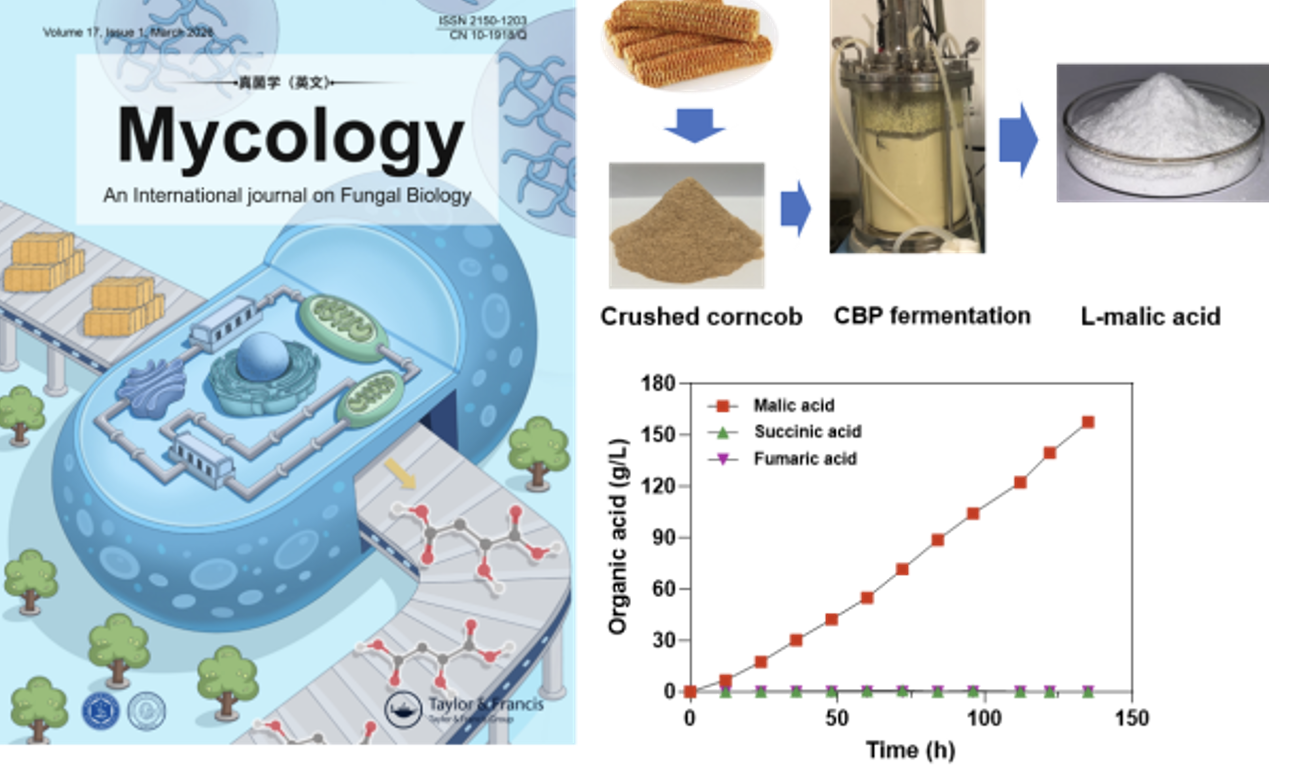
A team from the CAS Tianjin Institute of Industrial Biotechnology utilized the thermophilic fungus *Myceliophthora thermophila* as a chassis to investigate the regulation of intracellular reducing power distribution and efficient extracellular biomass degradation. Addressing the NADH requirement for intracellular malic acid synthesis, the team engineered the fungus’s intracellular reducing power metabolism; this reduced NADH consumption by competing pathways and balanced the interconversion between NADH and NADPH. Using 75 g/L of milled corncob as the substrate, the engineered strain achieved a malic acid titer of 48.1 g/L, demonstrating improved synthesis efficiency. This study reveals the critical role of cofactor dynamic balance in high-level organic acid synthesis by filamentous fungi and offers a novel metabolic regulation strategy that simultaneously facilitates biomass degradation and product synthesis.
To further enhance the conversion rate of biomass to malic acid, the team investigated the efficiency of lignin depolymerization within the biomass. The study demonstrated that the physicochemical barrier formed by lignin is a key factor limiting the release and utilization of polysaccharide components. By upregulating the expression of the peroxidase DyP, the team promoted the oxidative remodeling of lignin-related structures, increased the accessibility of cellulose and hemicellulose, and enhanced cellulose degradation, cellooligosaccharide uptake, and intracellular phosphorolytic utilization. In a 5-L bioreactor, the malic acid titer reached 157.6 g/L with a productivity of 1.17 g/L/h, and the yield was 0.55 g/g based on total corn cob input. The process eliminates the need for separate chemical pretreatment and enzymatic hydrolysis steps, as well as the addition of exogenous cellulase during fermentation, demonstrating the technical potential of fungal consolidated bioprocessing (CBP) to simplify the lignocellulose conversion workflow and reduce reliance on exogenous enzymes.