https://en.people.cn/n3/2026/0901/c90000-20494561.html
https://www.cas.cn/cm/202609/t20260901_5119418.shtml
http://english.cas.cn/newsroom/cas-in-media/202609/t20260901_1189541.shtml
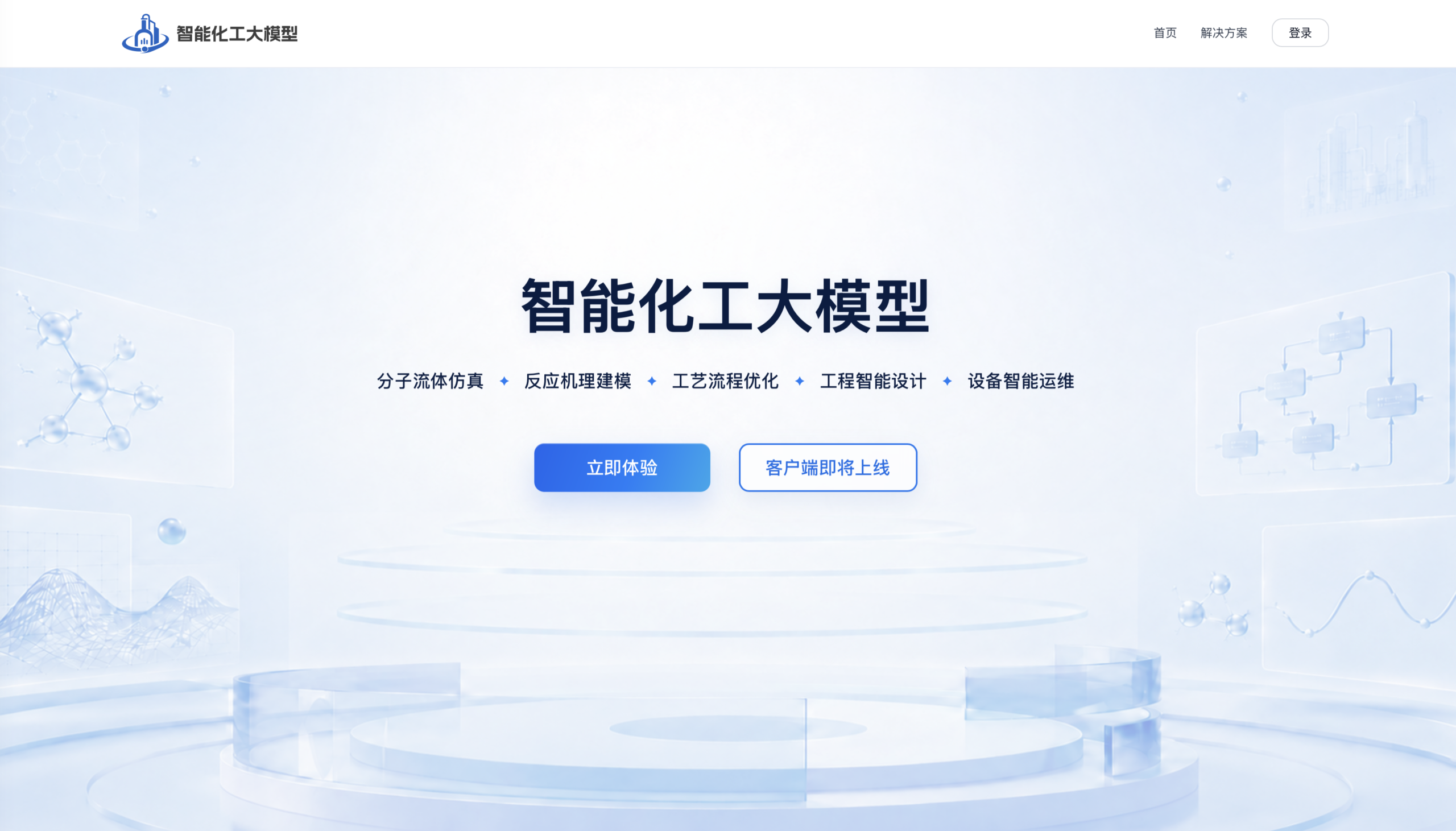
The latest version of China’s chemical engineering large language model ChemELLM 3.0 Pro was released, marking a significant leap from knowledge acquisition to intelligent execution of chemical tasks, and providing new support for managing complex chemical operations.
ChemELLM 3.0 Pro was jointly developed by the CAS Dalian Institute of Chemical Physics DICP, iFlytek, Alibaba Cloud Computing, and other institutions and enterprises. More than 300 chemical enterprises, universities and research institutes have registered to use the model, with cumulative API calls exceeding 14 million.
The new version breaks away from the conventional application model centered on knowledge Q&A and content generation, establishing a four-tier architecture comprising
- a large model,
- intelligent agents,
- professional skills and tools, and
- application scenarios.
In this architecture, 1. the large model functions as the cognitive core, responsible for professional knowledge comprehension, multimodal information parsing, solution generation and task planning. 2. Intelligent agents act as the execution entities, handling 3. process decomposition, tool invocation, result verification and dynamic adjustments around task objectives, forming 4. a closed loop that integrates cognition, reasoning, planning, execution and validation.
According to assessments by a chemical-domain evaluation system, the ChemELLM 3.0 Pro achieved text-based Q&A accuracy and multimodal Q&A accuracy of 82 percent and 81 percent, respectively, with overall scores showing respective improvements of 20.2 percent and 31.4 percent compared with the 3.0 version.
According to DICP, as a next step it will develop a ChemELLM 4.0 version with enhanced reasoning and multi-tool collaborative planning capabilities. By using typical mature chemical processes such as methanol-to-olefins as validation scenarios, the institute will integrate key stages including laboratory research, engineering design and plant operations to create a novel paradigm enabling a seamless “lab-to-plant” transition in a single step.
Here follow more details from an article published in Chinese Science Daily on Sept. 1, 2026
As the latest iteration of China’s first large model for the chemical industry, 3.0 Pro goes beyond merely “understanding and answering questions.” It is transforming into an intelligent engineering partner capable of “planning, executing, and verifying” tasks alongside engineers.
According to Ye Mao, a researcher at DICP and leader of the intelligent chemical industry large model team, 3.0 Pro marks a significant leap from a ‘specialized knowledge Q&A model’ to an ‘intelligent execution system for chemical tasks,’ providing a new technological foundation for the intelligentization of chemical R&D, engineering design, and production operations.
The Hard-to-Cross “Valley of Death”
The chemical industry is a vital foundational sector of the national economy, with products spanning areas essential to daily life—such as clothing, food, housing, and transportation. It also serves as a crucial basis for adjusting energy structures, achieving “dual carbon” goals (peaking carbon emissions and achieving carbon neutrality), and advancing new industrialization. However, under traditional paradigms, the development of new technologies for chemical industrial processes faces multiple challenges.
According to Ye Mao, the chemical industry is characterized by complex subjects, vast scale spans, diverse data types, and strict engineering constraints. Taking a catalytic reaction from the laboratory to the factory requires stages such as laboratory-scale trials, pilot-scale tests, and industrial trials—a process that can easily take decades. Countless “promising candidates” that performed excellently in the laboratory have faltered during the pilot-scale testing phase—a stage known in the industry as the “Valley of Death.”
Under the traditional R&D paradigm, engineers rely on experience, trial-and-error, and physical experiments; optimizing a single process parameter or adjusting a workflow requires significant investments of time and capital. Establishing a new paradigm of “Laboratory – Virtual Factory – Physical Factory”—and achieving “digitalization-first” in the pilot-scale phase—would result in massive savings of time and resources. While existing general-purpose large models can handle Q&A and text generation, they lack specialized knowledge, scientific mechanism constraints, multimodal analysis capabilities, and task execution abilities. Consequently, they struggle to serve as the intelligent foundation needed to support the entire lifecycle of chemical engineering R&D, design, and production, and cannot drive a paradigm shift in the industry. What engineers need is not merely a “Q&A machine,” but an intelligent assistant capable of understanding requirements, breaking down tasks, invoking tools, performing calculations, and outputting actionable solutions.
Driven by this need—and under the guidance of Liu Zhongmin, an academician of the Chinese Academy of Engineering and Director of the Dalian Institute of Chemical Physics (DICP)—the DICP team began working on applying artificial intelligence (AI) to chemical technology development as early as 2016. In March 2024, building on prior collaborations, DICP and Huawei Technologies Co., Ltd.—together with partners such as the School of Software at Dalian University of Technology and the Yulin Institute of Clean Energy Innovation—developed the “Intelligent Chemical Engineering Large Model 1.0.” This initial version enabled rapid retrieval of chemical knowledge and the autonomous design and optimization of chemical processes. It demonstrated the potential to shorten R&D cycles and paved the way for the rapid industrialization of laboratory achievements.
Subsequently, the team embarked on a journey of continuous technological iteration, launching versions 2.0 and 3.0. Each upgrade achieved breakthroughs in both the depth of capabilities and the breadth of applications. The official debut of version 3.0 Pro marked the model’s entry into a new phase characterized by the deep integration of “cognition” and “execution.”
From “Intelligent Assistant” to “Engineering Partner”
Compared to previous iterations, version 3.0 Pro moves beyond the traditional large-model paradigm focused primarily on Q&A and content generation. Instead, it establishes a four-layer technical architecture comprising “Large Model – Intelligent Agent – Specialized Skills & Tools – Application Scenarios.” Within this framework, the large-scale intelligent chemical engineering model serves as the cognitive core, handling the comprehension of specialized knowledge, the analysis of multimodal information, solution generation, and task planning. Meanwhile, intelligent agents act as the executing entities; centered on task objectives, they manage process decomposition, tool invocation, result verification, and dynamic adjustments, thereby establishing a closed-loop capability that integrates cognition, reasoning, planning, execution, and validation.
For instance, when an engineer submits a request for process design or optimization, the model not only grasps the user’s intent but also automatically breaks down the requirements—identifying necessary physical property calculations, selecting the appropriate simulation software, and determining the required engineering design steps. It then analyzes and verifies the computational results to ultimately generate comprehensive solutions and recommendations.
This robust execution capability is underpinned by an extensive library of specialized tools. Currently, version 3.0 Pro integrates over 400 chemical engineering intelligent agents and tools. It undergoes continuous pre-training on a corpus of chemical engineering data comprising tens of billions of tokens and is fine-tuned using high-quality Q&A datasets of a similar scale, providing the professional support needed to execute complex chemical engineering tasks. In multidimensional performance evaluations within the chemical engineering sector, 3.0 Pro achieved accuracy rates of 81.96% for text-based Q&A and 80.75% for multimodal Q&A—representing relative improvements of 20.2% and 31.4%, respectively, over version 3.0.
Beyond the metrics, a more fundamental shift lies in the model’s elevated positioning. “3.0 Pro is no longer limited to simply ‘providing answers’; instead, it organizes and formulates solutions tailored to specific chemical engineering tasks. It has evolved from a ‘specialized assistant’ that aids in knowledge acquisition into an ‘intelligent engineering partner’ capable of collaborating with professionals to complete complex tasks,” Ye Mao said.
A New Paradigm: “Straight from Lab to Plant”
From the very beginning of development, the team led by Ye Mao and Liu Zhongmin focused on core chemical engineering application scenarios. For them, empowering real-world industrial applications is the fundamental mission of the large-scale intelligent chemical engineering model. According to Liu Zhongmin, the rapid advancement of AI brings both new opportunities and challenges to traditional research fields. Therefore, developing intelligent chemical engineering—and achieving a transition where new technologies move ‘straight from the laboratory to the plant’—represents a critical technological frontier that the industry must conquer, both now and in the future.
The large-scale intelligent chemical engineering model serves as the core engine enabling the Dalian Institute of Chemical Physics (DICP) to establish this new paradigm. To date, over 300 chemical enterprises, universities, and research institutes have registered to use the intelligent chemical industry large model, with the cumulative number of API (Application Programming Interface) calls exceeding 14 million. This figure reflects the reality of countless engineers utilizing “AI teammates” in scenarios ranging from technology R&D and engineering design to process optimization and fault diagnosis.
Simultaneously, the Dalian Institute of Chemical Physics (DICP) has spared no effort in developing data infrastructure. It established my country’s first big data center covering the entire petrochemical and chemical industry chain—spanning R&D, design, production, and market—and was selected by the National Data Bureau as a “chain leader” and a pilot unit for high-quality dataset construction in the sector. On Changxing Island in Dalian, the country’s first intelligent pilot-scale testing platform with a thousand-ton capacity has commenced operations. It generates—on demand—data on catalytic reactions and processes under real-world operating conditions that are difficult to replicate in laboratories or capture from industrial units, thereby providing a steady stream of “real-world fuel” for the continuous evolution of the large model.
At the launch event for the Intelligent Chemical Industry Large Model 3.0 Pro, DICP and its partners held an inauguration ceremony for a joint innovation laboratory dedicated to intelligent chemical technology. Focusing on areas such as the R&D of intelligent chemical large models and agents, the construction of industry data and computing power platforms, the integration of industrial software, and application in typical scenarios, the laboratory will conduct joint research on key technologies, co-build platforms, validate use cases, and facilitate the commercialization of achievements. By pooling advantageous resources from industry, academia, research, and end-users, the partners aim to build an open and collaborative innovation ecosystem for the intelligent chemical industry.
Looking ahead, DICP will join hands with partners to further enhance the model’s capabilities in cross-scale understanding, solving complex scientific problems, and multi-agent collaboration, while iteratively developing the Intelligent Chemical Industry Large Model 4.0—featuring deep reasoning and multi-tool collaborative planning. It will use mature, representative processes—such as methanol-to-olefins—as validation scenarios to seamlessly connect key stages including laboratory R&D, engineering design, and plant operations. The goal is to establish a new paradigm for chemical R&D that bridges the gap between the laboratory and the factory, driving the chemical industry’s transition from digitalization to intelligence.