https://www.cas.cn/cm/202608/t20260824_5118856.shtml
Partial translation of an article by Gu Yekai published in People’s Daily on August 24, 2026, Page 19
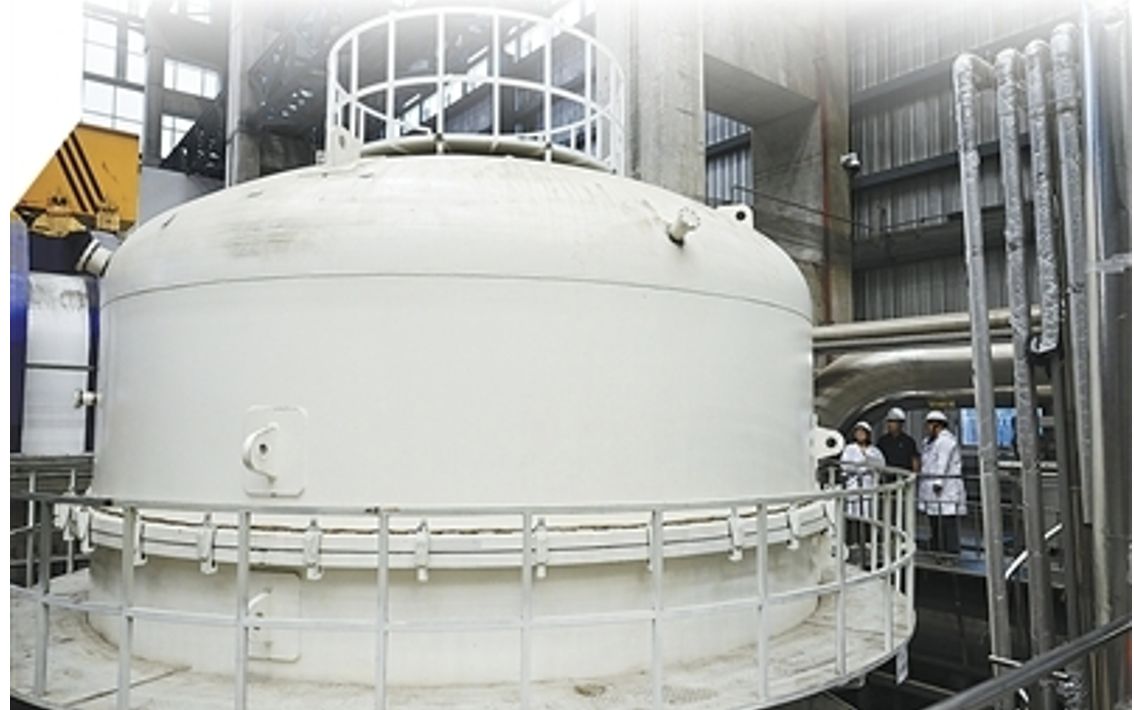
Photo: Researchers inspect the testing platform for the high-temperature superconducting central solenoid coil of the “artificial sun” at the Institute of Plasma Physics, Hefei Institutes of Physical Science, Chinese Academy of Sciences. (Photo by Xinhua News Agency reporter Zhou Mu)
Nuclear fusion is the process that powers the sun; it is a nuclear reaction in which two or more light atomic nuclei fuse to form a heavier nucleus under conditions of extreme temperature and pressure, releasing immense energy in the process. Nuclear fusion energy is safe, clean, and virtually inexhaustible. Consequently, this ideal future energy source for humanity is often referred to as the “artificial sun.”
How can nuclear fusion energy transition from the laboratory to industrial application, and when will it reach ordinary households? Commercialization would drastically reduce humanity’s reliance on fossil fuels and potentially reshape the global energy system.
Nuclear fusion energy is dubbed the “artificial sun” primarily because its main fuel—deuterium (an isotope of hydrogen)—is abundant and widely distributed on Earth. Duan Xuru, Chief Scientist in the field of fusion at the China National Nuclear Corporation (CNNC), explains that deuterium exists in vast quantities in seawater; the deuterium extracted from a single liter of seawater can release energy equivalent to burning 300 liters of gasoline through fusion reactions.
Furthermore, nuclear fusion energy is inherently safe and environmentally friendly. Because the reaction requires extremely demanding conditions—such as temperatures exceeding 100 million degrees Celsius—any malfunction causes the reaction to cease automatically as the necessary conditions are no longer met, eliminating the risk of a meltdown. Additionally, the process generates no long-lived radioactive waste and produces no greenhouse gases during operation.
Currently, China is accelerating the construction of multiple nuclear fusion devices, with scientific research, engineering, and industrial development advancing in tandem. In Chengdu, Sichuan Prefecture, China’s next-generation “artificial sun”—the HL-3 (Huanliu-3) tokamak—has surpassed the “double 100-million-degree” milestone, with plans to conduct burning plasma experiments by 2027. Meanwhile, in Hefei, Anhui, the all-superconducting tokamak fusion device has achieved steady-state operation at 100 million degrees Celsius for over a thousand seconds, and construction is accelerating on the world’s first compact fusion energy experimental device.
Nuclear fusion is essentially the reaction that powers stars; achieving self-sustaining fusion requires creating reaction conditions within a high-temperature, high-density ionized gas (plasma) environment. The mainstream approaches to nuclear fusion fall into two categories:
- magnetic confinement (exemplified by tokamaks and stellarators) and
- inertial confinement (exemplified by laser-driven target pellets
alongside novel concepts such as magnetized target fusion.
Among these, magnetic confinement fusion using tokamaks is currently the most promising pathway for the early realization of practical fusion energy applications. Focusing on this technology, institutions such as the Southwestern Institute of Physics (SWIP) under the China National Nuclear Corporation (CNNC) and the CAS Institute of Plasma Physics (Hefei) have made significant strides in areas including high-parameter and long-pulse plasma operation, the R&D of key fusion reactor technologies, and the development of core components. Simultaneously, domestic universities and research institutes are actively participating in fusion research, while private enterprises are entering this emerging sector, driving the accelerated development of diverse technological pathways.
In recent years, China has achieved a series of important breakthroughs in the operation of fusion devices and the research and development of key technologies for fusion reactors. Recently, ISO 19991:2026 “Fusion technology — Experimental magnetic confinement fusion facilities — Supersonic molecular beam injection fueling technology for fusion devices”—a standard spearheaded by China — was officially released. This marks the first international standard in the field of fusion fueling.
Supersonic molecular beam injection fueling technology is a critical fuel replenishment method for controlled nuclear fusion devices. As an advanced fueling technology pioneered by China, it has already been deployed on more than ten magnetic confinement fusion experimental devices both domestically and internationally. The journey of this technology—from original research and device application to the establishment of an international standard—epitomizes the rapid breakthroughs my country is achieving in nuclear fusion research and key technologies.
In March 2025, the HL-3 (China Huanliu-3) device achieved “dual 100-million-degree” high-parameter operation for the first time in China, reaching temperatures of 117 million degrees Celsius for ions and 160 million degrees Celsius for electrons—setting a new operational record for Chinese fusion devices. In May 2025, the device’s fusion “triple product” reached the order of magnitude of 10²⁰, propelling China’s fusion program rapidly toward the stage of burning plasma experiments. Throughout this process, a host of new principles, methods, and equipment were put into operation, including high-power microwave gyrotrons, high-power neutral beam injection heating systems, novel methods for enhancing core energy confinement, three-grating precision spectrometers, and compact Thomson scattering polychromators.
The high-power gyrotron is a core component of the HL-3 device’s electron cyclotron resonance heating system; for a long time, it relied on imports. In 2020, the team at the Southwestern Institute of Physics (SWIP) launched a research initiative aimed at the domestic production of the entire electron cyclotron system, setting out to conquer the system’s final technical hurdle.
The gyrotron is a metal cylinder standing over two meters tall and weighing more than 300 kilograms. While unassuming in appearance, its internal structure is incredibly intricate and complex, presenting formidable technical challenges. Through the simultaneous advancement of exploration and optimization, and the concurrent execution of manufacturing and iterative design, researchers—after repeated trials—finally developed a high-power microwave gyrotron. This breakthrough has placed China at the forefront of the nuclear fusion field, specifically regarding the achievement of temperatures reaching hundreds of millions of degrees Celsius.
As a complex systems engineering endeavor, nuclear fusion energy has generated significant technical and engineering demands across areas such as materials science, cryogenics, magnet technology, testing, and control systems. Thus, achieving the strong superconducting magnetic fields required for controlled nuclear fusion relies on cryogenic environments ranging from the liquid helium to liquid hydrogen temperature zones. As nuclear fusion energy develops, the scale of cryogenic refrigeration systems continues to expand.
For years, the CAS Technical Institute of Physics and Chemistry (TIPC) has focused deeply on screw-type helium compressor technology. In 2015, the institute established a joint laboratory with Fujian Snowman Co., Ltd. to tackle the challenges of large-scale screw helium compressor technology. Breaking away from the conventional mindset that dictated low rotational speeds for rotor profile designs, they developed a new rotor profile suitable for compressing low-molecular-weight gases. This innovation addressed critical issues such as helium leakage and the excessive heat generation caused by a high adiabatic index, effectively enhancing the compressor’s efficiency and reliability. A series of industrial products has since been developed, with the overall technology reaching a world-leading level.
What advantages does China possess in the development of nuclear fusion energy? China boasts a comprehensive nuclear industry system and extensive experience in nuclear engineering. China can leverage the industrial strengths of enterprises—particularly in engineering design, materials production, and equipment manufacturing—and focus on the pivotal role of nuclear engineering technology throughout the entire lifecycle of fusion reactors. A solid foundation for engineering practice has been established, and steady progress is being made toward the goals of constructing an engineering experimental reactor and a commercial demonstration reactor.
Globally, the commercialization of fusion energy is accelerating. According to the International Atomic Energy Agency’s *World Fusion Outlook 2025* report, nearly 40 countries worldwide are advancing fusion programs. However, the commercialization of fusion energy still faces multiple challenges. On the scientific and technological front, critical breakthroughs are urgently needed to address challenges such as the steady-state operation of burning plasma, materials capable of withstanding high-energy neutron bombardment, and materials that can handle extreme heat loads. Regarding the industrial ecosystem, issues such as supply chain maturity, economic affordability, investment sustainability, and regulatory adaptability must also be resolved.
China has designated nuclear fusion energy as a key component of its forward-looking future energy strategy and is accelerating the development of fusion science and engineering capabilities. Domestic fusion development is driven by the national research system and major scientific facilities, following a progressive pathway that spans from fundamental physics experiments and integrated validation of key systems to research on burning plasma and engineering reactors. These efforts are translated into concrete engineering tasks through investments in major facilities, dedicated R&D programs, industrial clusters, public platforms, and supply chain localization. Opportunities and challenges coexist. In recent years, artificial intelligence has shown initial success in research areas such as plasma operation monitoring, control, and instability prediction. It holds promise for solving plasma control challenges and offers significant potential for development in fusion reactor system R&D, as well as in operation and maintenance. A breakthrough in high-temperature superconducting magnets could provide stronger magnetic fields and significantly enhance plasma performance; this would enable more compact future fusion reactors, shorten construction cycles, reduce costs, and accelerate technological iteration.
Private enterprises are also making progress in the nuclear fusion sector. For instance, Nova Fusion Energy Technology (Shanghai) Co., Ltd. has developed “Nova-1,” an experimental nuclear fusion device based on the Field-Reversed Configuration Small Modular Reactor (FRC-SMR) concept. According to Mei Huadeng, Head of Public Affairs at Nova Fusion, Nova-1 integrates the advantages of existing magnetic confinement and inertial confinement technologies. It utilizes pulsed reaction energy for direct power generation and supports various fuels, such as deuterium-tritium and deuterium-helium-3. The company aims to achieve commercial applications characterized by high density, 24/7 stable operation, zero-carbon emissions, proximity to end-users, cost competitiveness, and the synergy of computing power and electricity generation. Breakthroughs in the domestic production of the four core components were successfully achieved this year, and final assembly and integration are now underway. The device is set to enter the operational testing phase in October, with plans to reach a fusion temperature of 100 million degrees Celsius by 2027.
The development of nuclear fusion relies on global scientific and technological cooperation. Since China joined the International Thermonuclear Experimental Reactor (ITER) project—a major international scientific undertaking—in 2006, hundreds of domestic enterprises and institutions have participated in the initiative. Their involvement has spanned tasks such as materials research and development, the creation of key technologies and processes, manufacturing, and the integration and installation of the fusion reactor. The contributions made by Chinese scientists and engineers have powerfully advanced the ITER project and earned high praise from the global community.
“Research into magnetic confinement controlled nuclear fusion began in the 1950s and has now reached a stage characterized by open, collaborative, and joint international participation,” said Duan Xuru. Nuclear fusion energy holds the promise of solving shared human challenges such as energy shortages and climate change; open cooperation is the inevitable choice for addressing these issues.