https://j.people.com.cn/n3/2026/0806/c95952-20486157.html
A research team from the Institute of Advanced Technology at the University of Science and Technology of China has developed a flexible electronic skin capable of sensing multidimensional tactile information. Achieving technical breakthroughs in both material flexibility and sensing performance, this innovation enables robots to distinguish between temperatures and levels of applied force.
According to Chang Zixuan, the project lead for the flexible electronic skin, this electronic skin is equipped with flexible pressure sensors, with high-density microsensors arranged across its surface. By integrating it with AI (artificial intelligence) models, it can simultaneously recognize multidimensional tactile data, such as pressure magnitude, direction, and temperature changes. All the sensors are integrated onto an ultra-thin, flexible film. At its thinnest point, it measures just 0.1 millimeters; it is pliable and can conform closely to various irregular, curved surfaces. It is suitable not only for a robot’s face, arms, and palms but also for surfaces with more complex shapes.
In transitioning from a laboratory-scale prototype to a market-ready product, the team resolved three core challenges: material performance, manufacturing technology, and signal processing algorithms. According to Chang, the team utilized a proprietary polyurethane film for both the substrate and encapsulation layers, significantly enhancing durability and wear resistance. They also overcame challenges related to the high-precision manufacturing technology required for mass-producing the densely packed sensors and optimized the signal acquisition and processing systems, thereby providing high-quality tactile data to support AI model training.
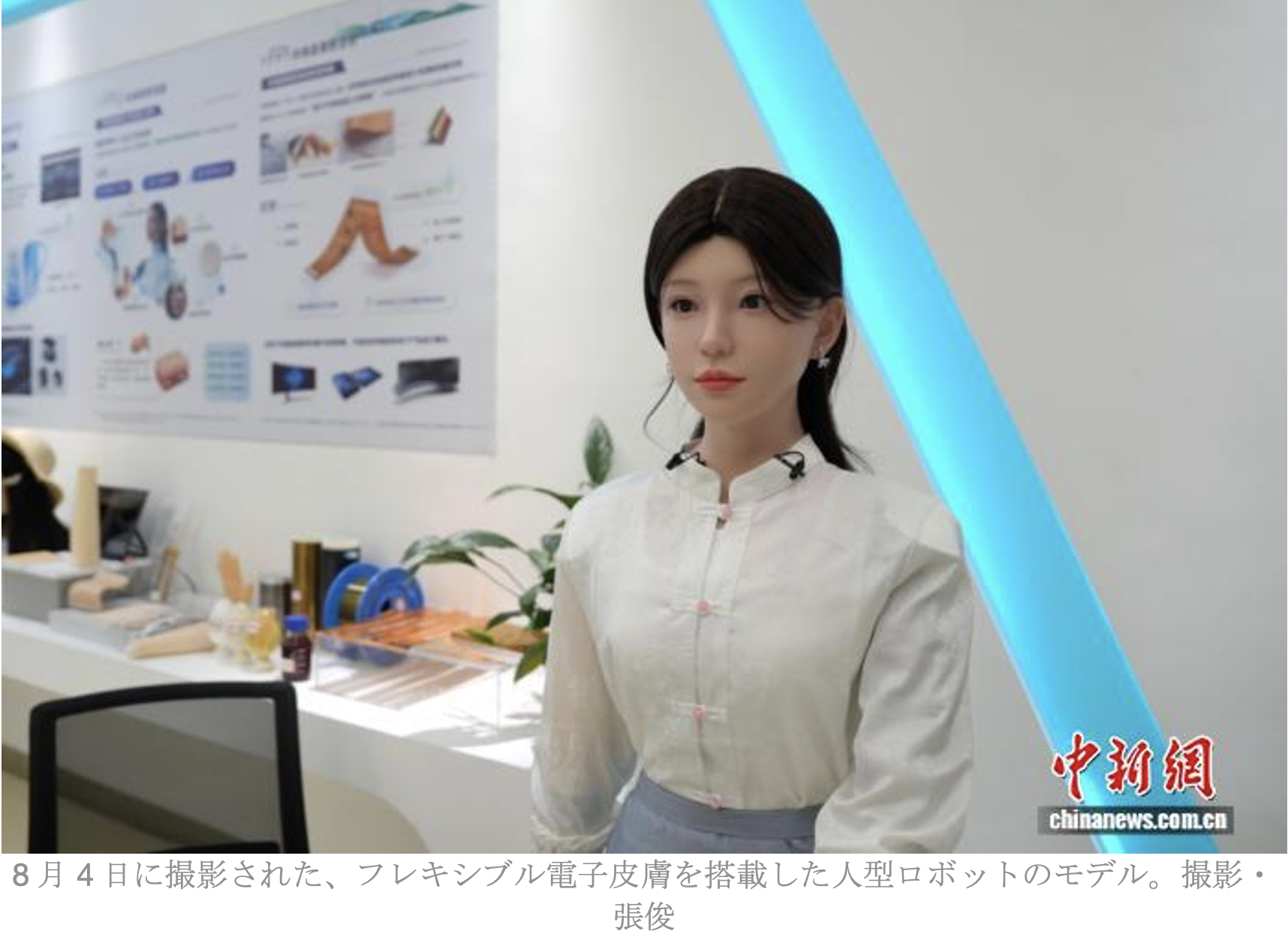
Photo: A humanoid robot model equipped with the flexible electronic skin, photographed on August 4. Photo by Zhang Jun
The primary raw material for this electronic skin is an eco-friendly, bio-based material derived from agricultural and forestry waste, such as straw, offering a distinct cost advantage. A palm-sized tactile sensor costs approximately 1,000 ¥.
Efforts are currently underway to bring this technology to practical application, with expectations that it will eventually be integrated into humanoid robots. By sensing contact with people or obstacles—detecting information beyond the scope of vision—it enables safe human-machine interaction. Additionally, this electronic skin has potential applications in smart cockpits for new energy vehicles and in smart home systems; it can monitor users’ sitting or sleeping postures and related health data without physical contact, promising to meet diverse needs ranging from smart elderly care to home health management.