https://en.people.cn/n3/2026/0728/c90000-20482484.html
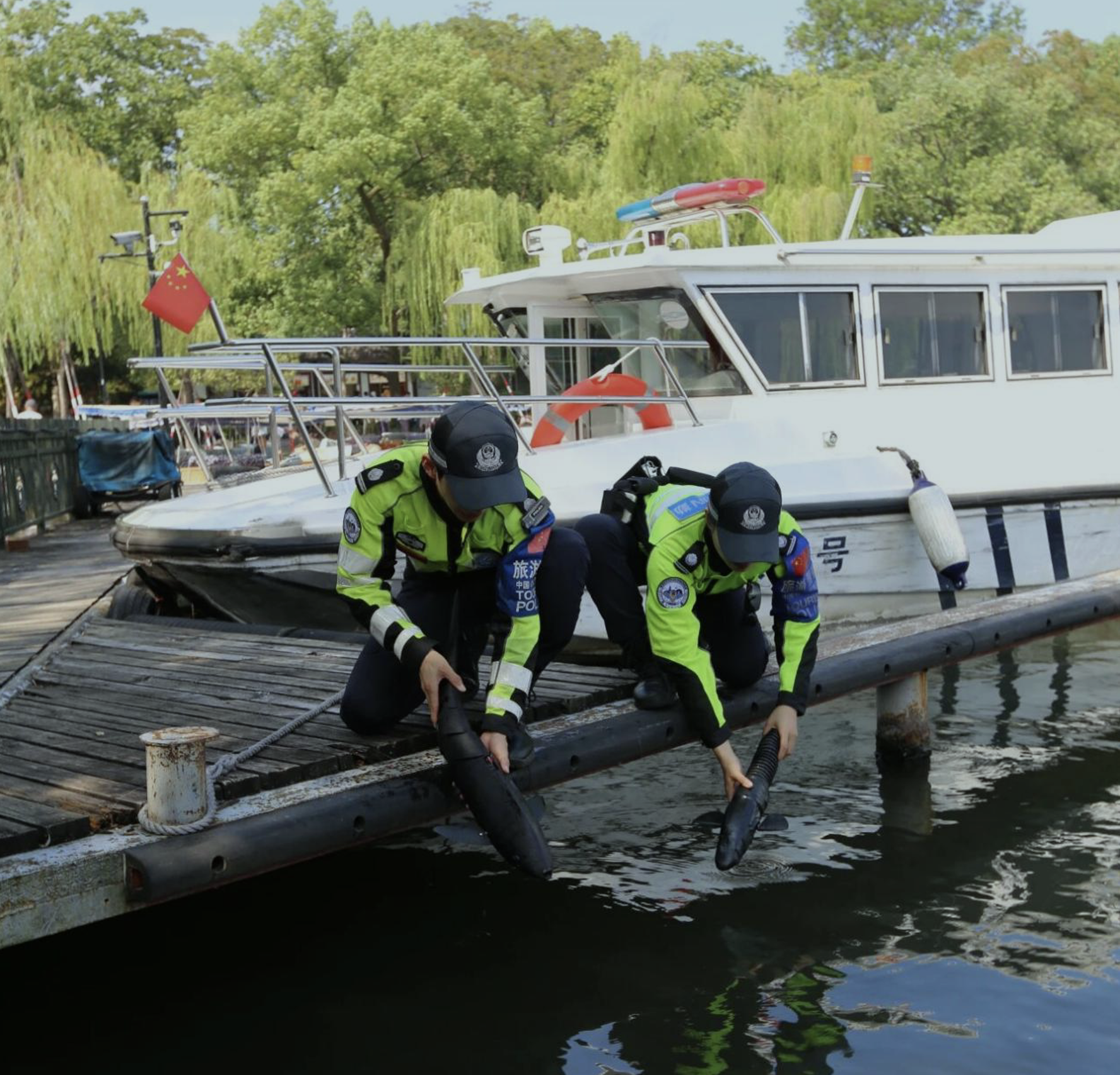
Custom-designed biomimetic robotic fishs, developed specifically for West Lake’s unique environment, now patrol the lake. Modeled after a lemon shark, they weigh about 4 to 5 kilograms and can easily be lifted with one hand. A gray outer shell is made of a specialized material that closely mimics the texture of real fish skin. Inside the sealed body are the battery and control system, while two high-definition underwater cameras are embedded in its head.
The robotic fish was jointly developed by West Lake Patrol and the CAS Institute of Automation. After nearly a year of development, the team overcame several technical challenges, including flexible tail-fin propulsion, underwater obstacle avoidance, and ultra-low-noise operation. The final version of the robotic fish is capable of round-the-clock submerged patrols. It also works in coordination with unmanned vehicles, robotic dogs, drones, and smart roadside devices to form an integrated security network.
Propulsion is what enables the biomimetic fish to move efficiently underwater. Its tail, made of a flexible material, moves like that of a real fish, providing the thrust needed for agile turns. Two side fins help it stay submerged and allow it to dive to depths of over 10 meters. Under remote control, the robotic fish can swim forward, turn, dive, and accelerate. Its propulsion system gives it full 360-degree maneuverability and up to four hours of battery life. With a tail-beat frequency of 1 to 5 hertz and a speed of 0.3 meters per second, it creates almost no noticeable water disturbance when operating in shallow water.
The robotic fish is designed primarily for ecological protection and public safety. Equipped with two high-definition underwater cameras and other sensors, it transmits real-time underwater footage to the command center as it patrols. It can monitor water temperature and pH levels, identify invasive species, and support ecological monitoring and biodiversity surveys.
The robotic fish can also help recover mobile phones and other electronic devices accidentally dropped into the lake by visitors, a task previously carried out using retrieval poles.